

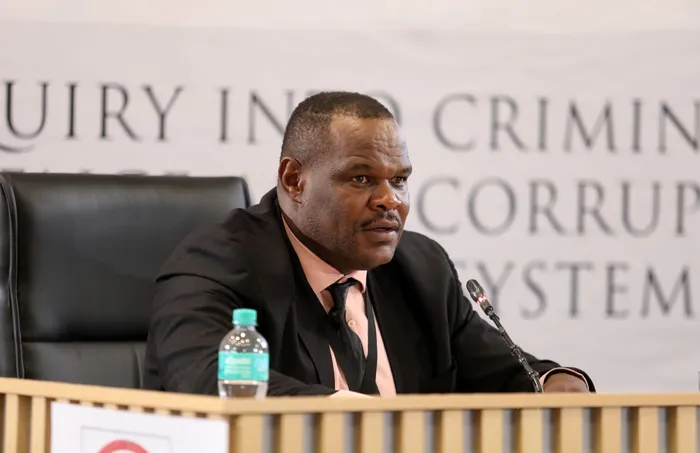
Sergeant Fannie Nkosi
Image: Oupa Mokoena / Independent Newspapers
It was his alleged ties to criminal syndicates, his possession of police dockets he was never authorised to have, and the belief he has "mastered the art of undermining the criminal justice system" that saw prosecutor Tholoana Sekhonyana argue that suspended police sergeant Fannie Nkosi should be denied bail.
Nkosi appeared at the Pretoria North Magistrate's Court for his formal bail application on Monday.
After hearing arguments from both sides, magistrate Thandi Theledi reserved judgment for Wednesday, when she will rule on whether Nkosi — who previously told the court he can afford R10,000 bail — will walk free or remain behind bars.
The 42-year-old was arrested earlier this month after a raid on his Pretoria North home by the Madlanga Commission task team.
The Madlanga Commission investigated allegations that criminal syndicates captured parts of the police service.
Nkosi is accused of acting as a link between suspected cartel figures, government officials and senior police leadership.
He initially appeared before the commission as Witness F before his identity was revealed.
His testimony pointed to alleged connections between police officers, politicians and a crime network known as the Big Five.
Big Five is a group linked to cash-in-transit heists, kidnappings and murders.
It is the state's case that he was found with state-owned ammunition and a hand grenade, six case dockets, R50,000 in cash and seven unsecured licensed firearms at his house.
He was charged with defeating the ends of justice, theft, unlawful possession of explosives, and multiple counts of failing to safeguard firearms and ammunition.
"These dockets were not allocated to [Nkosi] and no legitimate reason exists for him to be in possession of same," Sekhonyana told the court.
"The evidence suggests that the applicant operated outside the bounds of lawful police conduct and engaged in unauthorised investigative activities, thereby undermining established procedures.
"Even if this honourable court were to impose a high amount of bail, it will be paid using the proceeds of crime, which the applicant can easily forfeit in return for his freedom."
But his defence advocate Siza Dlali told the court the charges before it had nothing to do with the Madlanga Commission.
He said Nkosi was presumed innocent, and that his right to freedom should not be taken away before a trial court found him guilty.
"These charges have got nothing to do with what transpired at the Madlanga Commission," Dlali said.
"Every applicant that comes before you is presumed to be innocent.
"You should not treat this matter as if you are in a trial court.
"This right is a precious right.
"And it's only the trial court that will have to determine whether he is guilty or not guilty, and that his freedom should be taken away."
Before either side could get to the substance of the bail application, however, the state and the defence clashed over whether the previous week's postponement was legitimate.
Nkosi's bail application started the previous Monday but was cut short when Sekhonyana told the court she could not continue the following day because she had commitments in the high court.
As a result, the matter was postponed to April 20.
Nkosi instructed his attorneys to double check, and they obtained the high court roll for the rest of the term, where, according to Dlali, Sekhonyana's name did not appear.
He said Nkosi believed "there is a deliberate conduct by the state to delay these proceedings and to frustrate him".
Sekhonyana was furious.
"These are very, very serious allegations against my character as a prosecutor," she told the court.
She said she had been appearing in a criminal trial from Tuesday through to Friday.
Her name was not on the published roll because the matter was heard alongside a linked case.
"My learned colleague did not do the research properly," she said.
She asked for the bail application to stand down so she could fetch court records to clear her name.
"I cannot proceed with this matter in light of the fact that I'm being alleged to be a liar, who lied to the court to say I'm going to court, whereas I was not going to court," she said.
"The accused must be satisfied that a prosecutor with integrity is appearing before this court. And as of now, I am a prosecutor who does not have any integrity, and I have to clear my name."
Theledi shut the exchange down.
"I am not going to cast a stone and say that you are guilty of any misconduct or any misrepresentation," she told Sekhonyana.
"You have your side of the story. We also have those allegations.
"For now, I'm not going to hold these proceedings and wait for anything else.
"You can get those records later in the day."
With that settled, Dlali resumed his argument on the merits of the bail application.
He told the court the firearms seized from Nkosi's home no longer posed any risk.
"Those firearms have been taken by the state," he said.
"One cannot say that because of the allegation, the applicant will endanger the life of his minor child and his wife."
He rejected claims that Nkosi could use police connections to interfere with the case.
He added the witnesses were mostly members of the task team that raided Nkosi's home.
"It is my respectful view that there is no evidence that Nkosi will influence the members of the national task force who will be giving the evidence against him in the main trial."
On the six dockets, the two sides were far apart.
The state said the dockets were stolen, while Nkosi said he was authorised to have them as part of a presidential task team investigating cash-in-transit robberies.
Dlali argued the state's version contradicted itself.
"How do you now come to the conclusion that those dockets were stolen," he asked.
"At the same time you are saying that Nkosi went directly to the police station and demanded those dockets be given to him?"
On the question of Nkosi's safety — the state argued his life could be at risk if released — Dlali said there was no evidence to support it.
After Nkosi's identity was made public at the Madlanga Commission, he continued living at home without incident, he said.
Sekhonyana then delivered the state's closing arguments.
She told the court the case fell under Schedule 5 because one of the charges — contravening the Explosives Act — carried a minimum sentence of 15 years.
That placed the onus on Nkosi to prove that the interests of justice permitted his release.
She argued Nkosi showed a propensity to commit further offences.
His premises were searched by a team from KwaZulu-Natal in October 2025 and R385,000 in cash was found.
He could not explain where it came from, and it was confiscated.
A few months later, another large sum was found at his home.
She described his conduct as "a pattern of deliberate and unlawful behaviour".
On the question of whether Nkosi might flee, Sekhonyana said the risk was real.
She said he was suspended and faced possible dismissal and that the charges were serious and the evidence strong.
She said Nkosi faced the prospect of at least 15 years in prison on the explosives charge alone.
"What is to be expected in prison is a far cry from the life of abundance that he is accustomed to," she said.
She pointed to a discrepancy in the ammunition records.
An exhibit showed Nkosi was issued 60 rounds and returned 72, meaning he had 12 more than he was given.
On top of that, 42 additional rounds of state ammunition were found at his home, with no explanation for how he obtained them.
She told the court a statement from a clerk at an archive store showed that one of the dockets in Nkosi's possession — a 2013 common robbery case — had no record of being booked out and was never signed for.
"Further showing that the accused works in unscrupulous ways," she said.
She flagged an inconsistency regarding his passport.
In his affidavit, she said he made it clear it was handed to the investigating officer.
On a subsequent occasion, he said he was willing to hand it over.
"That inconsistency goes directly to his credibility and his willingness to be candid with the court," she said.
Sekhonyana flipped Nkosi's own safety argument against him, saying that if his life was in danger, he was safer in custody than outside.
"His release may in fact expose him and others to harm," she said.
IOL