

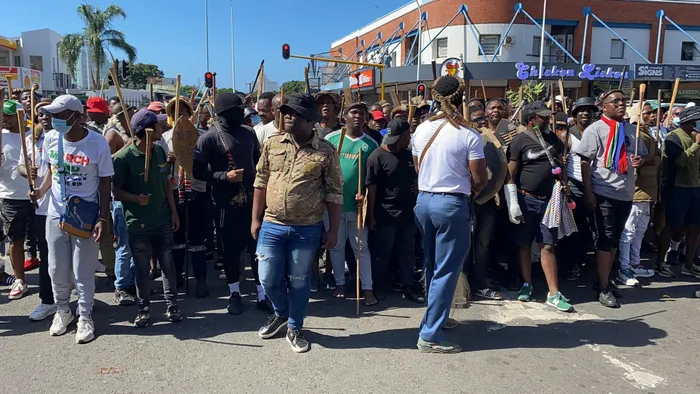
Calls for an end to unregulated protests in Durban CBD are intensifying as businesses face forced closures and fears of rising criminality.
Image: Sipho Jack
There are growing calls for an immediate end to unregulated protests in the Durban CBD as businesses remain shuttered amid reports of violent altercations and incidents.
This comes as the March and March movement, which has called for an end to illegal immigration, have been holding “clean-up campaigns” in the CBD in recent days. The movement's members have clashed with foreign nationals during the protests with violence breaking out on Monday which led to damage to property and people being injured.
Political leaders and refugee organisations are demanding accountability for the week-long disruptions.
The Democratic Alliance (DA) in eThekwini has questioned the disruptions to business operations in the CBD, labelling it a direct threat to the city's constitutional order.
Councillor Sharmaine Sewshanker warned that the unregulated nature of these demonstrations is placing residents at severe risk.
"Unregulated protests create conditions for criminal activity, including looting and muggings," Sewshanker stated. She emphasised that while the right to protest is protected, it must remain within the framework of the Constitution. "Criminal acts carried out under the guise of protest action must be condemned and dealt with decisively."
The DA has called on protest organisers to take full responsibility for ensuring demonstrations remain lawful and has demanded that those responsible for the damage be held accountable.
While the city grapples with the protests, the Southern Africa Refugee Organisations Forum (SAROF) has brought a more severe allegation to the table. In a detailed statement, the forum described the events as a "well-coordinated wave of xenophobic attacks" that are spiralling out of control across KwaZulu-Natal.
SAROF claims that "well-armed vigilante groups" are allegedly working in collaboration with local government authorities to justify violent actions against refugees and asylum-seekers.
"A silent xenophobia has been ongoing for several months, with no response from government authorities," the forum stated. They highlighted that different forms of the issue, including "administrative, health, and education xenophobia" have now evolved into a form of "silenced xenophobia" that is ignored by mainstream media because the targets are Black Africans from sub-Saharan countries.
The forum warned of a looming starvation crisis: "Refugee communities in Durban are enduring dire hardships, facing the threat of forced starvation... with restrictions preventing them from working, they are left with mounting expenses and little means to survive."
Responding to the claims of "minimal law enforcement presence," eThekwini Metro Police spokesperson Colonel Boysie Zungu insists that the city is under heavy surveillance.
"We have the POP (Public Order Policing) unit working with SAPS monitoring the situation in affected areas," Zungu said. He flatly denied that there as a lack of boots on the ground. "There is no lack or challenges of visibility there. We have enough deployment on the ground composed of foot patrol and motor units supplementing POP. Our camera rooms are monitoring as well."
March and March leader Jacinta Ngobese-Zuma said the group’s activity in the CBD should not be described as a protest, but rather a community-led clean-up in response to deteriorating conditions.
“We don’t have a demonstration. We have a clean-up where South Africans have noted with great concern the state our CBDs are in,” she said, citing failing infrastructure, illegal trading in the streets, and what she described as a lack of law enforcement.
She said the initiative aimed to “rekindle the life that the city had before”, accusing municipal authorities of focusing only on well-maintained areas while neglecting others.
Responding to claims that the clean-up campaigns amount to xenophobia, Ngobese-Zuma rejected the characterisation.
“People are just using the word xenophobia anyhow. How does cleaning a city turn into xenophobia?” she said, adding that businesses compliant with regulations were able to continue operating.
She further argued that concerns raised by residents relate to law enforcement and economic pressures faced by locals.
“We’ve got our own people who are poor and need opportunities,” she said.
Ngobese-Zuma also criticised the municipality for what she described as a lack of engagement, saying previous requests for meetings and memorandums had gone unanswered.
“That doesn’t stop us from being responsible citizens that want to see their place clean,” she said.
She added that members of the organisation had been involved in an altercation during the clean-up, with at least one incident of violence recorded.
For more stories from The Mercury, click the link THE MERCURY