

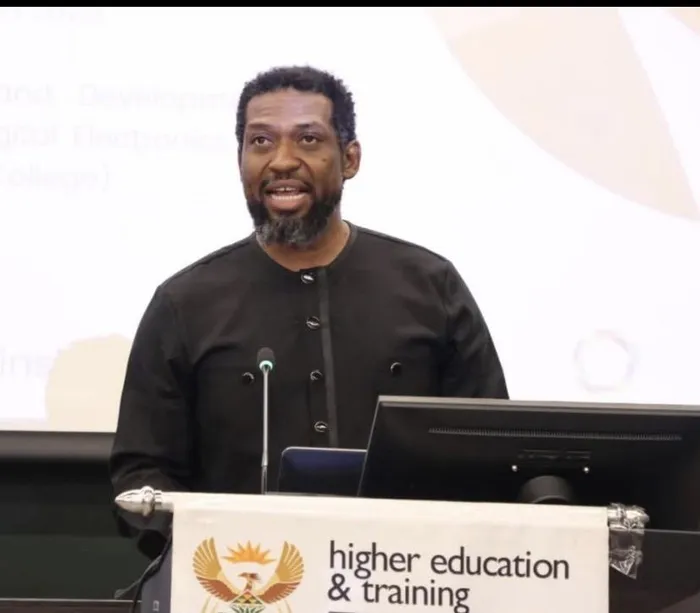
Higher Education Minister Buti Manamela highlights the urgent need for reform in South Africa's education system
Image: Supplied
Higher Education and Training Minister Buti Manamela has warned that South Africa’s education system is failing to transition young people into work, leaving 3.4 million youth outside of employment, education or training.
Speaking at the Inside Education Summit at Gordon Institute of Business Science, Manamela said the country is facing a structural failure rather than a simple unemployment problem.
“Our crisis is not only unemployment. It is a crisis of pathways,” he said, adding that the system is not effectively moving young people “from learning into earning”.
He described the education system as a “pipeline” that is leaking at multiple points, from early childhood development to post-school training and entry into the labour market.
Manamela said the mismatch between training and economic demand is evident in the country’s artisan shortfall. The economy requires about 30,000 artisans annually, but only around 20,000 are produced.
“That gap is a constraint on growth, infrastructure development and industrialisation,” he said.
At the same time, demand for technical and vocational education continues to outstrip capacity, with TVET colleges receiving millions of applications for limited spaces.
Government has set targets of 37,000 artisan registrations this year and aims to increase annual qualifications to 29,000 within two years, alongside expanding work-based learning opportunities.
With the formal job market unable to absorb all graduates, Manamela said entrepreneurship must become central to the education system.
“There are not enough jobs to absorb them,” he said.
While all 50 public TVET colleges now offer entrepreneurship programmes, he stressed that training alone is insufficient without broader economic reform.
“Entrepreneurship will not thrive in an economy that is structurally closed,” he said, pointing to barriers in accessing funding, markets and opportunities.
Manamela also linked youth exclusion to early childhood inequality, citing data showing that only 42% of children are developmentally on track by age five.
“Inequality is produced early,” he said, noting that gaps in nutrition, stimulation and early learning continue to shape long-term outcomes.
Government has allocated R18.4 billion to early childhood development over the medium term and plans to expand access to an additional 300,000 children, though the minister conceded funding remains below what is required for quality provision.
Despite education receiving the largest share of public expenditure, Manamela said outcomes are undermined by fragmentation and weak coordination across the system.
“Too many initiatives. Too little alignment,” he said.
He added that failures in delivery — including delays and inefficiencies — are eroding public confidence.
“When systems fail… we are breaking a contract,” he said.
Manamela called for a coordinated approach between government, industry and civil society to align education with economic needs, warning that progress will be measured on implementation rather than policy.
“We have the plans. We have the resources. We have the targets,” he said. “The question is delivery.”
For more stories from The Mercury, click the link THE MERCURY