

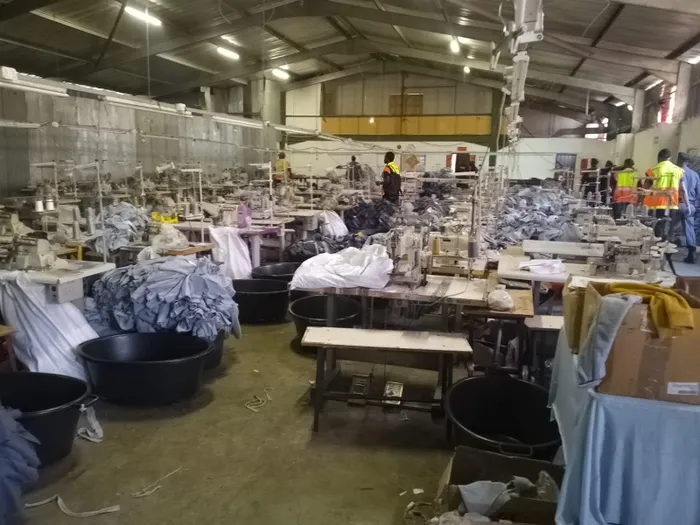
South Africa’s retail giants have moved to initiate punitive legal and financial proceedings against suppliers linked to a harrowing sweatshop operation in Newcastle, KwaZulu-Natal.
Image: Facebook/ Department of Employment and Labour
Major South African retailers have moved to initiate punitive legal and financial proceedings against suppliers linked to a harrowing “sweatshop” operation in Newcastle, KwaZulu-Natal.
In February, a coordinated inspection blitz in Newcastle’s textile and clothing industry in KwaZulu-Natal has uncovered widespread labour and immigration violations, resulting in the arrest of two Chinese employers and the discovery of 34 undocumented foreign workers.
According to recent reports, the companies have said they are blacklisting non-compliant factories and launching an urgent auditing blitz across their provincial supply chains to terminate business with any unregistered entities.
However, Fachmy Abrahams, the National Collective Bargaining Officer for the South African Clothing & Textile Workers Union (SACTWU), argued that these remedial steps are decades overdue.
Speaking on the matter, Abrahams said the issue was not new. He said it had been a topic of discussion with retailers for several years.
He noted that the current exploitation specifically targets undocumented migrants because their lack of legal papers leaves them with no recourse.
"These very vulnerable people who come for no fault of their own, to try to find a better life, are being abused because they have no recourse," Abrahams explained. "They feel that they can't go to the authorities because they are undocumented."
The recent investigation by the Department of Employment and Labour confirmed that unscrupulous employers deliberately hide workers in appalling conditions to avoid detection.
Abrahams described the living and working quarters found on-site as being at levels where "some of us won’t let our animals live in," noting that workers are trapped by their own vulnerability.
For more stories from The Mercury, click on the link THE MERCURY