

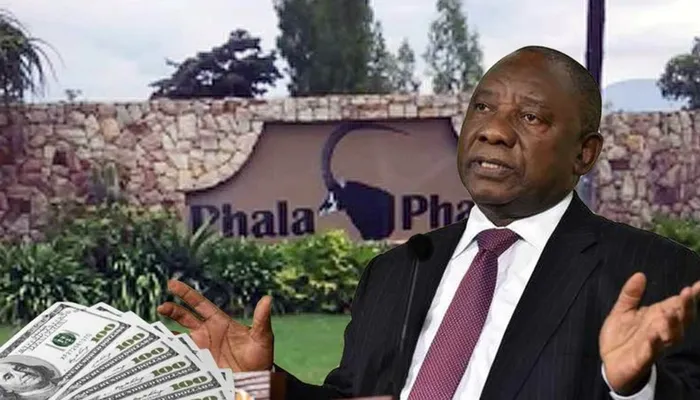
President Cyril Ramaphosa is set to know his fate on Friday when the Constitutional Court delivers its verdict on the matter brought by the EFF.
Image: IOL
As the Constitutional Court is expected to deliver a judgment tomorrow in a landmark Phala Phala case involving President Cyril Ramaphosa, opposition parties and political experts have called for justice and the president to be held accountable.
Political parties believe the ConCourt ruling will repair the reputational damage to government institutions that found themselves “scrambling to protect” Ramaphosa after the scandal broke into the public domain. Tomorrow’s ruling is expected to make a determination on whether Parliament acted lawfully when it rejected a report recommending an impeachment inquiry into Ramaphosa. The dispute centres on a Section 89 independent panel chaired by retired chief justice Sandile Ngcobo.
The panel concluded that there was sufficient evidence to justify Parliament considering the establishment of an impeachment inquiry against the president. The findings relate to allegations involving the handling of foreign currency at Ramaphosa’s Phala Phala game farm in Limpopo. The panel examined claims that about R9.5 million in foreign currency was concealed in a sofa on the property and later stolen, along with questions about whether proper procedures were followed following the incident.
The report concluded that the evidence presented was sufficient to warrant further scrutiny through a formal impeachment inquiry. However, the National Assembly voted by 214 votes to 148 to reject the report. That vote halted the impeachment process before it could proceed to the inquiry stage.
ATM president Vuyolwethu Zungula, who has been at the forefront of the Phala Phala legal battle, posted on X that South Africans must remember that the president is not above the law and that several laws were broken in the Phala Phala case.
He also stated in a video posted on his social media that the president was highly protected by institutions.
Zungula said: “There are certain principles that ought to guide us as a country: the rule of law and the principle that we are all equal before the law. Now, if any ordinary person would have committed the same crimes as those committed by Ramaphosa, we do not think all these institutions would have kept quiet; they would have acted. “We are dealing with a person that is highly protected by institutions. As a member of Parliament, it is our duty to ensure he is held to account. We are going to continue with this process until Mr Ramaphosa is impeached and a motion of no confidence is passed against him.”
ActionSA national chairperson Michael Beaumont said the Phala Phala scandal saw one government institution after another fall over themselves in a bid to clear the president of any accountability for a patently obvious breach of the country's laws.
“Parliament was one of those institutions, and this is the essence of the case before the Constitutional Court. Parliament refused to institute proceedings to investigate the president and rushed to clear him while Parliament still enjoyed an ANC majority prior to the 2024 general elections. “The case before the Constitutional Court seeks to declare the actions of Parliament as unconstitutional in its failure to hold the president to account,” he said.
Rise Mzansi said: “We will respect the judgment of the Constitutional Court. We have all trust in the abilities of the justices of the Constitutional Court to deliver a judgement that is in line with our Constitution and will deepen our constitutional democracy.”
The DA declined to comment on the matter, saying they will await the court outcome before speaking out. The IFP and the EFF had not responded to requests for comment. Anda Mbikwana, a commentator who specialises in matters of constitutional law and democratic governance, described the Phala Phala matter as a “constitutional reckoning - one that will determine whether South Africa’s hard-won democratic framework means what it says, or whether it bends to the weight of office”.
Mbikwana said the role of the apex court is to determine if Parliament acted rationally and lawfully in its application of the law. “The Constitutional Court’s role in all of this is not to adjudicate guilt or innocence in a criminal sense, nor to serve as an extension of party politics. Its mandate is distinctly constitutional: to ensure that the processes undertaken by the National Assembly were rational, lawful, and procedurally fair - and that Parliament neither over-stepped nor abdicated its oversight responsibilities.”
Political scientist Kenneth Kgwadi was much more forthright, saying Ramaphosa “is guilty, and he knows it”. “He violated several pieces of legislation in the country, which led to breaching his own oath of office. In a bid to buy some time, Parliament resorted to appointing an inquiry, a regular political tactic used for cover-ups, led by retired judge Sandile Ngcobo. The outcomes, which suggested that Ramaphosa had a case to answer, did not favour the ANC, and their only option was to abuse their parliamentary majority, not to adopt it,” said Kgwadi.
In a statement, Arthur Fraser, former head of the State Security Agency who first blew the whistle on the Phala Phala matter, said he will reserve comment until the constitutional court ruling. “I trust that the decision of the court will reaffirm that we are all equal before the law. Otherwise, I will reserve my comment and wait for the apex court to pronounce itself.”
For more stories from The Mercury, click the link THE MERCURY