

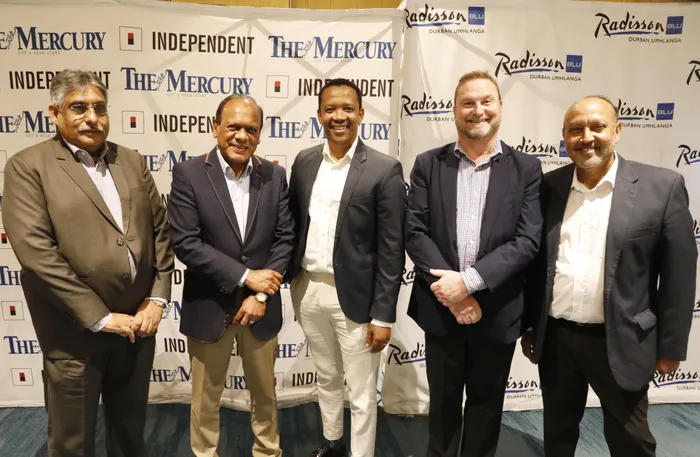
Sanjith Hannuman, CEO of consulting firm AVIB, business tycoon and Oceans Umhlanga chairman Vivian Reddy, The Mercury’s editor Philani Mazibuko, Dube TradePort CEO Hamish Erskine and Eric Apelgren, former eThekwini Municipality head of International Relations seen at Radisson Blu Hotel, Durban Umhlanga last night for a Networking cocktail event focusing on Africa’s tourism potential. The event took place as Durban plays host to Africa’s Travel Indaba.
Image: Doctor Ngcobo / Independent Newspapers
As Africa's Travel Indaba officially kicked off in Durban, a high-powered panel of industry titans and development experts gathered at a networking cocktail event last night to debate a critical question: Can South Africa, and KwaZulu-Natal in particular, seize the moment as global conflict reshapes travel patterns?
The event hosted by Radisson Blu Hotel Durban, Umhlanga and The Mercury newspaper included a panel discussion with Oceans Umhlanga chairman Vivian Reddy, Dube TradePort CEO Hamish Erskine, Sanjith Hannuman, CEO of consulting firm AVIB, and Eric Apelgren, former eThekwini Municipality head of International Relations. The discussion, moderated by The Mercury’s editor Philani Mazibuko, centered on the “profound global uncertainty” caused by Middle East disruptions and whether Africa’s infrastructure and private sector are truly aligned to offer a “revelation” to global travellers.
Erskine revealed the stark reality of how geopolitical conflict impacts local shores. He noted that the war in the Middle East came as a “shock” to KZN logistics, with cargo volumes being significantly impacted.
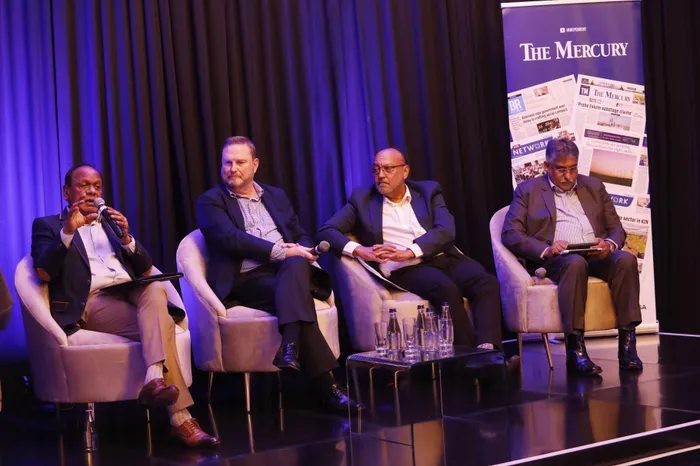
There was a robust panel discussion at the Radisson Blu Hotel Durban, Umhlanga on the pitfalls and opportunities for tourism growth.
Image: Doctor Ngocbo / Independent Newspapers
However, he emphasised a strategic shift toward diversification. “Ethiopian Airlines provides an excellent, safe African destination... and we are re-establishing the London route. We are looking at capturing an ever-broader set of routes.”
Erskine assured the audience that King Shaka International Airport is ready for a travel surge, with a billion-rand infrastructure upgrade currently underway.
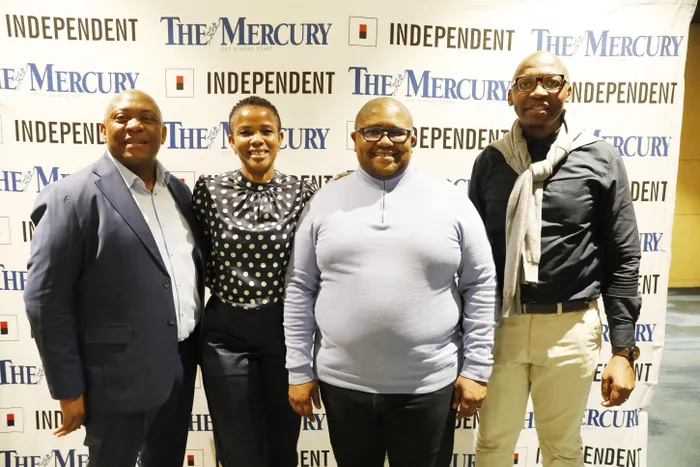
A networking cocktail event focusing on Africa’s tourism potential was held at Radisson Blu Hotel, Durban Umhlanga on Monday night. Seen at the event were: Linda Sibiya, Minenhle Dlamini, Brian Mpono and Nhlakanipho Gumede.
Image: Doctor Ngcobo/Independent Newspapers
Hannuman, who is also a behavioural life coach, offered a psychological perspective on the shift in traveller behaviour. He argued that while destinations like Dubai have historically sold “aspiration,” Africa has an irreplaceable advantage: Ubuntu. “The traveller isn’t asking ‘Where will I be impressed?’ anymore. They’re asking ‘Where will I be safe? Where will I be human?’,” Hannuman stated. “Fear has a long tail... this isn’t short-term; it’s structural. Africa must sell belonging. No competitor can manufacture genuine human warmth.”
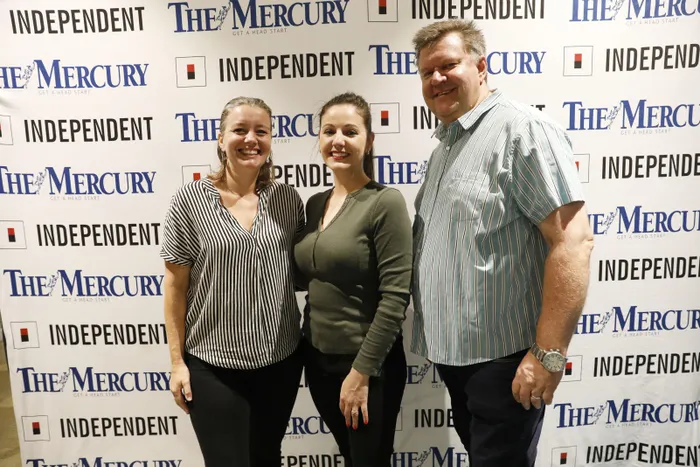
Yvonne Fourie, Michelle Fourie and Danie Smith.
Image: Doctor Ngcobo/Independent Newspapers
Apelgren highlighted the “self-inflicted wounds” of South African tourism, specifically the lack of a united front between city, provincial, and national government. “You can get a five-star hotel anywhere in the world... but we have something different,” he said.
However, he warned that the “authentic experience” is ruined when basic services fail. “You go to the Drakensberg and the road is a problem, the water is not secure, and the lights are off. People remember those things.” Apelgren also said authorities need to look beyond traditional markets like London and Berlin, suggesting deep-dives into cities like Atlanta and Manchester to find new growth.
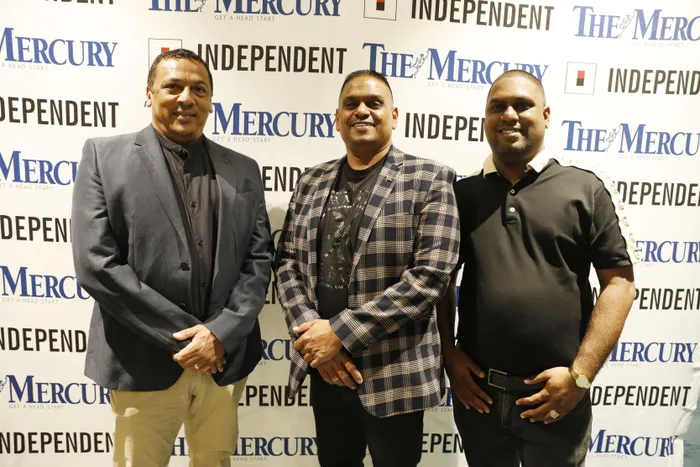
Dhilosen Pillay, Dr Brandon Pillay and Trevolin Chetty..
Image: Doctor Ngcobo/Independent Newspapers
Reddy was candid about what it takes to get developments off the ground. “Private capital does not invest in hope; it invests in certainty,” he said. He called for “patriotism” in local media and public service, urging for every Uber driver and hotel worker to be trained as a “tourism ambassador” to counter negative safety perceptions.
“Capital follows confidence, and confidence follows execution,” Reddy added, citing a project in Nigeria where a government-built airport paved the way for a Radisson Blu development. He also praised the government’s recent urgency regarding the UPL group’s R18 billion investment in KZN, which includes a transformative ethanol plant. He noted that such policy shifts are vital to saving industries like the North Coast’s sugar sector, which supports 40,000 jobs.
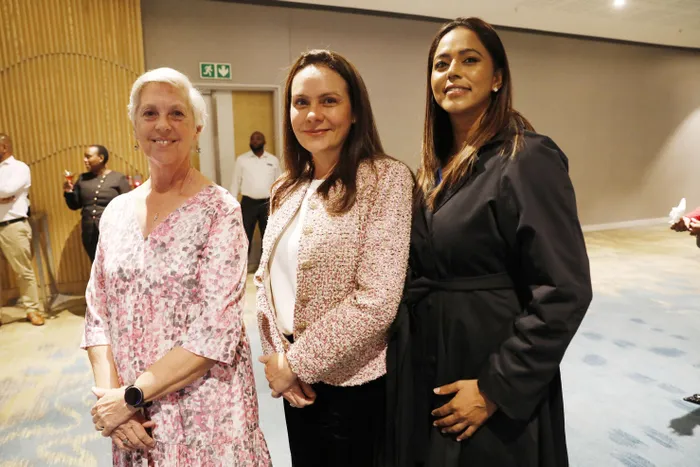
Naomi Crous, Jeannie Sarno and Keshni Dhanesar.
Image: Doctor Ngcobo/Independent Newspapers
Meanwhile, Deputy Tourism Minister Maggie Sotyu opened proceedings at Africa’s Travel Indaba 2026 with the Business Opportunity Networking Day (BONDay) at Durban’s International Convention Centre yesterday.
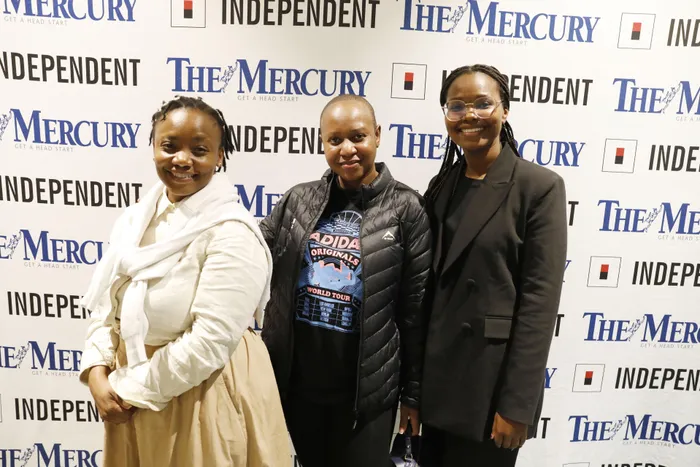
Katlego Mphahlele, Mashudu Tshikovhi and Uviwe Mbombela.
Image: Doctor Ngcobo/Independent Newspapers
Sotyu said the tourism sector, despite significant global shifts, continued to serve as one of Africa’s economic powerhouses by creating jobs, attracting investment, and acting as a catalyst for entrepreneurship.This year’s Indaba theme is ‘Unlimited Africa: Growing Africa’s Tourism Economy’.
For more stories from The Mercury, click the link THE MERCURY