

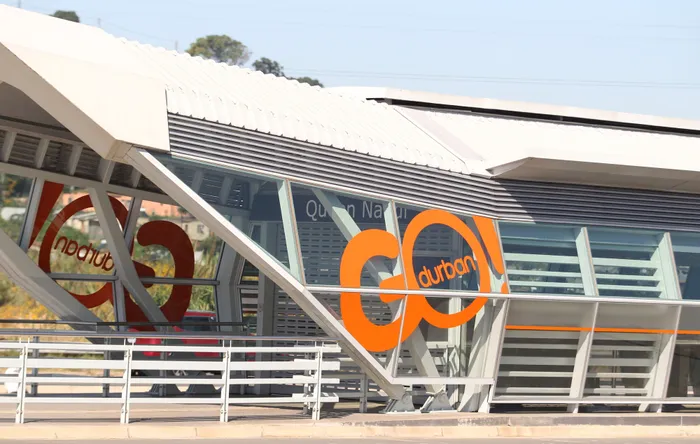
In eThekwini, the Go! Durban is long overdue and has been besieged with challenges.
Image: DOCTOR NGCOBO Independent Newspapers
The Bus Rapid Transit (BRT) system, which has cost the country an estimated R80 billion to implement, is at risk of being phased out following concerns that the national project has failed to take off. The National Portfolio Committee on Transport revealed that the committee and the National Treasury are concerned about poor implementation, performance issues and funding cuts. In KwaZulu-Natal, the Go! Durban transport system—a project of the eThekwini Municipality that cost about R10.2 billion—is battling several issues, and to this day, not a single bus is on the road.
The chairperson of the Transport Portfolio Committee, Donald Selamolela, explained the National Treasury’s position. “They are just going to halt the funding while we look for a better way to implement this in a way that is economically viable and serves the public. They are saying they don't want this to continue to be a fund where money just keeps going out. That is what they are saying: halt the funding while we look at other modalities because the truth is that we have spent billions on this, and there are still no buses on the road.”
The committee visited KZN recently and expressed serious concerns about the implementation of the Msunduzi Project. It stated that the programme should not have failed in Pietermaritzburg, especially after so much money had already been spent.
The committee noted that this programme should have benefited commuters and also provided employment opportunities for the city's residents. The successful implementation of the programme had the potential to be a catalyst for economic growth and job creation.
Sandra Dickson, a Good Party councillor in the City of Cape Town, said in a recent statement that BRTs across the country are facing serious challenges. Dickson mentioned that nationally, more than R80 billion has been spent on Integrated Public Transport Networks (IPTN) and BRT systems over roughly two decades. “However, during the November 2025 Medium-Term Budget Policy Statement (MTBPS), the National Treasury effectively acknowledged in Parliament that the national IPTN/BRT programme had failed to deliver public transport improvements proportional to the scale of funding invested.
“These concerns were reiterated in the 2026 Estimates of National Expenditure (Vote 40: Transport) and during oversight discussions before Parliament's Portfolio Committee on Transport in 2026. Treasury highlighted implementation delays, incomplete transport corridors, lower-than-expected passenger volumes in some cities, operational sustainability concerns, and increasing financial pressure on municipalities. As a result, the Treasury has now started restructuring and scaling back portions of the Public Transport Network Grant programme.
“The concern is that one of the major national funding pipelines used to support and expand BRT systems is now being reduced because the Treasury no longer believes the programme delivered sufficient value relative to the billions spent nationally. This creates a long-term financial risk for municipalities,” said Dickson, adding that municipalities might find themselves at risk of having to maintain the assets already built.
One user posted that the government has admitted that the BRT projects have failed dismally to become a viable mass transit system, attracting about 152,000 daily users compared to the 8 million daily commuters using minibus taxis. “Projects in several cities are being abandoned or significantly scaled back. For example, in KwaZulu-Natal, the Msunduzi Municipality has halted the BRT plans in their area; the scheme has been described as a failed fiasco that was never fully implemented,” said the post.
Councillors in the Msunduzi Municipality have become aware that the government intends to abandon the entire project. “The news that they are now looking to abandon this across the country is very disappointing, especially after billions have been spent on it. This is like throwing money away,” said ACDP councillor in Msunduzi, Rienus Niemand. “We say that the government is now looking at scrapping the entire project across the country; that would be a great loss," said Niemand. "In Msunduzi, the infrastructure is already there; there are lanes, and there are traffic lights.
“Had the project been fully implemented, it could have provided huge relief to commuters and those pushing for public transport by ensuring that there is a cheap and reliable transport system. The implementation of this could have been a significant boost to the economy of the country," he said.
DA councillor and spokesperson on the eThekwini Transport Authority (ETA), Lyndal Singh, said in a statement that the Go! Durban project is facing challenges.
“This project has already come at a massive cost to residents and continues to do so. More than R8 billion has been spent on infrastructure, yet none of the stations are operational, some remain incomplete, and the City continues to spend millions of ratepayer funds annually on security and maintenance of idle, vandalism-prone facilities.
“National Treasury funding has been withheld and reclaimed, meaning that the ongoing costs of maintaining this unused infrastructure are now borne by ratepayers. These are funds that should be directed towards fixing potholes, repairing water infrastructure and leaks, maintaining electricity networks, improving sanitation, and strengthening community safety. At a time when communities are struggling to access even basic services, this is indefensible,” said the councillor.
For more stories from The Mercury, click the link THE MERCURY