

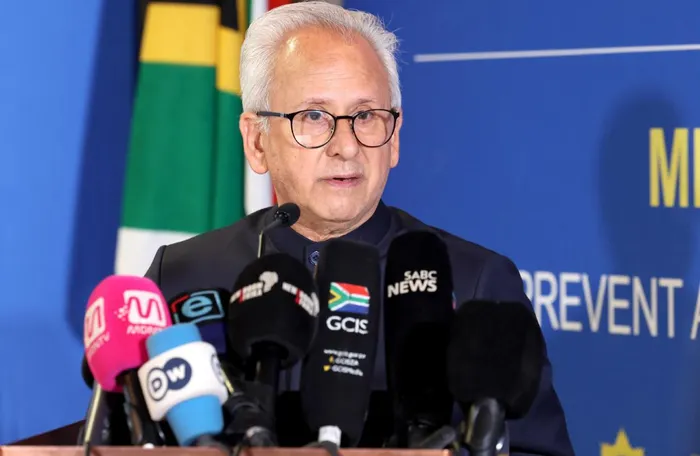
Police Minister Firoz Cachalia outlines the 2026/27 budget for the South African Police Service, focusing on accountability, crime intelligence, and combating corruption, while addressing community safety and modernising policing efforts.
Image: File
Police Minister Firoz Cachalia says the government’s 2026/27 police budget will focus on strengthening accountability, crime intelligence, detective services, and organised crime investigations as part of a long-term plan to rebuild the South African Police Service (SAPS).
Tabling the Police Budget Vote in Parliament in Cape Town on Tuesday, Cachalia said SAPS had been allocated R127.072 billion for the 2026/27 financial year, increasing to R135.8 billion by 2028/29.
“This Budget backs our longer-term strategy focusing on the integrity of the SAPS, its intelligence and investigative capabilities in order to improve community safety,” he said.
Cachalia acknowledged that while many police officers continued to serve with “integrity, courage, and professionalism”, corruption remained a serious challenge within SAPS, particularly in procurement systems.
“The SAPS, like other public institutions, particularly in its procurement systems, is bedevilled by systemic corruption. Those involved must and are being held accountable,” he said.
He said a dedicated task team had been established to investigate referrals arising from the Madlanga Commission and that “arrests will continue”.
The minister also announced that Acting National Commissioner Lt-General Puleng Dimpane was implementing reforms to SAPS procurement and supply chain management systems in partnership with the Government Technical Advisory Centre in National Treasury.
According to Cachalia, the reforms are aimed at modernising procurement systems, strengthening oversight, and improving transparency.
Crime intelligence and detective services were identified as key priorities in the budget.
Cachalia said SAPS would implement a turnaround strategy over the Medium-Term Expenditure Framework to strengthen crime intelligence capabilities and improve intelligence-led policing.
He also said the government intended to strengthen the Detective Service and improve the quality of criminal investigations.
“To retain expertise, the Detective Critical Skills Allowance of R1000, introduced in October 2025, will continue to support both SAPS and DPCI investigators,” he said.
The minister said challenges affecting forensic services, including DNA analysis, ballistics, cybercrime investigations, and digital forensics, would also be prioritised.
The government has allocated an additional R18 million for firearm licensing and compliance activities under the Firearms Control Act.
More than R200 million will also be invested in the development of a digital Firearms Control Management System aimed at improving firearm tracking, compliance monitoring, and operational efficiency.
Cachalia announced that SAPS would introduce a renewed focus on the country’s 50 highest-crime precincts.
He said detailed assessments would be conducted to evaluate leadership, staffing, detective performance, operational readiness, and infrastructure requirements at those stations.
The minister added that police stations, mobile Community Service Centres, and station maintenance programmes would continue receiving investment to improve service delivery and police visibility.
He said the Police Modernisation Project would continue to digitalise administrative systems to improve operational efficiency and allow more officers to focus on frontline policing.
On gender-based violence and femicide, Cachalia said R1.6 billion had been set aside for activities linked to the fight against GBVF, with an additional R50 million allocated to provincial baselines.
Meanwhile, the Independent Policing Union of South Africa (IPUSA) said the budget should be used to strengthen institutional capacity, improve accountability, and modernise policing.
IPUSA said public confidence in SAPS had been weakened by escalating crime and allegations involving senior police officials.
The union called for the full independence of the Independent Police Investigative Directorate (IPID), including direct reporting to Parliament.
IPUSA president Bethuel Nephtal Nkuna said: “The 2026/27 Police Budget must deliver more than promises. IPID’s direct reporting to Parliament is non-negotiable.”
Nkuna also said SAPS management failures, shortages of resources, and inconsistent discipline continued to affect morale and service delivery.
The union further called for stronger crime intelligence structures, transparent supply chain management systems, improved protection for whistleblowers, and the strengthening of the Directorate for Priority Crime Investigation.
Cachalia said the Police Reset Agenda was intended to build “a more capable, more honest, and more focused police service”.
“This Budget is not a silver bullet. But it is an important step towards a more capable, more honest, and more focused police service,” he said.