

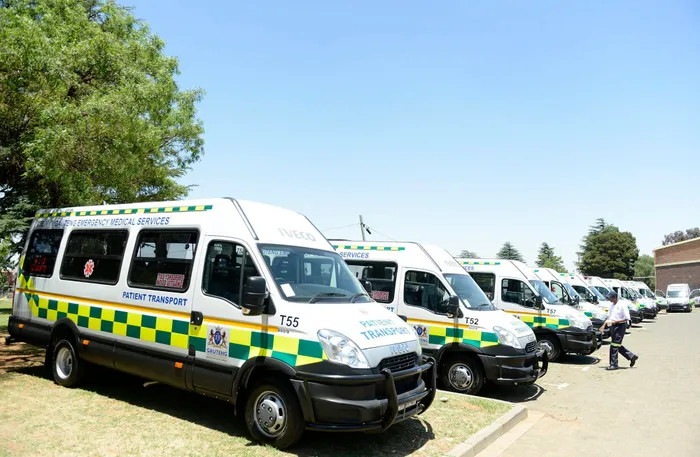
A recent report highlights the challenges faced by the Department of Health regarding its fleet management.
Image: Dumisani Dube
More than 200 ambulances belonging to the KwaZulu-Natal Department of Health are “parked in different workshops waiting to be repaired. This accounts for almost half of the ambulance stock the department has. This information was revealed in a report to the Health Portfolio Committee, where the department detailed the challenges it faces regarding its fleet.
The department has often come under fire, especially over ambulance response times, with community members complaining that the ambulances do not arrive when they are called for an emergency. Following complaints by members of the portfolio committee in past meetings, the department detailed the extent of these challenges, stating that most of the delays it is experiencing relate to the repair of ambulances and other vehicles.
The department has a contract in place with a service provider tasked with managing the department's fleet. The service provider is appointed by the National Treasury to manage government fleet across the country. If a vehicle breaks down or is damaged, the service provider will begin the process of assessing the damage, getting quotes for the work to be done, and then approving the necessary work.
However, the department has said that this process takes too long in this province and can take up to a month in some cases, leading to vehicle shortages. The service provider also manages the department's assets like petrol cards. In the report, the department states that it has encountered significant challenges relating to the service provider's performance.
“These challenges prompted the department to engage the National Treasury in September 2025, as concerns raised with the service provider were not adequately addressed, particularly regarding contract performance,” it stated.
Detailing the extent of the challenges, the report revealed that the department has about 449 ambulances, and 225 are out for repairs. The Emergency Medical Services (EMS) fleet, which consists of rescue, response, patient transfer, and administrative vehicles, has 484 vehicles, and about 205 are out for repairs. General vehicle repairs total around 3,080, with more than 600 currently out of service.
The issues experienced included, among others, delays in conducting vehicle inspections. “Inspections are often undertaken after unreasonable delays, in some instances exceeding 14 working days to over a month. Inspectors only inspect the vehicles specifically assigned to them and leave others on the dealer’s floor uninspected, which has resulted in significant delays.”
In some instances, the service provider's inspectors conducted assessments purely through visual inspection, without the use of diagnostic tools. “Such practices lead to inaccurate evaluations, resulting in additional quotation requests from dealerships — ultimately prolonging vehicle downtime,” said the report. In several instances, vehicles have had to be returned to dealerships for remedial work due to substandard repairs.
“The service provider has repeatedly demonstrated a failure to appreciate the urgency and critical nature of the department’s mandate. Since this service provider took over the contract, vehicles have often been sent to small merchants lacking the required technical expertise. As a result, some vehicles have been tampered with, leading to deterioration and frequent replacement of parts. Vehicles sent for minor repairs are sometimes returned with additional or recurring defects, and in some cases, parts appear to have been removed, misappropriated, or replaced with old or aftermarket components,” the report added.
It was noted that other problems include merchants using aftermarket parts, with inadequate quality checks by inspectors to verify the suitability and compliance of such parts. Serious concerns have emerged regarding prima facie fraudulent activities, particularly relating to fuel and toll transactions.
“Significant discrepancies have been observed between benchmarked prices and actual charges for parts and services, in some instances exceeding four hundred per cent (400%). For example, a battery replacement that normally costs about R2,500 is quoted with a labour cost exceeding R3,500, bringing the total to over R6,000 for a simple replacement.
“The Service Level Agreement requires service providers to negotiate pricing with dealers and merchants; however, this has not occurred,” it stated.
For more stories from The Mercury, click the link THE MERCURY