

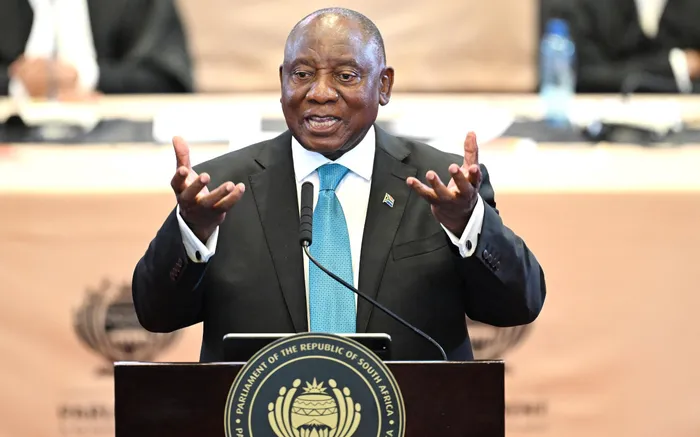
President Cyril Ramaphosa announces a $5 million contribution to combat the Bundibugyo Ebola outbreak affecting Central and East Africa.
Image: GCIS / Phando Jikelo
President Cyril Ramaphosa has announced that South Africa will contribute an initial $5 million to support the continental response to the Bundibugyo Ebola outbreak currently affecting parts of Central and East Africa.
Addressing a High-Level Meeting of African Ministers of Health convened by the Africa Centres for Disease Control and Prevention on Monday, Ramaphosa warned that the outbreak posed a serious regional threat due to porous borders, insecurity, population movement, and active trade routes in the affected areas.
“Africa is once again being tested by a dangerous Ebola outbreak affecting the Democratic Republic of the Congo and Uganda, with a serious risk of wider regional spread,” he said.
The South African president, who serves as the African Union Champion on Pandemic Prevention, Preparedness, and Response, said more than 200 people had already died. He noted that the Africa CDC described this outbreak as the second largest since the 2014 West Africa epidemic.
Ramaphosa paid tribute to frontline health workers responding to the crisis, saying governments and partners needed to ensure they had adequate protective equipment, staffing support, and medical resources.
“It is of utmost importance that we ensure their lives and livelihoods are protected,” he said.
He praised Africa CDC Director-General Jean Kaseya for coordinating a continental response alongside the World Health Organization.
Ramaphosa also commended the governments of the Democratic Republic of the Congo, Uganda, and South Sudan for choosing cooperation and regional solidarity in responding to the outbreak.
The president said although there were currently no approved therapeutics or vaccines specifically for the Bundibugyo strain of Ebola, organisations including Gavi, the Vaccine Alliance, Coalition for Epidemic Preparedness Innovations, and Unitaid were working with Africa CDC and WHO on vaccine and therapeutic candidates aimed at clinical trials.
He called for accelerated research, stronger genomic surveillance, expanded laboratory systems, and equitable access to vaccines and treatments.
The continental preparedness and response plan adopted at the Kampala High-Level Ministerial Meeting is expected to cost about $319 million between June and November 2026. According to Ramaphosa, African countries have already committed around 10% of the required funding through domestic contributions.
“Africa is no longer waiting for others to act passively,” he said.
Ramaphosa urged African governments, financial institutions, philanthropists, and the private sector to contribute to the response effort. He specifically welcomed support from business leaders including Aliko Dangote, Benedict Oramah, George Elombi, and Simon Tiemtoré.
He also appealed to the international community to support Africa’s response efforts, warning that delayed action could worsen the humanitarian and economic impact of the outbreak.
“The world is safer when Africa is safer,” Ramaphosa said.
He added that the outbreak highlighted the need for long-term investment in resilient health systems, local manufacturing of medical countermeasures, emergency operations centres, and sustainable domestic financing for public health systems across the continent.
For more stories from The Mercury, click the link THE MERCURY