

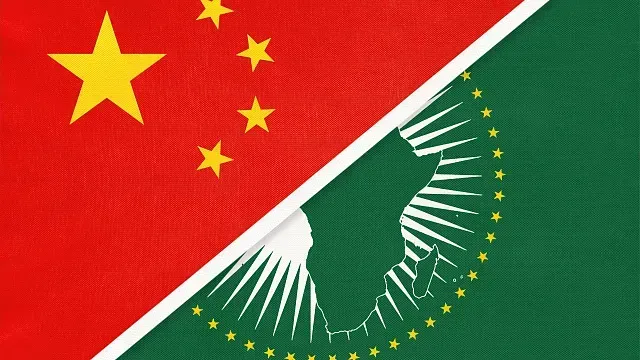
Chinese Vice-Foreign Minister believes it is important to maintain relations with Africa
Image: TV BRICS
On the 20th of January 2025, China Daily published a report titled “Closer China-Africa cooperation energises Global South growth,” showing Chinese Foreign Minister Wang Yi’s early-year visit to Africa and exalting expanding ties between Beijing and African countries. The article’s core message is that the deepening of China-Africa engagement is unlocking opportunities for industrial development, trade growth, and modernisation and this resonates with broader geopolitical shifts and is reflective of a strategic evolution of Sino-African relations.
To understand the importance of this initiative, it is crucial to place it within the larger architecture of China’s multi-layered cooperation frameworks that go far beyond infrastructure and conventional trade to encompass industrialisation, agricultural modernisation, and capacity-building partnerships. These efforts are becoming increasingly framed by Chinese authorities and African leaders as mutual empowerment within a global context that is historically shaped by unequal North-South relations.
Historically, the role of China in Africa has been anchored within large-scale infrastructure projects under the Belt and Road Initiative (BRI) from railways and ports to highways and bridges. China has been playing a significant role in transportation corridors such as Kenya’s Standard Gauge Railway and even the revitalisation discussions around the Tanzania-Zambia line, intended to improve regional rail-sea trade links.
However, the present initiative portrays a more diversified cooperation agenda. The zero-tariff policy that has been extended to Africa’s least developed countries (LDCs) marks a tangible shift toward leveraging China’s vast consumer market to boost African exports, from Rwandan chilies and Kenyan avocados to Malagasy livestock products , further enhancing value capture within African economies rather than just relegating them to raw commodity exporters.
This strategy is in direct alignment with principles articulated in official Chinese policy documents that emphasise industrial, agricultural, and digital transformation cooperation. China’s foreign ministry has shown plans for vocational training, industrial parks, and agricultural modernisation, aiming to train tens of thousands of African technical personnel and create sustainable production capabilities within local economies.
One of the initiative’s most promising dimensions is in knowledge and technology transfer. African countries confront structural constraints in agricultural productivity, despite owning significant uncultivated arable land , a paradox that collaboration and cooperation can help resolve. Collaboration via the China-Africa Agricultural Science and Technology Innovation Alliance (CAASTIA) shows how China’s experience in high-yield and climate-smart agriculture can be adapted to African contexts, strengthening food security and local resilience.
This cooperation contrasts with some Western models that have previously prioritised aid over joint value creation. For example, while the European Union’s Global Gateway invests in infrastructure and clean energy, critiques have emerged about the cost inefficiencies and limited downstream industrial integration. China’s approach, conversely, emphasises long-term capacity building.
Perhaps the most important implication of this initiative is its contribution to a much more equitable global order. As described by some scholars and policy analysts, the China-Africa partnership is part of a broader effort that is aimed to empower the Global South politically and economically, challenging monolithic global governance structures that are dominated by Western powers.
It is also important to understand that African states engage China not simply as recipients but as co-architects of development strategies that align with continental priorities such as Agenda 2063. The China-Africa relationship, when aimed at respecting African leadership in setting development goals, has the potential to deliver durable growth and stronger representation in global affairs.
The China Daily article emphasises a momentum that extends far beyond diplomatic optics. The China-Africa cooperation initiative, rooted in infrastructure, trade liberalisation, and practical capacity building, is representative of an evolving model of South-South partnership. Yet its success will depend on genuine reciprocity, robust local governance, and continuous adaptation to Africa’s diverse development landscapes.
Written by:
*Dr Iqbal Survé
Past chairman of the BRICS Business Council and co-chairman of the BRICS Media Forum and the BRNN
*Sesona Mdlokovana
Associate at BRICS+ Consulting Group
African Specialist
**The Views expressed do not necessarily reflect the views of Independent Media or IOL.