

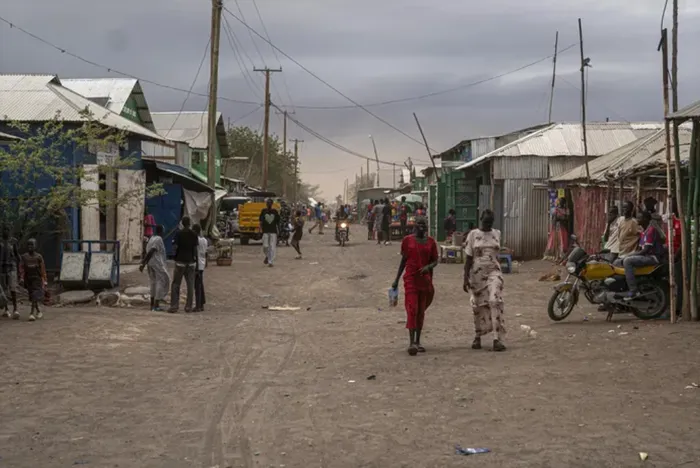
Kakuma is one of the world's largest refugee camps, with nearly 300,000 residents.
Image: INTERNAL
The word "weapon" has become so routinely attached to sexual violence in conflict reporting that it risks losing its precision. In Sudan, precision is exactly what is required. What Médecins Sans Frontières documented in its latest report from Darfur is not the incidental brutality of undisciplined fighters. It is a programme.
Between January 2024 and November 2025, at least 3,396 survivors of sexual violence, 97 percent of them women and girls, sought treatment at MSF-supported facilities in North and South Darfur alone. MSF has been explicit that this figure represents only a fraction of the true scale. In December 2025 and January 2026 alone, 732 survivors were identified in displacement camps, many assaulted while fleeing or already inside the camps. There is nowhere safe. Women described being attacked on roads, in markets, in farm fields. "There is no way to stop the rapes," a 40-year-old woman in Jebel Marra said. "The only way is to try to stay home."
That statement carries its own horror. Staying home is itself not protection, it is captivity repackaged as survival strategy.
The RSF's April 2025 assault on Zamzam camp which sheltered nearly 500,000 people, produced testimonies of survivors who consistently and specifically identified their attackers as RSF fighters targeting the non-Arab Zaghawa community. This was not random. The UN Independent International Fact-Finding Mission, in its February 2026 report on El Fasher, documented RSF fighters making statements during acts of rape that left no ambiguity about intent: "We want to eliminate anything black from Darfur." The Mission concluded that the RSF's conduct in and around El Fasher bore the hallmarks of genocide, a finding grounded in evidence of killing members of a protected ethnic group, causing serious bodily and mental harm, and deliberately inflicting conditions calculated to bring about a community's physical destruction.
This is the context in which MSF is treating survivors. Sexual violence in this conflict is not a byproduct of chaos, it is a mechanism of ethnic elimination, deployed systematically alongside mass executions, forced displacement, and starvation.
In January 2025, then-US Secretary of State Antony Blinken formally determined that RSF forces had committed genocide in Darfur, sanctioning RSF commander Mohammed Hamdan Dagalo, known as Hemedti, specifically for the mass rape of civilians under his command. The UN High Commissioner for Human Rights, Volker Türk, reported in February 2026 that civilian killings in 2025 were nearly triple those of the previous year — at least 11,300 documented deaths, with many thousands still unaccounted for.
These are not numbers in dispute. They are numbers being produced while the world watches.
What makes Sudan's crisis distinct from other conflicts where sexual violence has been weaponised is the degree to which the international response has been structurally incapacitated. Russia's opposition at the UN Security Council has repeatedly diluted resolutions on Sudan, ensuring that references to conflict-related sexual violence and the role of external actors remain softened or absent. A UN Security Council resolution in 2025 extended the existing Darfur arms embargo only until September 2026, without expanding it to cover the rest of Sudan, and without explicitly naming the surge in sexual violence.
Meanwhile, Amnesty International has documented that the UAE has been supplying weapons and drones to the RSF, a finding that implicates Gulf geopolitics directly in the conditions enabling mass atrocity. The African Union's Peace and Security Council, for its part, has condemned the RSF's parallel government proclamation but has produced no effective civilian protection mechanism.
The ICC has been investigating since July 2023. Its Deputy Prosecutor confirmed in 2025 that there are reasonable grounds to believe war crimes and crimes against humanity are being committed. Confirmation of what survivors have been reporting for three years has not produced accountability.
Sudan is now entering the fourth year of a conflict that has displaced around 11 million people, produced what the UN has called the world's largest humanitarian crisis, and returned Darfur to conditions that echo, and by some assessments exceed , the atrocities of 2003 and 2004. African institutions have a particular obligation here. The AU's credibility as a guarantor of African peace and security rests on its willingness to act when the evidence is this clear.
MSF's Ruth Kauffman said this war is being fought "on the backs and bodies of women and girls." That is not metaphor. It is a medical finding drawn from clinical data. The international community has the findings, the determinations, the testimony, and the satellite imagery. What it lacks, as yet, is the political will to make the cost of these atrocities unbearable for those committing them.
That gap between documentation and consequence, is the true story of Sudan in 2026.
Written by:
*Dr Iqbal Survé
Past chairman of the BRICS Business Council and co-chairman of the BRICS Media Forum and the BRNN
*Sesona Mdlokovana
Associate at BRICS+ Consulting Group
Africa Specialist
**The Views expressed do not necessarily reflect the views of Independent Media or IOL.
** MORE ARTICLES ON OUR WEBSITE https://bricscg.com/
** Follow @brics_daily on Twitter for daily BRICS+ updates and instagram @brics_daily