

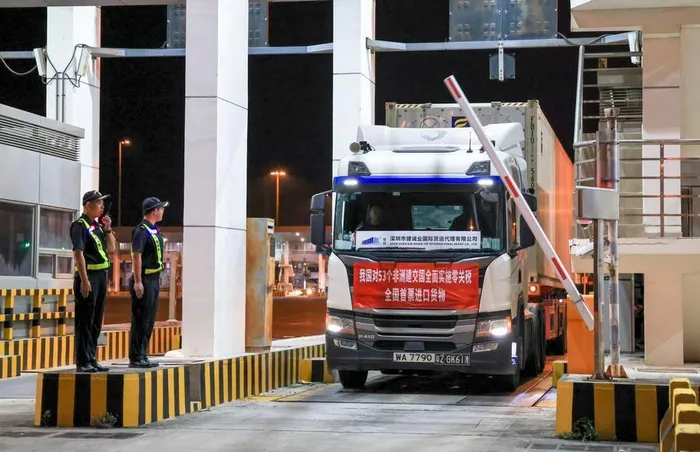
A container truck, transporting the first batch of imports under the expanded zero-tariff treatment to all 53 African nations with which China has diplomatic ties, enters Shenzhenwan Port at midnight in Shenzhen, south China's Guangdong Province
Image: XINHUA
China’s decision to extend zero-tariff treatment to all African countries with diplomatic ties marks one of the most significant trade measures in modern China-Africa relations. At a time when protectionism and trade barriers are rising globally, Beijing’s move signals a deeper commitment to African development, industrialisation and long-term economic partnership. The agreement stipulates that once exports to China reach a specified quota, all goods exported within that quota will qualify for zero tariffs.
Initiated on May 1, 2026, the policy expands duty-free access to an additional 20 African countries, completing China’s pledge to provide full zero-tariff treatment across the continent. From an African perspective, the announcement represents more than a trade adjustment. It reflects an evolving economic relationship increasingly centred on market access, investment and shared development.
For many African economies, access to large global markets remains one of the greatest barriers to growth. China’s latest decision effectively removes tariffs on exports from all 53 African countries with diplomatic relations with Beijing, creating new opportunities for African agricultural products, manufactured goods, minerals and processed exports to enter the world’s second-largest economy more competitively.
The policy builds on China’s earlier 2024 decision to grant zero-tariff treatment to 33 least-developed African countries. By now extending the arrangement to middle-income and developing African economies, Beijing is broadening the benefits beyond aid-based engagement toward a more integrated continental trade partnership.
For African exporters, particularly those seeking to diversify away from traditional Western markets, the move could help expand trade volumes and encourage greater participation in global value chains.
One of the most important implications for Africa lies in the potential to accelerate industrialisation. With Africa’s already, more than $123 billion exports to China, its leaders have long argued that the continent needs to resolve its trade imbalance and move beyond exporting raw materials toward greater local manufacturing and value-added production.
Zero-tariff access to China creates incentives for African producers to expand sectors such as agro-processing, textiles, automotive assembly, pharmaceuticals and light manufacturing. Countries participating in industrial parks and special economic zones linked to Chinese investment may particularly benefit from easier export access into Chinese markets.
The policy also aligns with the African Continental Free Trade Area (AfCFTA), which seeks to deepen intra-African industrial capacity and regional integration. Greater export opportunities could encourage infrastructure upgrades, manufacturing investment and supply chain development across multiple African economies.
In harmony with the AfCFTA it: (1) boosts African exports; (2) supports industrialisation, allowing room for value-added manufacturing; (3) encouraging regional value-chains, intra-African collaboration to boost trade capacity; (4) improving investment opportunities, greater Chinese market access.
While AfCFTA focuses on reducing tariffs within Africa, China’s policy expands external market access, creating an additional export destination for African producers.
China’s announcement comes amid growing global economic fragmentation, rising tariffs and renewed geopolitical competition. Against this backdrop, Beijing is positioning itself as a supporter of open trade and South-South cooperation.
For Africa, this presents both opportunity and strategic significance. Many African countries are increasingly seeking balanced partnerships that prioritise infrastructure, industrial growth and market access rather than dependency on commodity exports alone. This has become increasingly important within the current global era. Relations are increasingly fickle, where African leaders are attempting to escape global isolationism.
China’s proposal to negotiate a China-Africa Economic Partnership for Shared Development further suggests a shift toward longer-term institutional trade arrangements. If successfully implemented, such agreements could provide African exporters with more stable and predictable access to Chinese markets over the coming decade.
The broader significance of the zero-tariff policy lies in its symbolic message. China is not only expanding imports from Africa but also reinforcing its vision of a shared development model based on economic cooperation, connectivity and mutual growth.
For African policymakers, the challenge now will be ensuring that local industries are positioned to take full advantage of these opportunities. Increased access alone will not automatically transform African economies unless accompanied by investment in infrastructure, logistics, skills development and industrial competitiveness.
Nevertheless, the decision represents a major opening for African economies at a time when global growth remains uncertain. If effectively leveraged, China’s zero-tariff initiative could help strengthen Africa’s industrial ambitions, diversify exports and deepen the continent’s role within the evolving global economy.
Written by:
*Dr Iqbal Survé
Past chairman of the BRICS Business Council and co-chairman of the BRICS Media Forum and the BRNN
*Cole Jackson
Director of International Relations, Sekunjalo Group Africa Holdings
**The Views expressed do not necessarily reflect the views of Independent Media or IOL.
** MORE ARTICLES ON OUR WEBSITE https://bricscg.com/
** Follow @brics_daily on Twitter for daily BRICS+ updates and instagram @brics_daily