

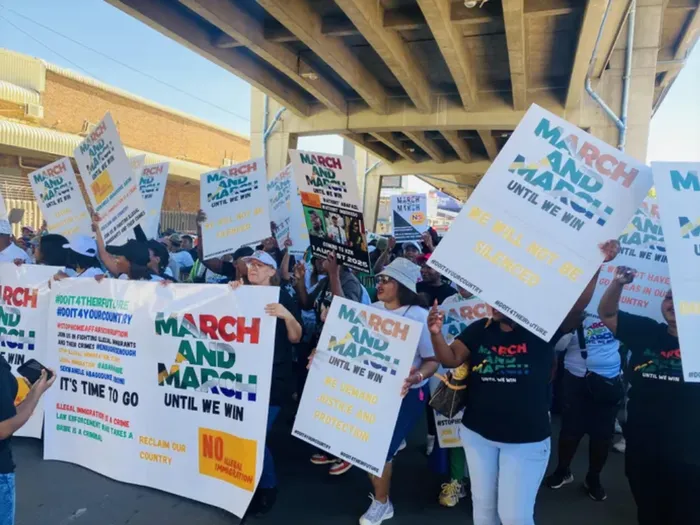
The decision comes after a series of anti-immigrant protests in South Africa, as well as claims of assaults and intimidation against other African nationals.
Image: XINHUA
There is something deeply revealing about a country that built its post-apartheid identity on the promise of a rainbow nation now prompting its neighbours to evacuate their citizens. On 13 May 2026, the Ghanaian government announced it would repatriate approximately 300 of its nationals from South Africa, following a formal travel advisory and voluntary registration with Ghana's High Commission in Pretoria. The decision, approved by President John Dramani Mahama, is not merely a consular formality. It is a diplomatic signal, and a damning one.
Nigeria has expressed similar concern, with both governments citing the safety and welfare of their citizens amid escalating attacks on foreign nationals. South Africa's President Cyril Ramaphosa has pushed back against the characterisation, insisting the country is not xenophobic and condemning the protests as unrepresentative of government or broader society. What he has not been able to deny is the environment that has made those protests possible.
South Africa's relationship with intra-African migration has never been simple. The country absorbed enormous migrant flows in the post-apartheid era, drawing workers from Zimbabwe, Mozambique, Nigeria, Ghana, and across the continent, precisely because it was the continent's most industrialised economy. The violence that has periodically erupted since, most catastrophically in 2008 when more than 60 people were killed in anti-immigrant pogroms, has always reflected a structural failure rather than an aberration.
What distinguishes 2026 from previous cycles is the organised, politically emboldened character of the movements driving the unrest. Two groups, Operation Dudula, fronted by Zandile Dabula, and the newer March and March movement led by former radio presenter Jacinta Ngobese-Zuma, have coordinated marches across Johannesburg, Tshwane, Durban, and Cape Town with near impunity. March and March, which emerged only in 2025, has quickly positioned itself as a pressure group demanding tighter visa regulations, a review of asylum policies, and enforcement against businesses employing undocumented foreign nationals. With local government elections scheduled for November 2026, multiple conservative parties have found it politically convenient to align with their demands. The calculus is straightforward and troubling.
The broader social survey data confirms this is not fringe sentiment. The most recent Afrobarometer data shows South Africans are more hostile toward immigrants than at any point since measurements began in 2003, with the hardening concentrated among poorer and working-class adults in Gauteng, KwaZulu-Natal, Limpopo, and Mpumalanga. These are the same communities facing an unemployment rate that reached 32.7% in Q1 2026, with youth unemployment sitting at 45.8%. When 8.1 million people are out of work and the state has visibly failed to deliver on its post-1994 promises, the search for a scapegoat follows a pattern as old as economic distress itself. Weimar Germany's targeting of Jewish merchants, post-recession Britain's pivot to Brexit rhetoric, and South Africa's recurring xenophobic violence are all symptoms of the same political pathology.
Adding a pointed legal dimension to the week's events, South Africa's Constitutional Court ruled on Tuesday that a refugee cannot remain in the country and reapply for asylum after a previous application has been denied. The Department of Home Affairs described the ruling as a victory against abuse of the asylum system. The ruling is technically defensible. It is also politically convenient in ways that should make observers uneasy. Judicial decisions do not occur in a vacuum, and framing the closure of asylum pathways as a governance win, in the same week that Ghana is evacuating its citizens, will not be lost on South Africa's African neighbours.
Home Affairs Minister Leon Schreiber, who has been aggressive in his pursuit of immigration enforcement since his appointment in 2024, has simultaneously expanded the department's labour inspection capacity, with the 2026 State of the Nation Address committing to hiring 10,000 additional inspectors to complement the existing 2,300. The stated rationale, protecting South African workers from exploitation, is legitimate. The risk is that enforcement, unaccompanied by economic reform, simply displaces the political pressure without addressing its source.
The more consequential question is what the current crisis does to South Africa's standing as a continental anchor and its stated commitments to African integration. South Africa is a founding member of the African Union, a signatory to the AU's Agenda 2063 framework, and one of the most vocal advocates for the African Continental Free Trade Area. The AfCFTA's long-term logic depends on the free movement of goods, capital, and eventually people across the continent. It is difficult to square that vision with a South Africa where Ghanaian and Nigerian nationals are being beaten in the streets of Durban and evacuated on government charters.
For Ghana specifically, the repatriation carries a particular historical weight. Accra has long positioned itself as a pan-African hub, from Nkrumah's foundational vision through to the Year of Return in 2019, which drew diaspora Africans and African Americans back to the continent as an act of cultural reconnection. The evacuation of Ghanaian nationals from a fellow AU member state sits uncomfortably alongside that legacy.
President Ramaphosa's framing in his weekly newsletter acknowledged that "undocumented migration places strain on healthcare, housing, and municipal services, particularly in poor communities." He is not wrong. South Africa's municipalities, particularly in Gauteng and KwaZulu-Natal, are genuinely under pressure. But the intellectual and political failure is the slide from acknowledging strain to implicitly validating the premise that migrants are its cause, rather than its symptom.
South Africa's infrastructure deficit, its housing backlog, its collapsing healthcare system, are products of three decades of state capture, mismanagement, and chronic underinvestment. The 345,000 jobs lost in Q1 2026 alone were not lost to foreign nationals. They were lost to an economy that contracted under policy uncertainty and inadequate structural reform. Ramaphosa's call to "deal decisively" with illegal immigration, however carefully qualified, provides political oxygen to movements that have never been careful in their distinctions.
What South Africa urgently requires is not more labour inspectors, but political leadership willing to name the real failure plainly, and neighbours willing to hold it to account for it.
Written by:
*Dr Iqbal Survé
Past chairman of the BRICS Business Council and co-chairman of the BRICS Media Forum and the BRNN
*Sesona Mdlokovana
Associate at BRICS+ Consulting Group
Africa Specialist
**The Views expressed do not necessarily reflect the views of Independent Media or IOL.
** MORE ARTICLES ON OUR WEBSITE https://bricscg.com/
** Follow @brics_daily on Twitter for daily BRICS+ updates and instagram @brics_daily