

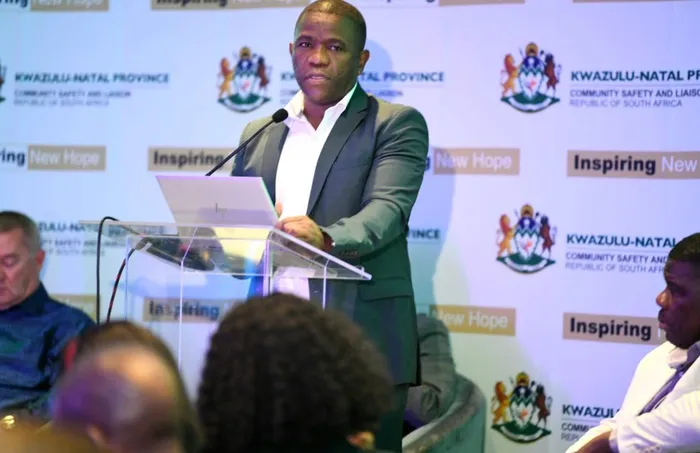
Police Commissioner Nhlanhla Mkhwanazi highlights Umzinyathi District as a hotspot for hitmen recruitment, linking crime to broken family structures, cultural neglect, and a lack of community intervention.
Image: KZN Provincial government/ Facebook
KwaZulu-Natal Police Commissioner, Lieutenant General Nhlanhla Mkhwanazi, has raised serious concerns about the uMzinyathi District in northern KZN describing it as a key source of criminal activity in the province.
Speaking during a Stakeholders’ Engagement Session in Durban, hosted by KZN Premier Thami Ntuli, Mkhwanazi urged a shift in focus from arrest statistics to tackling the root causes of crime.
The session aimed to bring together a diverse range of stakeholders to strengthen partnerships in the fight against crime and develop sustainable safety solutions across the province.
“We have a forgotten district, Umzinyathi, in this province, and I don’t know why, for whatever reason. Almost every hitman we get is recruited there, and they are recruited from a young age,” Mkhwanzi said.
He painted a bleak picture of life for many young boys in the area, citing broken family structures, cultural practices such as polygamy, and widespread social neglect as key contributors to the high levels of criminality.
“Just go around and ask any boy from that district, ‘What does your father say?’” he said. “The response is often: ‘My father is so-and-so. I don’t know him. He fathered me and my siblings, had another wife, moved to Johannesburg, and left us to fend for ourselves.''
He described how, in many cases, even uncles and extended family fail to step in when fathers abandon their children, leaving boys to grow up without guidance, vulnerable to recruitment into criminal networks.
“When these boys grow up, they don’t know what to do. They get recruited. They end up committing crime.”
He criticised the over-emphasis on arrest numbers as a measure of police success and stressed the importance of addressing the underlying issues that drive individuals to commit crimes.
“We don’t chase the number of arrests. We actually discourage arresting for no reason. We arrest if we really have to, if the crime is serious. It's not something that people can meditate on,'' he said.
Mkhwanazi explained that the South African Police Service (SAPS) uses three key performance indicators, with crime reduction and community satisfaction at the core.
He reported a 1.3% decrease in overall crime in the eThekwini region during the last quarter, with priority crimes such as murder, sexual offences, robbery, and assault under close scrutiny.
However, sexual offences remain a deep concern. “Our men, in this province, remain inhumane. We don’t respect females. We still treat them that badly,” he said.
Speaking to a room largely made up of men, Mkhwanazi challenged them to take personal responsibility in addressing the crisis of gender-based violence. “It means we, as men, are not doing enough to reach out to our colleagues to speak sense to them.”
He urged men to take their activism beyond conventional awareness campaigns and go directly into communities to engage their peers in meaningful conversations.
“Don’t rely on the media. Go out into households, into the taverns. Play a video of a gender-based violence victim on the TV while they’re watching a soccer match. Pause the soccer and show them the reality we face.”
Mkhwanazi also noted that many crimes, particularly sexual offences in rural areas, go unreported, and called for targeted interventions to address this reality. He added that without tackling the social roots of crime, efforts would continue to be reactive rather than preventative.
“What we see happening is the outcome. But we’re not analysing the causes of why people do what they do,” he said.
hope.ntanzi@iol.co.za
IOL News