

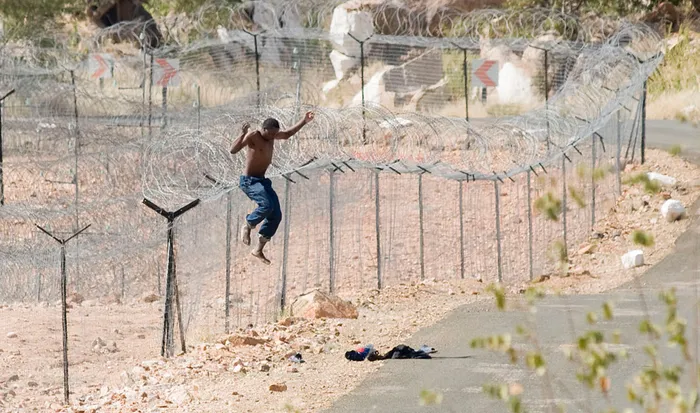
BMA Border Management Authority (BMA) Commissioner Dr Michael Masiapato says they are ready for festive season operations.
Image: Henk Kruger
Border Management Authority (BMA) Commissioner Dr Michael Masiapato has expressed concern over the increasing number of travellers intercepted attempting to enter South Africa illegally, with many being Basotho nationals, as well as Zimbabweans and Mozambicans.
Speaking at a media briefing in Pretoria on Sunday, Masiapato announced the festive season law enforcement operations and outlined security arrangements for the busy 2025 and 2026 holiday period.
He also provided a report on the BMA’s work during the second quarter of the 2025 and 2026 financial year, highlighting movement patterns of people and goods across ports of entry.
Over 8,000 people were arrested in the second quarter for attempting to enter the country illegally, Masiapato said.
The majority were Basotho nationals, followed by Mozambicans and Zimbabweans.
He said the festive season operations plan has been endorsed by key structures critical to border management, including the Border Technical Committee, the Inter-ministerial Consultative Committee on Border Management, the Parliamentary Portfolio Committee on Home Affairs, and the Parliamentary Select Committee on Security and Justice.
Operational support will be provided by the National Joint Operations and Intelligence Structures (NATJOINTS) and provincial joint operations (PROVJOINTS) across all nine provinces.
“It covers the work of the BMA across 71 ports of entry, comprising 52 land ports, 10 international airports, and nine seaports,” he said.
“This includes immigration facilitation, agricultural and environmental biosecurity, port health, and general border law enforcement, including access control.”
The BMA’s jurisdiction extends 10 kilometres inward from internationally recognised borders and 12 nautical miles seaward along the coastline.
Masiapato said the plan was informed by historical patterns and lessons learned from previous festive seasons, emphasising inter-governmental cooperation, law enforcement collaboration, and coordination with border communities.
“The December and January festive periods always bring a significant increase in traveller volume, placing pressure on our ports of entry,” he said.
“South Africa continues to confront complex border-related challenges, including illegal migration, cross-border crime, and smuggling of illicit goods, which strain resources, hinder economic growth, and undermine regional integration.”
He said the BMA has engaged neighbouring states to develop a robust and well-resourced border management system free from criminal interference.
“The festive period always positions us to anticipate risks, improve processing times, refine command and control, and elevate our responsiveness to the high-volume and complex border management environment,” he said.
He said data from recent festive periods shows that foreign travellers dominate cross-border movement.
“For instance, in 2023/24, out of about 5 million processed travellers, 78% were foreign nationals while 22% were South Africans.”
“As for 2024/25, of the 4.5 million processed travellers, 70% were foreign nationals with 30% South Africans,” Masiapato said.
Masiapato said historical data also confirms that the majority of illegal entry attempts occurred at key ports, including OR Tambo International Airport, Beit Bridge, Lebombo, Ficksburg, Maseru Bridge, Cape Town International Airport, Oshoek, and several Botswana border posts.
“These historical patterns, operational experiences, and strategic lessons formed the backbone of our planning,” he said.
He said the festive season plan comprises four phases, which include planning, execution, demobilisation, and sustenance.
The planning phase ran from September 15 to December 9, 2025 and included extensive consultation with public and private sector stakeholders.
According to him, several provincial governments and departments have committed personnel to assist in immigration management, queue management, and handling vulnerable travellers.
He said partnerships with freight associations and private companies will fund operations, while advanced surveillance and protective technologies, including drones and body cameras, will enhance detection and integrity.
The execution phase runs from December 10, 2025 to January 15, 2026, divided into the exit leg (10–31 December) and entry leg (1–15 January).
He said measures will focus on detecting narcotics, illicit goods, and stolen vehicles, while traffic management will be coordinated with road and transport authorities.
Port health teams will screen inbound travellers to prevent the importation of communicable diseases.
“Travellers arriving from Yellow Fever endemic areas will be required to present a valid yellow fever vaccination certificate. Otherwise, failure to produce such a certificate will result in travellers being refused entry into the country,” Masiapato said.
On immigration enforcement, he added, “All travellers entering or departing South Africa should be in possession of a valid machine-readable passport containing at least two completely unused pages… Parents travelling with a child must produce the unabridged birth certificate showing both parents’ details.”
He said agricultural biosecurity and environmental biodiversity teams will inspect regulated goods and monitor endangered and invasive species.
“Non-compliance will be handed over to the Enforcement Team of the DFFE for further investigation,” Masiapato warned.
Masiapato said the demobilisation phase begins from January 16, 2026, with ports returning to normal operating hours, staff redeployed, and operational debriefings conducted.
He said the sustenance phase will continue from January 17, restoring ports to regular operations in preparation for Easter 2026.
simon.majadibodu@iol.co.za
IOL News