

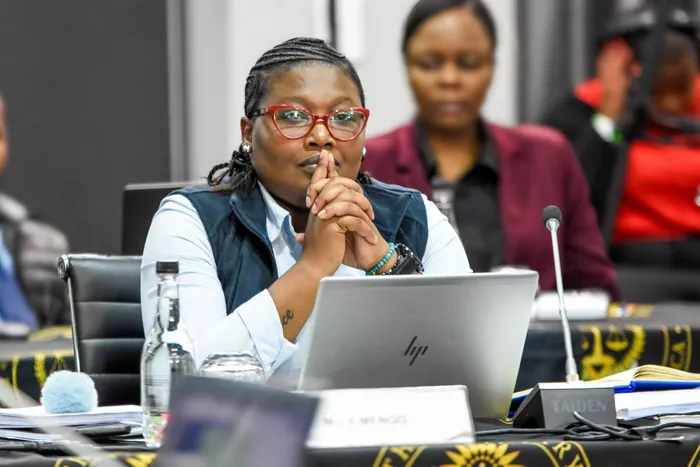
Andiswa Mengo laid a complaint of sexual harassment against Eastern Cape Judge President Selby Mbenenge.
Image: Office of the Judiciary
The ruling that cleared Eastern Cape Judge President Selby Mbenenge of sexual harassment allegations has ignited fierce debate about power dynamics in the workplace, with experts warning it could have a chilling effect on future complaints.
Judges Matter said the Judicial Conduct Tribunal's (JCT) rejection of the “power differential” concept in its not guilty verdict has raised concerns that victims of harassment may now be discouraged from coming forward.
JP Mbenenge was found not guilty of gross misconduct, gross incompetence, and/or gross incapacity under Section 177 of the Constitution.
In its order, the JCT panel, made up of retired Gauteng High Court Judge President Bernard Ngoepe, retired Gauteng High Court Judge Cynthia Pretorius, and Advocate Gift Mashaba SC from the Pretoria Bar as additional members, said Mbenenge was, however, guilty of a degree of misconduct due to his flirtatious relationship with the complainant, Andiswa Mengo.
Mengo filed a complaint of sexual harassment against Mbenenge in 2022 for allegedly making unwanted sexual advances towards her.

Complainant Andiswa Mengo and Judge Selby Mbenenge.
Image: File
Coordinator of Judges Matter Alison Tilley said: “Whether or not you can find the power differential… (it means that) her refusals can be read not as refusals. They are saying that she lied about a number of instances.
“From here, this finding is going to go to what is called a small Judicial Services Commission (JSC), and they are then going to accept or reject that (findings). This isn’t the last step in the process. Once it gets to the finding by the JSC, that can then be appealed. It’s not the end.
“The discussion from here will be what sexual harassment looks like in the workplace and whether the Tribunal is correct in finding that power differential didn’t play a role here. That is what will be most controversial and may well discourage, in which the finding is made, it may discourage people from coming forward.”
Tilley said with the introduction of the Sexual Harassment Policy for the Judiciary by Chief Justice Mandisa Maya in August last year, may help clarify issues around relationships in the workplace, which are in contravention of the policy.
The policy was established as a zero-tolerance approach to abuse of power, including intimidation and victimisation.

Eastern Cape Judge President Selby Mbenenge has been found not guilty by the JSC tribunal of accusations of sexual harassment.
Image: Office of the Chief Justice / S Lioners
The JCT, chaired by Ngoepe, found that Mengo’s omission of “flirtatious and salacious messages that she herself had written and sent” to Mbenenge did immeasurable harm to her case.
An extract from the JCT report read: “The complainant clearly lied, which inevitably severely compromised her credibility; this was demonstrated when we dealt with the issue of the two statements, and in other areas such as why she would have wanted to meet with (JP Mbenenge) in East London to tell him to stop sending flirtatious messages only for her to thereafter still continue sending such messages. We make it clear that we did not disbelieve her simply because she was a woman. The finding that she did lie did immeasurable damage to her case.”
The JCT further noted that by Mengo’s “proven dishonesty”, it indicated lack of honesty on her part in formulating and pursuing her complaint.
The JCT made a number of findings, including that there was no sexual harassment and that the exchange of WhatsApp messages was consensual.
“The finding made that there was an objective reasonable belief on the part of (JP Mbenenge) that the flirtatious exchange of the messages was not unwelcome; in this respect, we point to the established fact that a number of flirtatious – others very salacious – messages were by the complainant herself…
“The flirtation took place between adults; both of whom were parents in their own right and therefore conversant with matters of the heart. As we have seen, the messages were not for public consumption; the parties agreed to deleting them, thereby intending to keep them between themselves,” the report noted.
Mengo’s complaint was largely based on a number of WhatsApp messages exchanged between the parties over a long period of time.
A number of these messages were attached by Mengo to her affidavit.
chevon.booysen@inl.co.za