

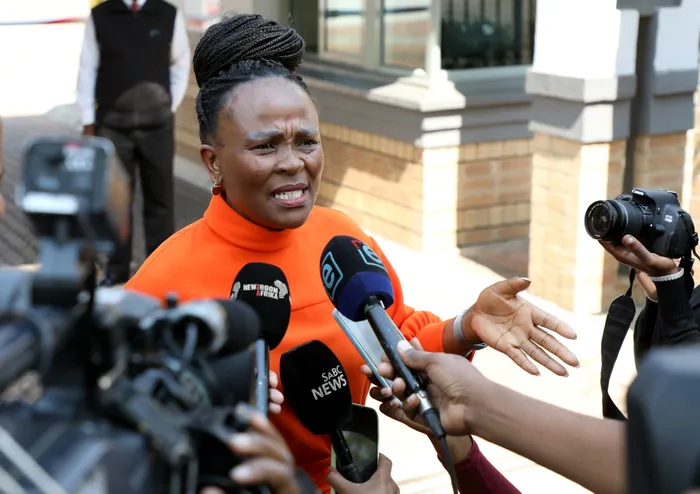
President Cyril Ramaphosa has fired Busisiwe Mkhwebane after parliament voted for her removal. Picture: Oupa Mokoena / African News Agency (ANA)
Image: Oupa Mokoena / Independent Newspapers
The Labour Court in Johannesburg has dismissed an application by the office of the Public Protector of South to overturn a R1.5 million arbitration award that reinstated a senior provincial manager who publicly criticised former Public Protector Busisiwe Mkhwebane.
Judge Reynaud Daniels ruled that the arbitration award issued by Commissioner James Matshekga under the auspices of the Commission for Conciliation, Mediation and Arbitration (CCMA) was reasonable and should stand.
This is after Sphelo Hamilton Samuel, who served as Senior Manager: Provincial Representative in the Free State, was dismissed in December 2020 following a disciplinary process that consolidated nine charges of misconduct into five.
The charges stemmed from multiple incidents, including:
An alleged assault of a complainant by Peter Seabi in 2011;
Submitting a complaint to the Speaker of the National Assembly about Mkhwebane without following internal grievance procedures;
Participating in media interviews on SABC and Radio 702 in which he criticised Mkhwebane and discussed the institution’s operations;
Allegedly disclosing confidential information and inciting staff against Mkhwebane.
Samuel referred an unfair dismissal dispute to the CCMA. In June 2022, Commissioner Matshekga found the dismissal substantively unfair and ordered Samuel’s reinstatement, with 12 months back pay.
The Public Protector’s office subsequently approached the Labour Court to review and set aside the award.
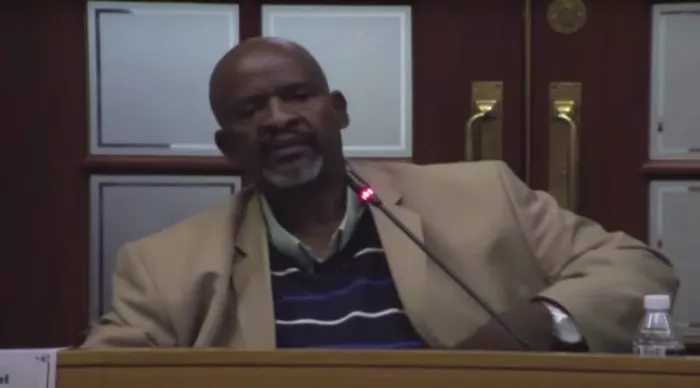
Public protector’s Free State head, Sphelo Samuel, testifying in the impeachment inquiry of Busisiwe Mkhwebane.
Image: Screenshot
A key issue concerned the assault charge arising from an incident that occurred at least nine years before disciplinary proceedings were instituted.
The court upheld the commissioner’s finding that the employer had effectively waived its right to discipline Samuel due to the extraordinary delay. Judge Daniels held that the employer's inaction over nearly a decade was inconsistent with an intention to enforce disciplinary action.
“With a delay of approximately nine years, the overall substantive fairness of the disciplinary process is inevitably and irremediably tainted,” the court found, noting that witnesses’ memories fade and evidence become compromised over time.
Even if waiver had not been established, the court agreed that the employer had failed to present sufficient evidence to prove the assault. A criminal conviction alone, the court emphasised, is not automatically proof of misconduct in a disciplinary setting.
The court also addressed the charges relating to Samuel’s complaint to the Parliament Speaker and subsequent media interviews.
Although the commissioner erred in suggesting that Mkhwebane needed to testify to prove that remarks were disparaging, the court held that this error was not material enough to render the outcome unreasonable.
Judge Daniels emphasised that Samuel’s comments were grounded in personal observations and made in what he believed was an effort to protect the integrity of the institution. The court highlighted that the Public Protector is a public body designed to safeguard the public interest and that the media policy must be interpreted in light of constitutional rights.
The court further noted that South African law protects good-faith disclosures that reveal or tend to reveal wrongdoing, corruption or unlawful conduct. It found that the commissioner had properly balanced the media policy against the constitutional right to freedom of expression.
The allegation that Samuel incited other employees was also rejected, with the commissioner finding that “incitement” in context refers to encouraging unlawful conduct.
In addition, the court recorded that Mkhwebane was herself removed from office by the President in September 2023 following a section 194 inquiry conducted by the National Assembly. The judgment noted that many of the complaints raised by Samuel featured in the final parliamentary report.
Applying the Constitutional Court’s test for review of CCMA awards — whether the decision is one that no reasonable commissioner could reach — the Labour Court found that the award was reasonable on the evidence presented.
The review application was dismissed, and no order as to costs was made.
sinenhlanhla.masilela@iol.co.za
IOL News