

With so many illegal service providers competing for customers, free trials are common, giving users full access to thousands of channels and on-demand content without spending a cent.
Image: IOL
Content that normally costs hundreds of rand a month can be accessed illegally for as little as R85, and in some cases, even for free.
A piracy syndicate operating from SA is selling access to the full DStv bouquet, including SuperSport, and content from streaming giants such as Netflix and Amazon Prime to anyone willing to look for it.
And looking is easy, because it is brazenly advertised on Facebook.
In some instances it costs nothing at all.
With so many illegal service providers competing for customers, free trials are common, giving users full access to thousands of channels and on-demand content without spending a cent.
Savvy viewers have caught on, hopping from one provider to the next, riding free trial after free trial without ever paying for it.
These reporters decided to put it to the test and find out who is behind it.
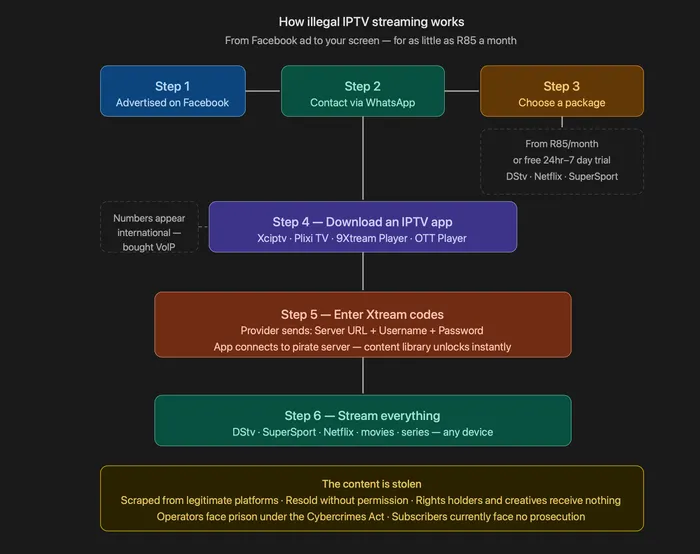
Providers advertise openly on Facebook, inviting interested viewers to make contact via WhatsApp.
Most of the numbers appear to be international, a detail that, as these reporters would discover, means very little.
Once contact is made, providers respond promptly with a menu of packages.
One provider, Cassify, offered the cheapest package at a very affordable R85 a month for DStv channels, live TV and movies, including a free 24-hour trial.
DStv’s official monthly subscription prices vary widely depending on how much content you want, with the most basic EasyView package costing around R29 per month for a small selection of channels, the Access tier about R139 per month, and the Family package near R329 per month.
Compact is roughly R469 pm, Compact Plus around R619 pm, and the full Premium bouquet — with the most channels including sports, movies and series — is close to R929 pm.
MultiChoice is now controlled by the French media group Canal+, which completed its takeover in September and now runs the company as part of its wider African operations.
Cassify's higher package costs R170 a month which unlocks more channels.
Subscribers were instructed to download one of several streaming apps — including Plixi TV, Xciptv and 9Xtream Player — through which the content is accessed.
A piracy syndicate operating from SA is selling access to the full DStv bouquet, including SuperSport, and content from streaming giants such as Netflix and Amazon Prime to anyone willing to look for it
Image: IOL
Another provider, TV For Life, which used a Kenyan number with a +254 prefix, offered a seven-day free trial followed by a R160 monthly fee.
It sent detailed setup instructions for multiple devices, including Android boxes, Firesticks, smartphones and smart TVs, directing users to download an app via a specific link.
The trial started automatically once the app was installed.
Two more providers, AiTV SA and another calling itself WTF TV, followed almost the same script: a free trial, an app download link and a payment link for renewals after the trial period.
After installation, the provider sends what is known as an Xtream code, a server URL, username and password that together act as login credentials.
The Xtream code system is a widely used back-end protocol that allows IPTV providers to manage thousands of subscribers and content streams simultaneously. Legitimate broadcasters also use versions of it.
In this case, however, the server hosts pirated material, content scraped from legitimate platforms without authorisation and made available to anyone who pays for access codes or, in many cases, simply signs up for a free trial.
Users open the app, navigate to the login screen and enter the server URL, username and password.
Within seconds, a full content library appears, organised into categories such as live TV, sport, movies and series.
SuperSport broadcasts, international news channels, Netflix titles and premium films appear side by side, accessible on devices ranging from smartphones to large smart TVs.
However, the interface is noticeably different from legitimate streaming services.
The system runs on IPTV — Internet Protocol Television — meaning content is delivered via the internet rather than satellite or cable.
When it came to payment, four different providers — all using international WhatsApp numbers — gave the reporters the same SA banking details: two accounts held by Brumilda Marais, one with TymeBank and the other with FNB.
A quick search showed that Marais is based in Kempton Park, not in the UK as her +44 WhatsApp prefix suggested.
Asked for comment, Marais initially denied any involvement.
“I don’t know what you’re talking about,” she said. “I’m not selling anything.”
When told that four providers had sent her banking details to customers, she said she was unaware of it.
“Someone must have used my details without me knowing. I think I was hacked or something.”
She said she would investigate. Her number later became unreachable.
A reseller told IOL they used virtual phone numbers bought online to avoid using their real contact details.
These Voice over Internet Protocol, or VoIP, numbers work over the internet rather than a physical SIM card, allowing users to choose numbers from almost any country and operate them from a phone or computer.
“We do not use our personal numbers,” the reseller, who declined to be named, said.
“We buy internet-based numbers that are not linked to us.
"We are running the number through an app, so we can receive OTP messages on there and everything.”
He said he used to be a reseller for Vuyisle Victor Salem.
A recent court judgement found Selem guilty on all charges for operating an illegal IPTV service known as Waka TV.
The Germiston Regional Court ruled that he had breached SA’s Cybercrime Act and committed fraud, and sentenced him to pay a R10,000 fine or serve 12 months in prison.
Police seized an unauthorised streaming device, marketing materials promoting access to DStv Premium content, and a phone with details of about 90 paying customers.
Frikkie Jonker, cyber security and broadcasting piracy director at Irdeto, the enforcement partner for MultiChoice Group in the fight against piracy across the African continent said: "This verdict is a good indication that the courts are getting tougher on those who commit crimes involving the illegal use of MultiChoice content.
"It sends a clear message that piracy will not be tolerated.
"We commend the police for their professionalism and their continued support in fighting the fight against broadcasting piracy.”
Data from Irdeto shows that users in five major African countries made about 17.4 million visits to the 10 most popular piracy websites.
This accounted for part of the 345.4m visits to these piracy sites by users worldwide between June and August 2021.
Kenya led with seven million visits, followed by SA with five million. Ghana recorded almost two and a half mission visits, Nigeria more than two million, and Tanzania 626,000.
For the actors, producers and crew who depend on legitimate viewership to earn a living, it was a direct attack on their income.
"It is theft. It is as simple as that," seasoned actor and producer Hlomla Dandala said.
"You see our content making someone else money and that person did nothing towards it.
"It is one of the many battles we as an industry are facing right now."
Dandala said the impact on performers is both financial and professional.
"When a show is stolen, my face is flooding the market but my pockets are empty," he said.
"I cannot get the next job because the next production says there is too much of you out there already.
"And it does not make sense that you are everywhere but earning nothing. It is not unlike hacking someone's bank account."
Veteran actress Lizz Meiring said the industry has been left almost defenceless.
"It is an absolute blatant theft of intellectual copyright," she said.
"We already do not get residual royalties in SA.
"We are one of the only countries in the world where actors do not get them. So this is a double blow.
"It just shows a complete lack of respect for the months and months of work that goes into creating something."
Executive producer Thandi Davids, whose credits include the Netflix documentary Senzo: Murder of a Soccer Star, said the damage bleeds through the entire value chain.
"Piracy is not fundamentally good for anyone who works in the sector, whether that be producers, performers or crew," she said.
"It means our budgets are lower.
"It means the people who are supposed to be earning that money are not.
"It impacts actors and all those who earn royalties. Those sales are going to someone else."
Davids said the problem demanded intervention at both national and continental level.
"We end up, when we are older and no longer working in the industry, without medical aid, without pensions," she said.
"The money that should be coming to us is going somewhere else.
"Our Broadcasting Act was written in the 1990s. It has not caught up with where technology is now. That gap needs to close."
TV and radio personality Buli G Ngomane said local productions carry a vulnerability that international content largely does not, because someone working behind the scenes can leak episodes before they are even broadcast.
It happened to her own show.
"The first seven or eight episodes were circulating and even posted on Facebook," she said.
"It is shocking. Very shocking.
"At the end of the day you are not contributing to the growth of the industry.
"You are literally destroying it."
Cybercrime expert Chad Thomas of IRS said dismantling these syndicates is achievable but depends entirely on political will and resources.
He said state cybercrime units, already stretched across far more serious organised crime, do not have the capacity to prioritise streaming piracy.
"A lot of the burden of investigating these syndicates falls to the private sector," he said, "but the private sector cannot effectively use these tools without working hand in glove with law enforcement.
"There has to be a public and private partnership."
Thomas said the law does have teeth.
Under Section 12 of the Cybercrimes Act, the theft of intellectual property is a criminal offence carrying a prison sentence, with the severity depending on the scale and value of the operation.
As for subscribers who knowingly sign up, Thomas said they currently have little to fear.
"They can claim ignorance and nothing really happens to them," he said.
He added that knowingly using a stolen service could, in theory, make a subscriber part of a broader conspiracy to steal intellectual property.
"But that," he said, "would be a hell of a stretch."
The real targets, Thomas said, are those running the operations.
"There should be an appetite to go after the enablers and those benefiting at the top," he said.
Dr Simon Howell, a crime expert, also told IOL there was no solid data on how much piracy took place.
"As a result, that significantly undermines various corporations and entities' ability to provide a regulated service and, of course, to provide a service that meets the standards which they are held accountable by.
"It is very difficult to combat this in SA because the kind of electronic surveillance available in the UK is not in place here."
** In a bid to clamp down on the syndicate, MultiChoice said it was deploying an advanced, multi-layered anti-piracy strategy that includes:
IOL