

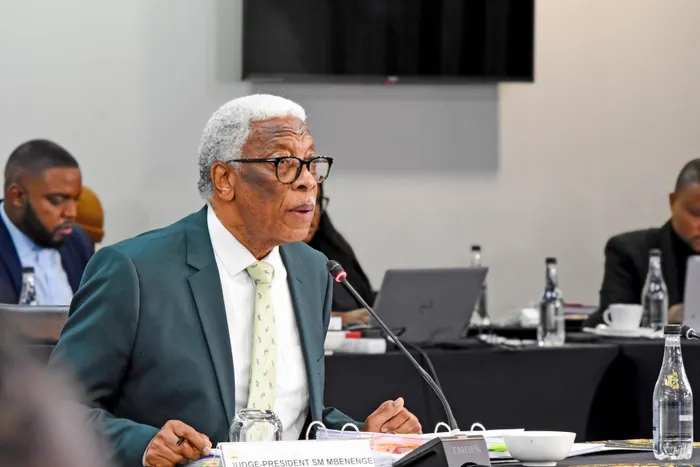
The Judicial Conduct Tribunal into Judge President Selby Mbenenge highlights the complexities of cultural interpretation within the legal system, revealing how Western frameworks can distort evidence and understanding.
Image: Office of the Chief Justice / S Lioners
The Judicial Conduct Tribunal into Judge President Selby Mbenenge, which concluded on October 21, 2025, was ostensibly convened to determine whether three specific elements of gross misconduct were present: (1) that he made unwanted sexual advances; (2) that he sent an image of his genitals; and (3) that his location on a key date corroborated the complainant’s claims that he had solicited an act of a sexual nature from her.
These three allegations, detailed in an affidavit submitted by the complainant, Andiswa Mengo, became the case’s foundational pillars. But what unfolded over the course of the tribunal was something altogether more complex – a collision between competing epistemologies, cultural erasure, and a legal culture increasingly comfortable with presupposition.
At the heart of this cultural collision was the treatment of isiXhosa communication – a language rich in idiomatic nuance and indirect expression – as if it could be compressed into a single epistemic meaning through the lens of Western feminist theory. The complainant’s thirteen instances of saying “no” were interpreted by expert witness Dr Lisa Vetten as evidence of refusal. Yet, as Advocate Muzi Sikhakhane pointed out, when translated faithfully in context, these responses read more like flirtatious hesitations than absolute denials. In isiXhosa courtship discourse, negotiation is implicit, and tone, timing and relationship history matter.
But this dimension was erased in the tribunal’s framing. Removed from their cultural matrix, the thirteen no’s ( Hayi’s – often used as an expression of suppressed delight, irony, or feigned shock to depict modesty) were transformed into prosecutorial evidence by a Eurocentric interpretive framework that elevates its own lens to universal status – a violence of erasure that the defence laid bare.
This cultural violence was not incidental. It revealed how legal institutions in post-apartheid South Africa are still struggling to reconcile divergent systems of meaning. The expert report, which heavily edited and retranslated the WhatsApp exchanges between Mbenenge and Mengo, omitted swathes of isiXhosa communication, reducing their relational complexity to a singular, Western notion of consent. In doing so, it presupposed an outcome and then read the evidence backwards to support it.
The tribunal, then, became a space in which the law drifted dangerously close to allegory – where assumptions were elevated to facts, and moral sentiment stood in for legal proof.
At the centre of the spectacle lies not only the respondent, but Advocate Muzi Sikhakhane, whose courtroom performance did more than test a witness – it exposed the extent to which liberal legal discourse has become a closed system, unable to accommodate contradiction or complexity. The real discomfort he stirred was not about gender politics or cultural relativism. It was about epistemic authority.
From the outset, the case was presented to the public as a morality fable. The familiar coordinates were quickly assembled: a powerful Black man, a vulnerable Black woman, the language of refusal, and an expert interpretation that left no room for ambiguity. The WhatsApp messages were extracted, translated, parsed. A conclusion was reached – one that did not rely on coercion or retaliation so much as the assumption that hierarchy alone renders consent impossible.
That assumption may pass muster in advocacy, but it is poor jurisprudence. What Sikhakhane argued, with precision and restraint, is that sexual harassment is not a philosophical abstraction. It is a legally defined harm. It must be demonstrated through conduct that is unwanted, persistent and abusive of power. In this case, there is no such pattern. The complainant’s messages, stripped of context and linguistic nuance, are taken as dispositive. Yet large portions of the original isiXhosa exchanges were removed in the expert’s report. This cannot be named an oversight. What Sikhakhane showed is that it is a method that constructs guilt through curation.
Two elements in particular have been presented to the public as settled, yet they collapse under scrutiny.
First, the suggestion that Judge Mbenenge sent images of his genitals. There is no authenticating evidence – no metadata, no chain of custody, no forensic linkage to his device. Yet this claim has been repeated as proven because it affirms a racialised moral panic that still governs South African media narratives.
Second, the claim that his location, on November 14, 2022, corroborates the complainant’s account of a particularly lewd act of showing her is genitals, saying: “See the affect you have on me as a man,” and asking if she “wanted to suck it”. Evidence exists that an attempt was made to trace his movements by the complainant’s legal team, contradicting Senior State Advocate Salomé Scheepers denial of this. The outcome does not place Mbenenge at the location suggested by the complainant. This contradicts one of the most inflammatory allegations – yet the exculpatory detail was omitted from final submissions.
What Sikhakhane accomplished, and what continues to unsettle the liberal legal establishment, is not simply a rebuttal of a single charge. It is a reorientation of the courtroom itself. His line of questioning returned the tribunal to a standard that has long been buried under layers of ideological sediment: proof. He neither denied the messages nor offered empty invocations of culture as a shield. Instead, he examined the conditions under which meaning is assigned – who assigns it, in what language, and with what institutional bias.
His interrogation of expert witness Dr Lisa Vetten was a case study in method. He did not attack her character. He asked what was removed, why it was removed, and what assumptions guided the reading of what remained. He reminded the room that legal expertise does not exempt itself from scrutiny when it borrows from imported interpretive frameworks that have little traction in African linguistic and relational contexts.
This was not a defence that leaned on identity. Rather it was a refusal to accept that identity – racial, gendered or institutional – can stand in for evidence. And this is precisely why it has provoked such backlash. Sikhakhane did not flatter the courtroom’s sensibilities. He demanded that it face its inconsistencies. That demand has been read by some as a rejection of feminism, by others as a regression to patriarchy. But what it actually signals is something far more disruptive: a refusal to let the law drift into allegory.
There is no shortage of voices willing to pronounce guilt on the basis of appearance, hierarchy or disgust. What is rare is a legal advocate who insists that dignity requires more than belief – it requires evidence. Sikhakhane reminded the tribunal that to conflate impropriety with illegality is to abandon jurisprudence for performance.
This case, regardless of outcome, will likely be remembered not for what it adjudicated, but for what it exposed. It forced the judiciary and its observers to confront whether the law still knows how to ask questions without answers built in. It revealed that the legal establishment remains deeply resistant to being challenged on its moral certainties. And it showed that when a Black advocate speaks with composure, rigour and depth – without apology, and without playing to the liberal gallery – he shakes the foundations of the house.
There are those who will argue that believing women must come first, and that the law must evolve. But what happens when belief hardens into dogma, and evolution becomes coercion by another name? Sikhakhane has posed the uncomfortable question. The tribunal may decide the facts, but the country will have to decide whether it still recognises the difference between power and persuasion, evidence and inference, law and sentiment.
And that, perhaps, is the real case on trial.
The Judicial Conduct Tribunal into Judge President Selby Mbenenge highlights the complexities of cultural interpretation within the legal system, revealing how Western frameworks can distort evidence and understanding.
Image: IOL
* Gillian Schutte is a South African writer, filmmaker, poet, and uncompromising social justice activist. Founder of Media for Justice and co-owner of handHeld Films, she is recognised for hard-hitting documentaries and incisive opinion pieces that dismantle whiteness, neoliberal capitalism, and imperial power.
** The views expressed do not necessarily reflect the views of IOL or Independent Media.