

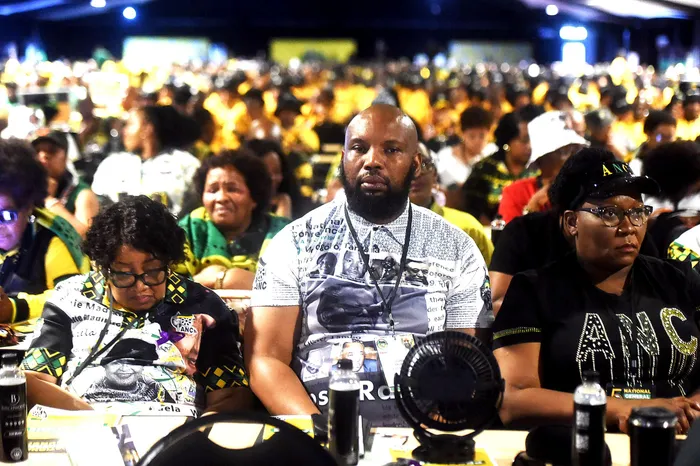
ANC Members attend the 5th National General Conference in Boksburg.
Image: Itumeleng English / Independent Newspapers
In Part 1, we said: this NGC is not another conference, it is a line in the sand. In Part 2, we argued: there is no economic recovery without defeating criminal (rule) sovereignty. Part 3 moves the focus to where everything either stands or falls: The branch, the street, the community.
If we lose them, we lose the country.
The ANC was not born as a TV studio or a Twitter account.
It was born as organised people, in real places, with real stakes.Today, that is where we are bleeding.
The NGC Base Document is blunt: public perceptions of the ANC are dominated by narratives of corruption, internal fighting and poor service delivery. It warns that unless renewal is deep and real, the movement may lose its status as “leader of society” and become just another electoral machine. The Dullah Omar (my) Region’s NGC preparatory report asks the same question in even sharper terms:
Their commissions focus on ideological orientation, organisational renewal, economic transformation, capable state, peace and stability all tied back to one basic issue: can people still feel the ANC in their everyday lives, beyond election week?
COSATU’s 8th Central Committee puts it more brutally from a worker’s angle: the economy has stalled, unemployment is at crisis levels, and communities live with collapsing municipal services and endemic crime a “betrayal of the working class”. Put simply: If the ANC is not visible where people live, work, travel and suffer, then it is not leading the National Democratic Revolution. It is commenting on it.
We must be honest about how we got here.
The Alliance and many internal reports converge on the same diagnosis:
ANC Today’s NGC special editions openly acknowledge this: renewal is necessary because the ANC’s legendary community organising capacity has not adapted to the post-1994 terrain and digital era; our liberation communications machinery did not fully migrate into the new battle of ideas. The SACP adds another layer: austerity, tenderisation and corruption have combined to disable key parts of the local state, hollowing out capacity while feeding predatory networks inside and outside government. This is not just about “organisational weakness”. It is about the loss of people’s power on the ground.
The good news is: we are not starting from zero. We already have instruments that, if given teeth by the NGC, could rewire the movement from the bottom up.
The Branch Functionality BarometerThe Branch Functionality Barometer is designed precisely to track whether branches are alive, accountable, and connected to communities not just in good standing on paper. It is part of the broader Organisational Accountability Framework and is meant to guide regular assessment and support.
National leadership has already described it as key to rebuilding structures from the ground up and re-establishing grassroots credibility.
The new List Guidelines for 2026 local elections tighten candidate selection: councillors must meet integrity standards, enjoy community support, and be selected through a transparent, rules-based process under the ANC Electoral Committee. These guidelines exist because we know one hard truth:People are not only judging the ANC on national speeches.
They judge us on who we put in the council chamber and how that person behaves.
The Dullah Omar (my) Region and its subregions have already produced serious NGC inputs calling for:
These are not abstract resolutions they come from branches and activists who see, every day, how dysfunction and criminality break trust and open space for opposition parties and mafias.
So what must this NGC decide?I would suggest four concrete shifts.
The NGC should resolve that:
Quotable line: “If a branch cannot serve the people, it should not decide who leads the people.”
The 2026 List Guidelines must be implemented with courage:
Quotable line: “A councillor is not a deployment for a comrade. It is a mandate from a community – and a mandate can be withdrawn.”
In many townships, informal “structures” already exist but they are run by drug bosses, extortion networks or protection rackets.
The ANC and Alliance must actively reclaim that terrain:
This is where COSATU’s call to defend public services and fight crime must be grounded in daily practice, not just campaigns. Quotable line:“If we abandon the street, the gang will govern it.”
The 2026 local government elections are not just another electoral cycle. They are a live test of whether NGC resolutions translated into:
Quotable line: “Every ward in 2026 will ask one question: Did the ANC listen at Birchwood or did it just clap?”
To comrades inside the ANC: This NGC is not just about who wins debates in commissions. It is about whether we still have the courage to rebuild branches as the basic units of people’s power, not as ATM cards for tenders and positions.
To South Africans who are not ANC members: You are entitled to be sceptical. You have seen too many promises broken.
What you should demand from this NGC is simple: Will branches come back to the street? Will councillors be accountable? Will the ANC be visible between elections not only when it wants votes?
If you need one sentence to carry into your commissions and caucuses, make it this: “This is not what we struggled for: we struggled so that the people in every ward, every street, every village would govern. If our branches are dead, that dream is dead. The NGC must bring them back to life.”
That is the next line in the sand. From Part 1’s welcome, to Part 2’s fight against criminal sovereignty, to Part 3’s call for living branches the message is consistent: Renewal is not a speech.
Renewal is a street-by-street, ward-by-ward reconstruction of people’s power.
Make that the work of this NGC.
* Faiez Jacobs is a former Member of Parliament, founder of The Transcendence Group, Capetonian, Activist, and Servant of the People.
** The views expressed do not necessarily reflect the views of IOL or Independent Media.