

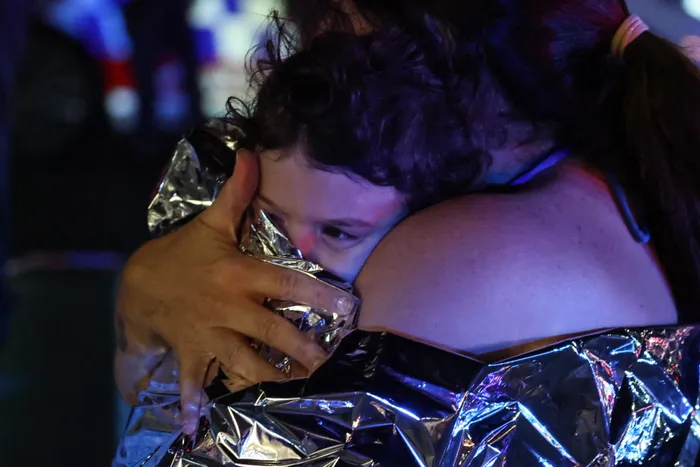
A woman holds her baby in a blanket after a shooting incident at Bondi Beach in Sydney on December 14, 2025. Australian police said two people were in custody following reports of multiple gunshots on December 14 at Sydney's famed Bondi Beach, urging the public to take shelter.
Image: David Gray / AFP
Over this past weekend, two of the most devastating mass shootings in recent memory occurred: one in Rhode Island at Brown University, and another at Bondi Beach in Australia.
At Brown University, the assailant murdered two students and injured nine. In Australia, two shooters—reported to be a father-and-son duo—opened fire on a group of people at Bondi Beach. Sixteen people were killed (including one of the shooters), and an additional 42 were injured.
Rhode Island and Australia share something in common: both have highly restrictive gun laws, with Rhode Island among the strictest in the United States.
In Australia, the law requires a “genuine reason” to own a gun, and it specifically excludes self-defence as a valid justification. Instead, Australians can generally obtain firearms for hunting, animal protection, occupational use, and similar purposes. Semi-automatic firearms, such as pistols, are effectively banned for general public ownership and are restricted to government agencies, the military, police, and certain occupational shooters. Civilians can typically own standard sporting and hunting rifles and shotguns, subject to an extremely strict licensing regime. Australia is often described internationally as a gold standard for gun control.
In Rhode Island, a person can obtain a concealed-carry permit only if they can demonstrate a proper showing of need (such as fear of personal injury or threats to property). Applicants must also pass a thorough background check, complete a certified firearms training program, and demonstrate high proficiency in shooting. Further, just this year, Governor Dan McKee signed legislation banning the manufacture, sale, purchase, and transfer of military-style semi-automatic weapons, which is set to go into effect in July of next year.
Yet, neither of their extremely strict gun laws kept firearms out of the hands of deranged killers. It took them out of the hands of the people who could have fired back.
What causes a person to take the most extreme measure one possibly can—taking the lives of others, knowing they may lose their own? How deeply troubled or fanatical must someone be?
A person doesn’t simply snap and decide to take lives. The moment they decide to pull the trigger is often the culmination of a long convergence of grievance, isolation, or ideology collapsing in on itself. The Bondi Beach and Brown University shootings are brutal case studies of that convergence.
Research on 1,725 mass murderers worldwide has found that dominant themes behind these acts include grievance and perceived injustice—humiliation, failure, rejection, and political outrage. At Bondi, the attack was timed to a Hanukkah event. This is no doubt a fitting pattern of two individuals, one now deceased, who converted their political or religious grievances into some sick justification for killing strangers who symbolise a group that they hate.
Reporting has indicated that the surviving Bondi suspect, Naveed Akram, has been on the government's radar for possible ties to an Islamic State-linked network in Sydney. While at Brown, investigators have still not been able to identify a clear ideological motive. Whatever comes from the Brown shooters' motivations, we can almost say for certain that they are a product of an extreme mental illness, as opposed to political fanaticism.
Of course, mental illness and political ideology should never distract from the tragedy inflicted by the perpetrators. No one deserves sympathy for taking the life of another, and mental state should not be used to downplay the deaths of victims. Two things can be true at once: a person can be profoundly unwell, and also be a brutal killer who deserves no sympathy. Whether a killing is driven by personal experience—bullying, for example—or by political or religious ideology, the reality is that someone willing to kill others and themselves is deeply unstable and dangerous.
In fact, virtually every major religion condemns unjustified killing. Taking the life of another in pursuit of religion—or even as part and parcel of ordinary life—is not a “Western” ideal. Unjustified killing is condemned across Judaism, Christianity, Islam, Hinduism, Buddhism, and many others.
When people kill in the name of religion, they are not killing in the name of their god. They are killing for their own beliefs—and dying for the same.

Recent mass shootings at Brown University and Bondi Beach raise critical questions about the effectiveness of gun control laws, and explores the intersection of mental illness and political ideology in understanding these tragic events.
Image: IOL
* Armstrong Williams is the manager and Sole Owner of Howard Stirk Holdings I & II Broadcast Television Stations and the 2016 Multicultural Media Broadcast Owner of the year.
** The views expressed do not necessarily reflect the views of IOL or Independent Media.