

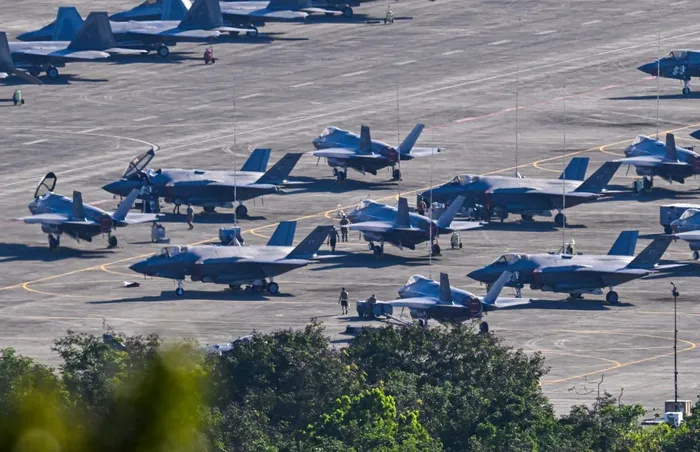
US military fighter jets sit on the tarmac at José Aponte de la Torre Airport, formerly Roosevelt Roads Naval Station, in Ceiba, Puerto Rico, on January 3, 2026. President Donald Trump said Saturday that US forces had captured Venezuelan leader Nicolas Maduro after launching a "large scale strike" on the South American country. "The United States of America has successfully carried out a large scale strike against Venezuela and its leader, President Nicolas Maduro, who has been, along with his wife, captured and flown out of the Country," Trump said on Truth Social.
Image: Miguel J Rodriguez Carrillo / AFP
This article is written in response to claims that cross-border military force may be justified by domestic criminal indictments or disputed elections. Such arguments, if left unchallenged, risk normalising a dangerous erosion of the UN Charter’s authority at a moment when conflicts in Ukraine and rising tensions around Taiwan already place the international system under severe strain. The purpose of this piece is not to defend any government, but to defend the legal framework that protects all states from coercion by the powerful.
There is one rule that prevents the world from sliding into permanent instability: states may not use force to settle political disputes. That rule sits at the heart of the United Nations Charter, drafted after two world wars to stop power, not principle, from deciding who governs whom.
Reports that the United States used force inside Venezuela to seize a sitting president, defended by references to criminal charges, electoral illegitimacy, and “law enforcement”, strike directly at that rule. These are not technical legal debates. Under international law, these justifications do not work.
If the world treats this moment as normal, the damage will not stop in Caracas. It will reach Kyiv. And it will reach Taipei.
Article 2(4) of the UN Charter bans the use of force against another state. There are only two exceptions:
That is the entire list.
There is no exception for domestic criminal indictments.
There is no exception for disputed elections.
There is no exception for leaders deemed corrupt or authoritarian.
As Corten (2012) demonstrates, the prohibition on the use of force remains legally intact even as selective state(s) practice erodes compliance in reality. The International Court of Justice
confirmed this baseline in Nicaragua v United States (1986), holding that even limited military action breaches the UN Charter when no recognised justification exists.
Supporters of the action argue that Venezuela’s president lost an election or retained power through military support. Even if that were accepted as fact, it does not change the law.
International law protects states, not the moral standing of their governments. Recognition affects diplomacy, who embassies engage with and who signs treaties, but it does not authorise the use of force. Talmon (1998) shows that claims of illegitimacy have never created a lawful right of intervention under international law.
There is no doctrine of democracy enforcement in the UN Charter. That idea was deliberately rejected after 1945 because it invites permanent intervention by powerful states against weaker ones.
If electoral illegitimacy justified force, sovereignty would become conditional, granted only to governments approved by the strong.
Even where serious criminal allegations exist, international law draws a bright line. A sitting head of state enjoys personal immunity from foreign criminal jurisdiction while in office. The International Court of Justice confirmed this unequivocally in Arrest Warrant (DRC v Belgium).
More importantly, even international criminal law rejects unilateral enforcement. Akande (2003) explains that accountability depends on institutional cooperation, courts, warrants, and state consent, not cross-border abduction by military force.
If even the prosecution of atrocity crimes relies on cooperation rather than coercion, drug trafficking allegations or electoral disputes cannot justify armed seizure.
The most dangerous development is not only the use of force. It is the rebranding of force as “law enforcement”.
Policing operates within a shared legal system. Armies do not. When armies begin enforcing domestic criminal law abroad, sovereignty becomes conditional, dependent on who has the power to indict. That logic travels.
Russia already claims Ukraine’s leadership is illegal and criminal. Once criminality and illegitimacy are accepted rhetorically as gateways to coercion, resistance weakens. Allies hedge. Neutral states abstain. Enforcement fractures.
Nothing here legalises aggression. Russia’s invasion of Ukraine remains a manifest violation of the Charter. Any attempt to seize Volodymyr Zelenskyy would compound that illegality.
But international law is enforced by coalitions, not judgments alone.
Ukraine depends on global unity to resist conquest. Taiwan depends on consistent norms to deter coercion. When leading states bend the rules, they weaken their own ability to mobilise others. Sanctions lose force. Deterrence becomes more expensive. The burden shifts to those already under threat.
If the rules based order is to survive, the response must be collective and clear.
First, restate the law without euphemism.
Force is unlawful without UN authorisation or self-defence. Criminal charges and legitimacy claims do not justify military action.
Second, use multilateral forums even when politics blocks outcomes. Security Council paralysis is not permission. The General Assembly exists to reaffirm the law when power intervenes.
Third, separate justice from war.
If leaders face credible allegations, the lawful routes are courts, extradition, and international tribunals, not soldiers.
Fourth, avoid complicity.
States should review military and intelligence cooperation that could support unlawful force. Principles matter only when conduct follows them.
International law does not fail because it is violated once. It fails when its authority is eroded by selective enforcement. If kidnapping presidents becomes acceptable when done by the powerful, sovereignty becomes meaningless. And when sovereignty becomes meaningless, no country, large or small, is safe.
The world must choose: rules, or the hollowing out of the rules-based order and international norms.
* Sherwyn Sean Cupido-Weaich is a legal and governance professional and researcher with an academic background in law and business. He holds a BA (Hons) in Business and Law (UK) and is completing an Executive MBA in Data Analytics (UK). He has published peer-reviewed research on economic justice and development and is currently engaged in research at the intersection of constitutional governance, data, and public-sector transformation.
** The views expressed do not necessarily reflect the views of IOL or Independent Media.