

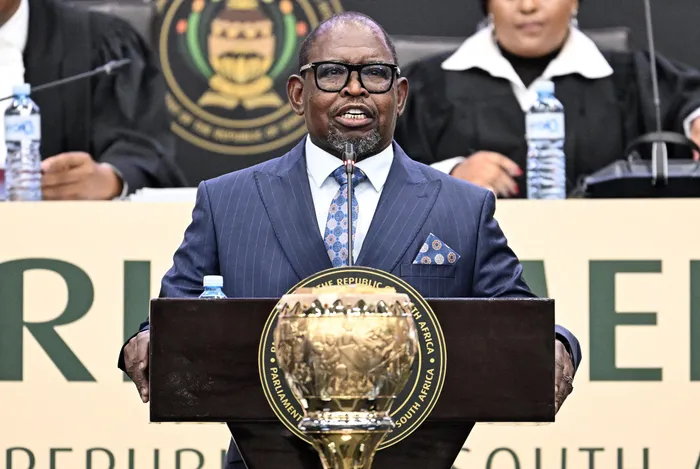
Finance Minister Enoch Godongwana delivered the 2026 Budget on Wednesday, February 26.
Image: GCIS
On the 25th of February 2026, Finance Minister Enoch Godongwana stood before Parliament and delivered a budget built on a story of redemption. Five years back, South Africa was grey-listed by the Financial Action Task Force, it was downgraded to junk status, and reeled from State Capture. On Wednesday, he told us, the country has been removed from the FATF grey list, that it received its first credit rating upgrade in 16 years, and achieved debt stabilisation for the first time in 17 years. These are commendable achievements and they matter. But achievements in a boardroom do not automatically translate into a better life in Khayelitsha, Mamelodi, or in Rustenburg.
Firstly, we have to give credit where it is genuinely due. The withdrawal of the R20 billion in proposed tax increases from the May 2025 Budget is a direct and tangible relief. The adjustment of personal income tax brackets fully in line with inflation means the middle class (teachers, nurses, junior managers) will not silently lose more of their salary to bracket creep. The increase in the tax-free savings account limit from R36,000 to R46,000 per year is one that is sensible. The VAT registration threshold rising from R1 million to R2.3 million is overdue and it is going to protect thousands of small business owners from administrative suffocation.
These are the kinds of measures that are of benefit to the aspirational middle class, the South African who earns enough to pay tax but does not earn enough to be insulated from inflation. This group has been silently squeezed for years. The 2023 and 2024 budgets offered them little beyond the usual rhetoric of fiscal consolidation. In 2026, they get something concrete.
The old age grant is increasing by R80, from R2,320 to R2,400. The child support grant increases by R20, to R580. These numbers are not shocking in isolation. They are shocking when you place them against the cost of a bag of maize meal, a litre of cooking oil, and a box of candles, and all of these items have risen faster than these grant increases over the past two years. Statistics South Africa's data consistently shows that food inflation hits low-income households the hardest, often running several percentage points above headline inflation. A R20 increase on the child support grant in this environment is not a lifeline. It can be considered a gesture.
The Social Relief of Distress grant, the R370 payment that about 8 million people currently receive, is continuing" in its current form." This phrase does significant political work while doing very little economic work. South Africa's unemployment rate is still above 32 percent by the official measure, and above 40 percent by the expanded definition. The SRD grant is definitely not a solution to unemployment. It is a pressure valve. The budget offers no structural answer to the fact that millions of working-age South Africans have no income and no prospect of formal employment.
The minister projected real economic growth of 1.6% in 2026, rising to 2% by 2028. He had presented this as an improvement. Technically, it is. However, the World Bank and the International Monetary Fund have both noted, repeatedly, that South Africa is in need of a growth of at least 5% per year to make a meaningful dent in unemployment. At 1.6%, the economy is barely keeping pace with the population growth. South Africa is not getting wealthier. It is remaining the same, while millions of people wait for a turn that mathematics suggests is not coming.
The mentioning of foot-and-mouth disease as a risk factor is one of the more unusual items in a national budget speech, but it does reflect a real vulnerability. South Africa's agricultural sector employs hundreds of thousands of people in rural areas where formal employment is almost nonexistent. A sustained outbreak could devastate livelihoods in provinces such as Limpopo and the Eastern Cape where the state is already stretched thin.
The most intellectually honest part of the speech was the acknowledgement that the skills development levy and the SETAs have not really worked. This is a truth that economists and employers have spoken about for years while the government continued to pour money into a broken system. The proposal for a dual-training skills model, where learners gain both theoretical knowledge and practical artisanal skills is not new in global terms, but it is way overdue in South Africa. Germany's apprenticeship system is one of the most studied and evaluated examples of reducing youth unemployment. If South Africa could implement this seriously, it could matter enormously for a generation of young people who currently have qualifications but no employable skills.
Minister Godongwana has brought to the table a budget that is fiscally responsible, technically competent, and politically careful. Compared to the panic of the 2020 Emergency Budget or the awkward trade-offs of the 2023 Budget, this one reads with more confidence. The macroeconomic foundations are more stable than they have been in years. That is not nothing, in fact, for a country that was genuinely close to a fiscal cliff, it is a big deal.
The 2026 Budget reads well on paper. The question South Africa must answer however, the one no budget can answer alone, is whether the machinery of the state can truly deliver what the documents describe. That answer will not come in a speech. It will come in whether the trains run, the clinics are stocked, the grants are paid correctly, and the water flows. For now, we will wait.
Written by:
*Sesona Mdlokovana
Associate at BRICS+ Consulting Group
Africa Specialist
**The Views expressed do not necessarily reflect the views of Independent Media or IOL.
** MORE ARTICLES ON OUR WEBSITE https://bricscg.com/
** Follow @brics_daily on Twitter for daily BRICS+ updates and instagram @brics_daily