

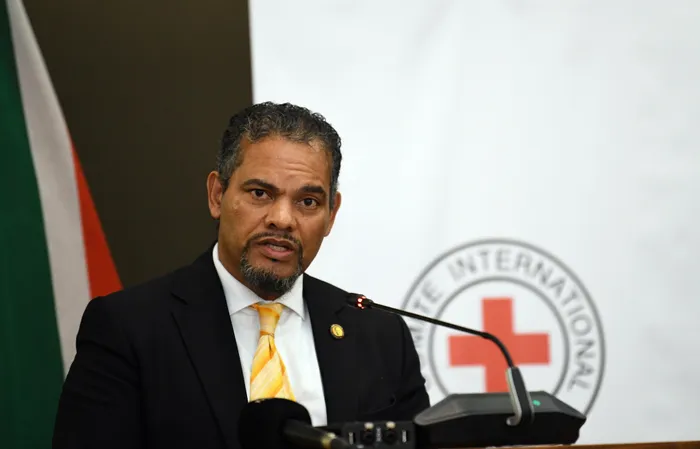
Deputy Minister for Department of International Relations and Cooperation Alvin Botes. The Commonwealth Foreign Affairs Ministers Meeting in London on March 8, 2026, comes at a critical juncture in international relations, highlighting the urgent need for a renewed commitment to multilateralism and strategic collaboration among member states.
Image: Supplied
The Commonwealth Foreign Affairs Ministers Meeting and Retreat, held in London on March 8, 2026, took place at a moment of profound consequence in international affairs. This is not a routine period of uncertainty, nor a temporary phase of diplomatic turbulence to be managed through familiar platitudes. We are living through a period of geopolitical rupture in which the normative, institutional and political foundations of the post-1945 international order are being tested, strained and, in some cases, openly defied.
Some of the most serious assaults on multilateralism are no longer coming only from rogue or marginal actors, but increasingly from major powers that once claimed to be its custodians. We are witnessing growing disregard for international institutions, diminishing respect for legal restraint, and an increasing willingness to substitute law with coercion, unilateral action and geopolitical pressure.
Over recent years, violations of international law have become more frequent and more brazen: genocide, unlawful unilateral sanctions, regime-change operations, the illegal arrest , abduction and rendition of a sitting head of state, the targeted assassination of a sitting head of state and of senior state officials, violations of sovereignty, and wars undertaken in violation of both the letter and spirit of international law. The illegal war in Iran forms part of this wider pattern in which force is increasingly privileged over diplomacy, and impunity over accountability.
What is at stake is not merely the breach of isolated norms. It is the erosion of the very idea that international conduct should be governed by law, sovereign equality and collective legitimacy, rather than by exceptionalism, military power and the political convenience of the strong. International law is too often invoked selectively against adversaries and ignored when it constrains allies. Multilateral institutions are expected to discipline the weak, yet are sidelined when they seek to hold the powerful accountable. This is not simply inconsistency. It is a crisis of legitimacy.
It was against this backdrop that Commonwealth Foreign Ministers met in London. Their task was not only administrative; it was political and strategic. At a time when the multilateral system is under severe strain, the Commonwealth itself faces a defining test: whether it can remain relevant, coherent and effective in an increasingly volatile world, or whether it too will drift into rhetorical irrelevance precisely when principled collective action and clarity of purpose are most needed.
The Commonwealth’s new 2025–2030 Strategic Plan is both timely and ambitious. It rests on three pillars: strengthening institutions, justice, human rights and citizen participation to build democratic resilience; boosting trade, digital readiness and access to finance, particularly for small and medium-sized enterprises, to deepen economic resilience; and advancing action on climate change, ocean protection and sustainable energy transitions to build environmental resilience.
Importantly, the Strategic Plan is underpinned by a commitment to social inclusion, particularly the need to enhance the participation and leadership of women and young people and to dismantle barriers to their effective engagement at all levels. In a world marked by widening inequality, democratic distrust and deepening social fragmentation, inclusion is central to legitimacy, resilience and long-term relevance.
But ambition alone is not enough. Ministers were therefore correct to focus on the practical reforms required to build a sharper, more disciplined and more efficient Secretariat capable of delivering measurable results within budget and without continued dependence on reserves. If the Commonwealth is to speak with credibility in defence of multilateralism, international law, democracy and sustainable development, it must demonstrate the same credibility in its own governance and implementation.
As Secretary-General Shirley Ayorkor Botchwey has argued, this moment should mark the beginning of a more resilient and results-driven Commonwealth. That is precisely the challenge. At a time when multilateral institutions are under pressure from both external assault and internal stagnation, the Commonwealth cannot afford to be ceremonial, cautious or vague. It must become more agile, more coherent and more willing to translate principle into delivery and political action.
South Africa used the retreat to highlight one of the organisation’s most important strengths: its North–South character. In a fractured global economy, and amid intensifying strategic rivalry, the Commonwealth remains one of the few forums capable of bringing developed and developing countries together within a shared institutional framework. Its diversity is not a weakness to be managed, but a strategic asset to be mobilised.
This places the Commonwealth in a unique position to act as a bridge across geopolitical divides and to champion a more equitable global agenda rooted in predictable development financing, technology transfer, fairer market access and a stronger voice for the Global South in global decision-making. With intra-Commonwealth trade already above US$850 billion and projected to exceed US$1 trillion, the opportunity is considerable. But trade growth alone is not enough. It must translate into easier market access, stronger regulatory cooperation, lower transaction costs and meaningful support for small and medium-sized enterprises. South Africa has rightly signalled its readiness to work with partners to deepen Africa–Commonwealth value chains in manufacturing, agriculture and services within the framework of the African Continental Free Trade Area.
This is why the March meeting mattered. Its outcomes will shape preparations for the Commonwealth Heads of Government Meeting later this year and help determine whether the Commonwealth enters that summit as a risk-averse administrative network or as a more assertive political actor.
For South Africa, the matter is clear. Our foreign policy remains anchored in the defence of multilateralism, the consistent application of international law, the centrality of the United Nations Charter, and the advancement of a just, inclusive and equitable international order. The Commonwealth must therefore not retreat into polite irrelevance. It must find the clarity and courage this moment demands.
The world does not need another forum that merely observes the erosion of norms while issuing carefully balanced communiqués. It needs institutions willing to defend the principles on which peace, justice, dignity, equality and sovereignty depend. In an age of impunity, silence is not neutrality. It is acquiescence. The true test of the Commonwealth is whether it will merely endure this crisis, or rise to confront it.
* Alvin Botes is the 1st Deputy Minister of International Relations & Co-operation.
** The views expressed do not necessarily reflect the views of IOL or Independent Media.