

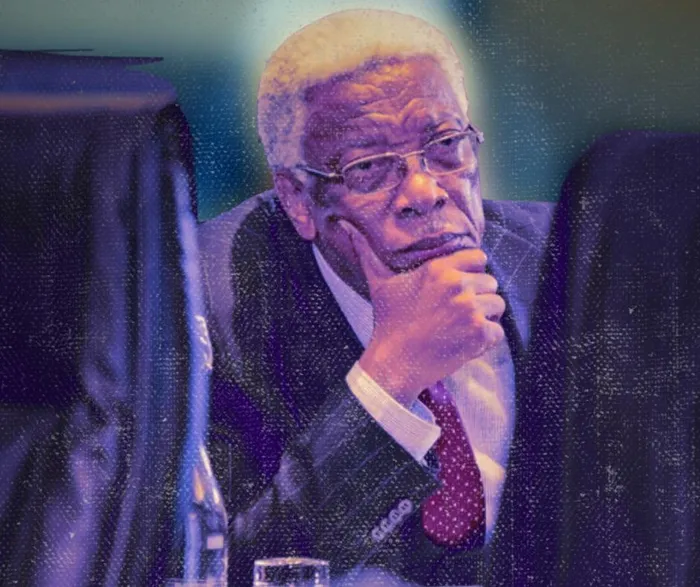
Judge President Selby Mbenenge's return to work remains uncertain amid a cloud of controversy and unanswered questions. As South Africans demand clarity from the Judicial Service Commission, the implications of this case extend beyond one man's career. What does this mean for judicial accountability?
Image: IOL Graphics / Office of Chief Justice
When does Judge President Selby Mbenenge return to work?
That question now sits in the public domain. South Africans followed this matter through months of hostile headlines, selective outrage, legal argument and institutional silence. The Judicial Service Commission now owes the country a clear answer.
The Tribunal cleared Judge President Mbenenge of sexual harassment and gross misconduct. It then produced a separate clause 5.1 finding linked to consensual flirtation during working hours. That finding now appears to stand between him and his office.
The public deserves to know whether the JSC uses that clause 5.1 finding to delay his return to work. The public also deserves to know whether the Commission intends to use it as a pathway towards impeachment.
The legal problem sits in the mandate. The JSC mandated the Tribunal to investigate sexual harassment allegations. It did not, on the argument now before the public, mandate the Tribunal to try a separate substantive charge under clause 5.1 of the Code of Judicial Conduct. Clause 5.1 cannot become a fallback verdict after the sexual harassment case collapses.
A respondent must know the case against him. He must answer that case. He must test the evidence aimed at that case. Fair process demands nothing less.
The Tribunal reports. The JSC classifies. Sections 20(3) and 20(5) of the JSC Act place that classification power with the JSC. Once the JSC received the Tribunal report, it had to decide whether the conduct amounted to gross misconduct or lesser misconduct. Before it took any step that could affect his office, status or return to work, it had to give him a meaningful opportunity to make representations.
That opportunity appears absent.
Had the JSC granted that space, Judge President Mbenenge could have challenged the clause 5.1 finding. He could have argued that consensual exchanges between adults during working hours, without proven harm to the administration of justice, cannot justify removal from office or continued exclusion from work. He could have argued mitigation. He could have argued that the Tribunal exceeded its mandate.
The JSC considered the Tribunal report on 5 March. Judge President Mbenenge understood that he would return to work on 6 March. Instead, the process pushed him back into limbo while the Commission withheld its position from the public.
That sequence demands public attention.
Why has the JSC kept silent? Why has it failed to explain why a judge cleared of sexual harassment and gross misconduct has not returned to work? Why does it handle a judicial officer’s office, reputation and constitutional status behind institutional walls while expecting public silence?
The JSC cannot preach legality while practising procedural ambush. It cannot invoke judicial accountability while discarding fairness. It cannot protect the judiciary by giving force to a finding that may have emerged beyond the Tribunal’s mandate.
Clause 5.1 now looks like the hinge in this matter. It may allow the JSC to convert a failed sexual harassment case into a continued exclusion from office. It may even become the basis for an impeachment route. Yet the available account does not show that consensual flirtation harmed the administration of justice.
The Promotion of Administrative Justice Act, PAJA, may have limited application because these proceedings carry a quasi-judicial character. That does not place the Tribunal or the JSC above the Constitution. Section 1(c) still binds every public body to legality, rationality and fair process.
The public needs one answer.
Did Judge President Mbenenge receive fair notice of the clause 5.1 case that may now affect his return to work?
If he did not, the process cannot stand.
A review court may have to decide whether the clause 5.1 finding was ultra vires. If so, any decision flowing from it becomes legally defective. In that event, a court should substitute the outcome rather than send the matter back into the same procedural maze.
Until then, the JSC must explain why Judge President Selby Mbenenge has not returned to work.
South Africa cannot allow a constitutional body to build a case backwards and call the result justice.

Judge President Selby Mbenenge's return to work remains uncertain amid a cloud of controversy and unanswered questions. As South Africans demand clarity from the Judicial Service Commission, the implications of this case extend beyond one man's career. What does this mean for judicial accountability?
Image: IOL
* Gillian Schutte is a South African writer, filmmaker, poet, and uncompromising social justice activist. Founder of Media for Justice and co-owner of handHeld Films, she is recognised for hard-hitting documentaries and incisive opinion pieces that dismantle whiteness, neoliberal capitalism, and imperial power.
** The views expressed do not necessarily reflect the views of IOL or Independent Media.