

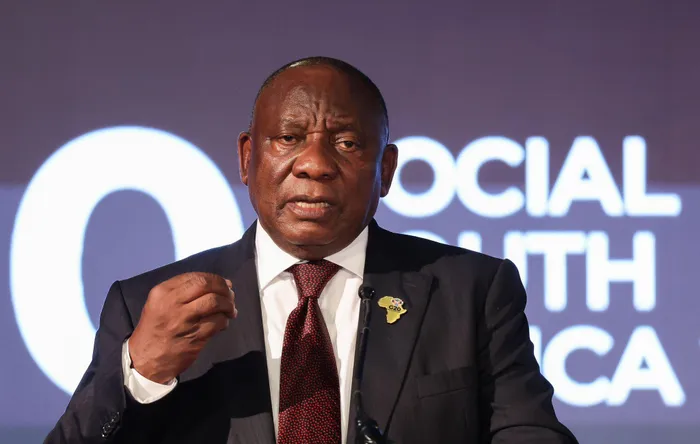
President Ramaphosa has hailed the historic summit as “the People’s G20,” celebrating South Africa’s cohesion, Ubuntu spirit, and global recognition for hosting a successful event advancing sustainable development and international cooperation.
Image: Presidency
South Africa has been widely praised by world leaders, diplomats, and international observers for its exceptional management of the G20 Summit held over the weekend in Johannesburg.
The two-day summit, which brought together 42 countries and institutions, marked the first time the G20 was hosted on African soil, placing the continent at the center of global discussions on development, climate, and economic stability.
Despite the absence of a high-level delegation from the United States, which prepares to assume the G20 presidency next year, South Africa’s hosting demonstrated remarkable professionalism, organisation, and coordination.
From transport corridors operating efficiently to media facilities meeting global standards, every aspect of the summit drew praise from seasoned diplomats and broadcasters alike.
Security was tight, with thousands of police officers deployed across Johannesburg.
“All members of the South African Police Service are on duty. Nobody is on leave, nobody is on a rest day,” said Lieutenant General Tebello Mosikili, emphasising that the large security mobilisation did not compromise public safety elsewhere in the country.
Dr Reneva Fourie, a policy analyst specialising in governance, development, and security, said:
“The achievement was far more than logistical excellence. It symbolised the capacity of a united country to assert itself on the world stage. South Africans, from government, civil society, academia, and the private sector, collaborated with remarkable cohesion to deliver a historic event. The summit showed the world that when South Africans stand together, we can achieve what many might regard as impossible.”
Central to the summit’s legacy was its focus on Africa and the wider Global South. The declaration addressed long-standing developmental challenges, including high public debt, energy poverty, food insecurity, and climate resilience.
It committed to improving debt frameworks for low-income countries, mobilising finance for just energy transitions, including tripling renewable energy capacity, and launching a voluntary platform for clean cooking solutions, addressing a silent crisis affecting millions.
The G20 Critical Minerals Framework reaffirmed the sovereign right of nations to develop their mineral resources to promote inclusive growth, industrialisation, job creation, and sustainable value chains, ensuring that Africa benefits directly from its resources.
Support for the African Union’s Comprehensive Africa Agriculture Development Programme and the African Continental Free Trade Area also reinforced regional food security, resilience, and economic integration.
“The success of the summit was rooted directly in the unity and cooperation across every sector of society,” Fourie said.
“The smooth coordination, welcoming spirit, and intellectual leadership displayed throughout the summit reminded the world that South Africa’s strength lies in its people. The country offered a calm, organised platform for dialogue focused on practical solutions, steering sensitive conversations with astute dexterity.”
World leaders were quick to acknowledge South Africa’s efforts.
President of France Emmanuel Macron said, “The first G20 on the African continent can be proud. Africa has to be valued and recognised in the G20, and now thanks to South Africa, this is the first one to be organised on this continent. So for me, by itself, this is a game changer.”
Indian Prime Minister Narendra Modi said the summit would contribute to a prosperous and sustainable planet and expressed gratitude to the South African government and people for their hospitality, noting that his meetings with other world leaders were “very fruitful” and would strengthen India’s bilateral relations..
''My meetings and interactions with world leaders were very fruitful and will deepen India’s bilateral linkages with various nations. I’d like to thank the wonderful people of South Africa, President Cyril Ramaphosa, and the government of South Africa for organising the summit.”
Mark Carney, Prime Minister of Canada, praised Ramaphosa for hosting a successful summit.
“Congratulations to President Cyril Ramaphosa on a successful summit, the first on African soil. We launched talks on an investment protection agreement to boost business between our nations and create more opportunities for Canadians and South Africans together.”
British High Commissioner to South Africa, Antony Phillipson, described the summit as historic, reflecting both substance and significance.
He noted that the themes championed by South Africa, solidarity, equality, and sustainability, were integral to the summit’s outcomes, including climate change, energy transition, global health, and debt sustainability.
He added that the G20 declaration, though a political document, would be implemented through global institutions such as the IMF, World Bank, WTO, and WHO, and that preparations were already underway for the next G20 hosted by the United States in 2026 and the United Kingdom in 2027.
IMF Managing Director Kristalina Georgieva expressed gratitude to President Cyril Ramaphosa for his chairmanship and South Africa’s hospitality.
Dick Schoof, Prime Minister of the Netherlands, thanked President Cyril Ramaphosa and the South African people, saying: "Many thanks to President Cyril Ramaphosa and the South African people for hosting this first G20 summit on the African continent. It was a successful summit, concluding with a meaningful and important final declaration."
Turkish President Recep Tayyip Erdoğan also commended South Africa for its long-standing commitment to human rights and its support for Palestine, calling the recent ceasefire in Gaza “crucial for global stability.”
He emphasised the importance of international cooperation, debt fairness, and renewable energy investment, and described South Africa as a “gateway to Africa” in promoting inclusive growth.
President Cyril Ramaphosa hailed the summit as a milestone for the continent, placing Africa’s growth and development at the centre of the G20’s agenda.
In his weekly letter to the nation, he emphasised that the summit had “given new prominence to engagement groups from across global society” and that the outcomes would benefit the country by addressing debt, climate action, and investment in critical minerals.
Ramaphosa described the gathering as “the People’s G20,” highlighting the contributions of government, civil society, academia, and the private sector.
''Above all, we thank each and every South African for contributing to this success, and for showing the world the strength of our values, the generosity of our people and the power of what we can achieve when we work together. Many of the foreign leaders and delegates who came to our country recognised what our Ubuntu spirit is all about.
''The success of the G20 Leader’s Summit, together with the improving performance of our economy and growing confidence in our reform programme, shows that South Africa is a country on the rise,'' said Ramaphosa.
hope.ntanzi@iol.co.za
IOL Politics