

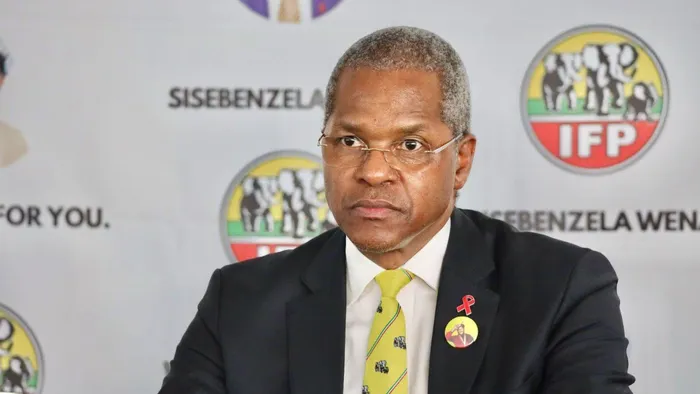
Whistleblower safety is critical.Cogta Minister Velenkosini Hlabisa stresses the need for stronger legal frameworks to shield those exposing corruption, following the tragic killings of Deokaran and Van der Merwe
Image: Facebook/IFP
Minister of Cooperative Governance and Traditional Affairs (COGTA), Velenkosini Hlabisa, has called for urgent reforms to strengthen the protection of whistleblowers in South Africa, following the murder of Marius van der Merwe, who was killed for exposing corruption.
Speaking at the launch of the Babita Deokaran Annual Lecture on Tuesday, Hlabisa highlighted the critical need to protect truth-tellers and those who expose corruption, stating that the country must act swiftly to prevent further tragedies.
Babita Deokaran, a former Acting Chief Director for Financial Accounting at the Gauteng Department of Health, was assassinated outside her home on August 23 2021.
She had been an instrumental figure in exposing financial irregularities, including nearly R850 million in suspicious transactions at Tembisa Hospital, which she attempted to block just days before her death.
Deokaran had warned that her life was at risk due to her efforts to prevent criminal syndicates from siphoning off public funds meant for patient care.
"Babita was killed because she stood between criminal syndicates and public money," Hlabisa said, emphasising the danger whistleblowers face in their efforts to expose corruption.
Deokaran’s assassination, according to the Special Investigating Unit (SIU), revealed a vast network of financial exploitation at hospitals, with suppliers and intermediaries inflating invoices, making bizarre purchases, and routing funds through shell entities.
Hlabisa further noted that while the SIU investigation into the Tembisa Hospital scam uncovered syndicates linked to more than R2 billion, including at least 15 implicated officials, the masterminds behind Deokaran’s death have not yet been brought to justice.
Six men were convicted for her murder, but the full accountability remains elusive, he said.
Hlabisa's comments reflect growing concerns over the safety of whistleblowers, particularly in light of the killing of Marius van der Merwe, also known as Witness D, who was assassinated outside his home in Brakpan last week.
Van der Merwe had testified before the Madlanga Commission in early November about torture and a custodial death linked to an operation in Brakpan, naming patterns of abuse and coercion that demanded further investigation.
Hlabisa condemned the killing, stating, "We are hopeful that the three people that have been identified and one that has been interrogated in relation to the death of Witness D will result in arrests and hard sentencing."
Both Deokaran and Van der Merwe’s murders highlight the personal risks whistleblowers face and the need for stronger legal protections.
Hlabisa emphasised that the current whistleblower protection framework, under the Protected Disclosures Act, has not kept pace with reality.
The Act fails to adequately protect contractors, volunteers, and family members, and lacks sufficient provisions for legal, psychological, and security support, said Hlabisa.
"The whistleblower framework has for too long left courageous individuals exposed," the Minister said.
He pointed out that, despite efforts to address these issues, the current systems are not enough to shield those who expose wrongdoing in the public and private sectors.
To address these concerns, Hlabisa welcomed the Department of Justice’s ongoing efforts to draft a new whistleblower protection bill, in line with recommendations from the Zondo Commission.
The new bill, he said, would expand the definition of a whistleblower, criminalise threats against them, and establish dedicated support agencies. Key provisions of the bill would also enable anonymous disclosures and provide stronger protection through the criminal asset recovery fund.
"We must support and accelerate the bill in the changes it will introduce," Hlabisa said.
He urged swift action to ensure that whistleblowers are properly protected from the risks they face in exposing corruption.
The Minister also pointed to the establishment of the Madlanga Commission, which is probing allegations of corruption and political interference within South Africa’s criminal justice system.
The Commission’s work is seen as crucial in restoring public trust in the justice system, but Hlabisa stressed that protecting witnesses and whistleblowers is essential for its success.
In the wake of these tragic deaths, Hlabisa reiterated the importance of building stronger institutions with proper oversight mechanisms to prevent further loss of life and ensure accountability.
"These murders are not random acts," he said. "They are the result of a corrupt system where institutions are weak, where oversight is performative, and where consequences are sporadic. We must break that chain."
Hlabisa described Deokaran’s death as a national tragedy, emphasising that her story remains a sad and unfinished one.
Hlabisa reaffirmed the government’s commitment to providing full protection for whistleblowers, ensuring that no individual who speaks out against corruption will face such a dire fate again.
"These murders must not be in vain. We must act with urgency, so that no one is left exposed," he said.
hope.ntanzi@iol.co.za
IOL Politics