

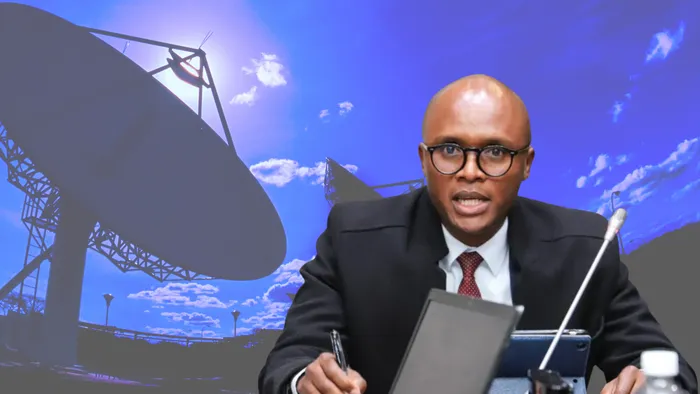
Solly Malatsi, Minister of Communications and Digital Technologies.
Image: X / IOLGraphics
The Government of National Unity (GNU) is facing fresh challenges following a controversial policy directive issued by Minister of Communications and Digital Technologies, Solly Malatsi.
The Government Gazette, issued on December 12, is widely seen as an attempt to clear the path for Elon Musk's Starlink to operate in the country by bypassing the strict 30% Historically Disadvantaged Groups (HDG) ownership requirements and replacing them with a less stringent "equity equivalent" model.
The policy has drawn immediate condemnation from the ANC, the EFF, and Rise Mzansi, who accuse Malatsi of executive overreach, undermining the nation's transformation framework, and selling out South Africa’s digital sovereignty to foreign interests.
The issue that pits the DA’s pro-business, deregulation stance against the ANC's commitment to Black Economic Empowerment (BEE) and national security. Malatsi is a senior DA member.
The directive allows foreign satellite network operators, like Starlink, to substitute Black equity ownership with "equity equivalent" investment programmes, such as investments in digital infrastructure.
Malatsi argues this "reinforces the need for regulatory parity," will "attract more investment," and help expand high-speed internet access to underserved communities.
However, his political partners and rivals are not convinced.
ANC spokesperson Mahlengi Bhengu, through a statement, expressed "deep concern," framing the Gazette as an unlawful executive manoeuvre.
The party stresses that no Minister had the authority to "amend or suspend legislation via a policy directive".
This, they argue, is a direct assault on South Africa’s democracy, mirroring "a troubling trend where Ministers belonging to the Democratic Alliance seek to bypass Parliament".
Furthermore, the ANC views the policy as unlawfully directing the Independent Communications Authority of South Africa (ICASA) to act beyond its statutory mandate, thereby destabilising the independent regulator.
The party has called on Parliament to urgently hold Malatsi accountable and urged ICASA to refuse to implement any directive inconsistent with the law.
The party views the "equity equivalents" as "less transformative substitutes" that could be replaced by "mere donations of Musk’s infrastructure as he deems fit".
Beyond the BEE concerns, the EFF raised the national security alarm, citing the unpredictability and "hostility" of Elon Musk towards South Africa.
The EFF warned Malatsi that if he had made guarantees to Musk to secure funding or support, they would pursue all mechanisms "in Parliament, in the courts, and on the streets to ensure that his illegal directives are not implemented".
Another GNU partner, Rise Mzansi's leader, Songezo Zibi, warned of the broader geopolitical and security risks associated with the offer made to Musk.
Zibi labelled Musk as a "huge security risk," citing his past threats to cut Starlink access to critical users like the Ukrainian military. "We can't have that Starlink thing here," Zibi stated, advocating for national security and digital sovereignty above all else.
Chairperson of the Portfolio Committee on Communications and Digital Technologies, Khusela Sangoni Diko on Saturday said Malatsi's "policy directives are an affront to the centuries-old fight for equity and redress by the black majority in this country".
"Mr Malatsi, in his capacity as Minister, has neither the legislative nor moral authority to reverse the gains of democracy through this unilateral action, unsupported by the Regulator, ICASA, or the department he leads, " said in a statement.
DA spokesperson Karabo Khakhau did not respond to questions sent to her on Sunday; however, Malatsi's spokesperson, Kwena Moloto, said that the policy direction aims to address the regulatory inconsistencies resulting from the Limitation on Control and Ownership Regulations that ICASA adopted in 2021 and then amended in 2022.
“Instead of selling equity stakes, companies can earn full ownership scorecard points by investing in initiatives such as skills development programmes, enterprise and supplier development, and critical infrastructure investments,” Moloto said.