

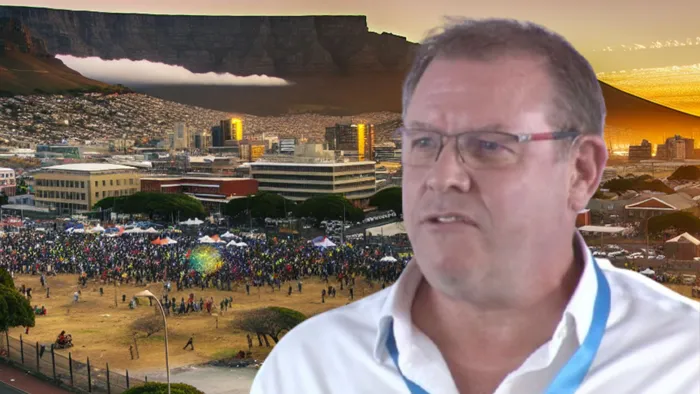
Cape Independence Advocacy Group's Phil Craig says they are currently making preparations to hold their own referendum in the Western Cape, but funding is the primary obstacle to holding a private referendum.
Image: Supplied
The Cape Independence Advocacy Group (CIAG) said on Friday it noted President Cyril Ramaphosa’s stance that he has no intention to hold a referendum to test public opinion on any part of South Africa.
“The CIAG welcomes that the discussion around Cape Independence has now become so firmly established in South Africa’s political discourse that the president has once again been required to officially comment on it,” Craig said.
He made the statement after it was reported earlier this week that Ramaphosa gave the clearest indication not to hold a referendum.
“In line with the constitutional responsibility of the president to uphold, defend, and respect the Constitution as the supreme law of the Republic and to promote the unity of the nation, I have no intention of considering a proposal or holding a referendum on the secession of any part of the country,” Ramaphosa said.
He was responding to parliamentary questions from EFF MP Thapelo Mogale, who asked whether he intended to hold a referendum to test public opinion for or against the secession of the Western Cape and the creation of a Volkstaat for Afrikaners and Western Cape Independence.
Craig said Ramaphosa’s comments appeared to be disingenuous.
He charged that the Constitution grants premiers the powers to call provincial referendums, and therefore any official referendum on Cape Independence would be called by the Western Cape Premier Alan Winde, and not by him.
Craig stated that his party had formally requested Winde to call a referendum and provided Ramaphosa a copy of their request.
“Since Premier Winde has thus far refused to call such a referendum, we are currently making preparations to hold our own referendum in the Western Cape following the successful example of Veneto in Italy.
“Few, if any, referendums are legally binding, so who calls it is less relevant than its credibility.”
Craig also said funding was currently the primary obstacle to the holding of a private referendum, and the CIAG invited potential funders to get in touch.
He added that the blind adherence to the absolute sanctity and supremacy of the Constitution is flawed.
“South Africa, like every other state, is bound by international law. There is no opt-out clause.”
He said Ramaphosa cannot simply quote an isolated provision of the Constitution and, in doing so, waive away the rights of all people to self-determination, which is recognised by the same Constitution and can be exercised.
Craig cited Ramaphosa’s repeated calls for a Palestinian state, support for Western Saharan independence from Morocco, and lack of support for Taiwan’s independence from China or Somaliland’s independence from Somalia.
“These double standards clearly establish that the president is determining his various positions on self-determination based upon political and not legal considerations. He is entitled to do so, but then he should be honest as opposed to hiding behind the law when it suits him and ignoring it when it does not.”
Craig added that CIAG noted with great interest that Ramaphosa cited his duty to promote the unity of the nation.
“Had the president and the ANC actually fulfilled this obligation over the last three decades, there would not be a Cape Independence movement to reckon with.”
He also said Ramaphosa and his party have denied the people of the Western Cape devolved powers.
“If his intention is to promote unity, he has a very funny way of going about it.”
mayibongwe.maqhina@inl.co.za