

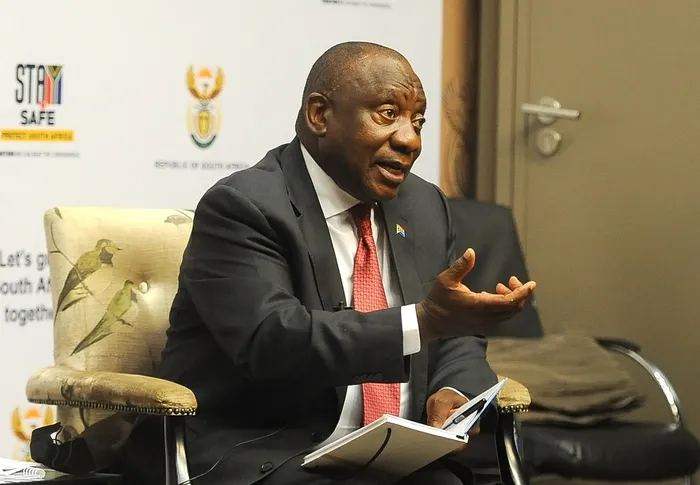
President Cyril Ramaphosa has defended his decision to appoint adv. Andy Mothibi as the new head of the National Prosecuting Authority (NPA).
Image: Phando Jikelo
President Cyril Ramaphosa has defended his decision to appoint Advocate Andy Mothibi as the new National Prosecuting Authority (NPA), saying he used his Constitutional powers after the panel told him that none of the candidates set down for an interview were suitable for the position.
The appointment, announced on Tuesday, surprised the public after Mothibi was appointed National Director of Public Prosecutions (NDPP) despite not being among the candidates interviewed during the formal selection process.
He will take over from Advocate Shamila Batohi, whose term ends in January.
Ramaphosa had in November appointed a seven-member advisory panel to oversee what he described as an “open and transparent” process to identify Batohi’s successor.
The panel shortlisted candidates from about 18 applications and conducted interviews, but later reported back to the president that none met the threshold required for the country’s top prosecutorial role.
Speaking to journalists on the sidelines of the ANC’s January 8 celebrations in the North West, Ramaphosa said the decision was driven by urgency and the gravity of the office.
“The law says the president can appoint whomever he wants,” Ramaphosa said.
“Because of the importance of the position, I wanted the public to have insight into the kind of person we need. But in the end, the panel advised that none of the candidates were suitable, and time was not on our side.”
Ramaphosa praised Mothibi as an experienced figure within the criminal justice system, citing his leadership credentials, work ethic and track record of delivery.
“I have appointed a known figure who has distinguished himself and demonstrated his ability. I am hopeful this decision will be accepted for what it is,” he said.
The appointment comes at a critical moment for the NPA, which is under mounting pressure to restore public confidence amid sluggish progress on high-profile corruption cases, capacity constraints and lingering fallout from the State Capture era.
Despite renewed political backing, the authority has struggled to secure consistent convictions in complex cases involving senior officials.
Ramaphosa acknowledged concerns around the process and said he would support reforms to make future appointments more transparent.
“In time, we would want the law or the Constitution to be amended to allow for an even more open process,” he said.
kamogelo.moichela@iol.co.za
IOL Politics