

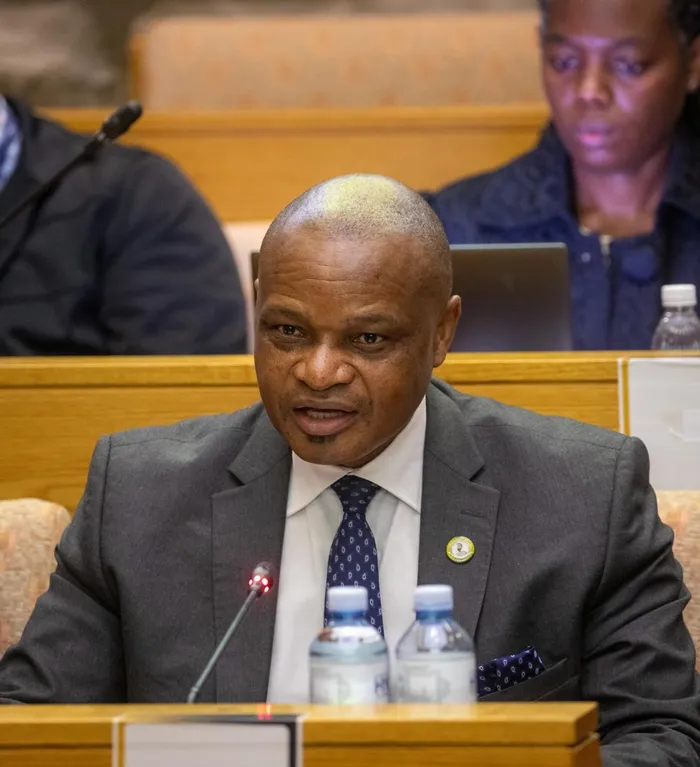
There has been mixed reaction from political parties to the appointment of Special Investigating Unit head Andy Mothibi as the National Director of Public Prosecutions.
Image: File
The Democratic Alliance (DA) has invoked the Promotion of Access to Information Act (PAIA) to compel the release of a report that informed President Cyril Ramaphosa’s unexpected appointment of Adv. Andy Mothibi as National Director of Public Prosecutions (NDPP).
Ramaphosa last week named Mothibi, the former head of the Special Investigating Unit (SIU), as the new leader of the National Prosecuting Authority (NPA), after an advisory panel concluded that none of the shortlisted candidates were suitable for the post.
The appointment surprised the public, candidates who had undergone interviews, and political parties, raising fresh questions about transparency and process.
The Presidency has confirmed that the appointment report will not be made public, arguing that it was prepared solely to advise Ramaphosa and was not legally required to be disclosed.
The DA has disputed this position.
In a statement on Sunday, DA justice and constitutional development spokesperson, Adv. Glynnis Breytenbach, said the secrecy surrounding the report undermines public confidence in an already fragile institution.
“The President cannot exercise sweeping constitutional powers behind a veil of secrecy,” Breytenbach said. “This report goes to the heart of whether the NDPP appointment process was lawful, rational and fair. South Africans are entitled to see it.”
The DA’s PAIA application comes amid mounting scrutiny of the NPA, which continues to face criticism over stalled state capture prosecutions, capacity constraints, leadership instability and public perceptions of political interference.
Analysts have repeatedly warned that restoring credibility to the prosecuting authority hinges on transparent leadership appointments and decisive action on high-profile corruption cases.
Ramaphosa has defended his decision, stating that he acted within his constitutional authority.
However, critics argue that the advisory panel process — which the President described in November as “open and transparent” — was rendered meaningless when its findings were effectively set aside without explanation.
The seven-member panel interviewed candidates shortlisted from 18 applications but ultimately advised that none met the required standard for the country’s top prosecutorial role. Mothibi was not among the interviewees.
Mothibi will assume office on February 1, replacing Adv. Shamila Batohi, whose term ends in January.
kamogelo.moichela@iol.co.za
IOL Politics