

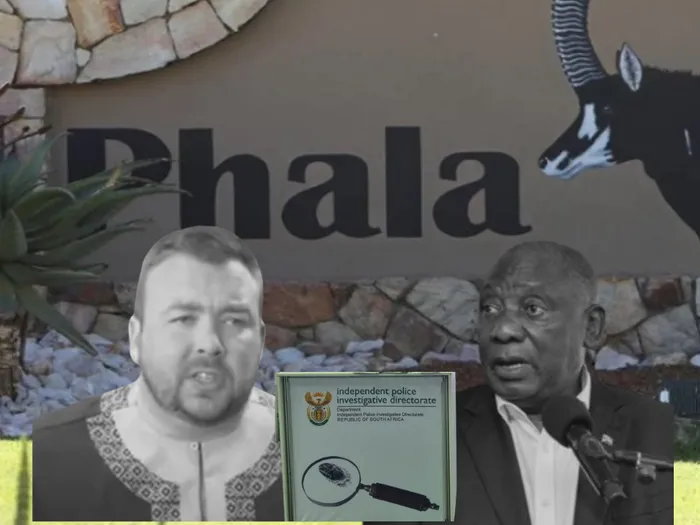
ActionSA has lodged a formal appeal against the Independent Police Investigative Directorate’s decision to refuse the unsealing of its investigation report into the conduct of members of the Presidential Protection Unit in relation to the Phala Phala matter.
Image: IOL Graphics
President Cyril Ramaphosa’s Phala Phala scandal is refusing to remain locked away in the political closet, resurfacing yet again as ActionSA prepares a legal challenge that could force fresh scrutiny of events the state has tried to seal off from public view.
In a statement on Tuesday, ActionSA National Chairperson, Michael Beaumont, said they had begun preparing legal papers to challenge the Independent Police Investigating Directorate’s (IPID) decision to classify its investigation report as “Top Secret”.
The party’s action follows an appeal lodged last month, which IPID failed to respond to.
ActionSA said the silence forms part of a broader pattern of obstruction that has marked its efforts since April 2025 to obtain the report.
Those efforts were repeatedly delayed, including explanations from IPID that its email systems were down.
The Phala Phala controversy erupted in 2022 after it emerged that large sums of foreign currency were stolen from Ramaphosa’s Limpopo game farm in 2020.
While the President maintained the money was linked to a legitimate game sale, questions persisted about possible money laundering, tax compliance and the conduct of security officials who handled the matter outside normal policing processes.
Those concerns were sharpened when the Public Protector found that PPU members conducted an improper and unauthorised investigation, amounting to maladministration, after probing the theft without opening an official police docket.
Beaumont said the party’s legal challenge would take a three-pronged approach.
It will contest the constitutionality of the Minimum Information Security Standards (MISS) Cabinet policy governing document classification, challenge the rationality of IPID’s decision to label the report Top Secret, and ask the court to compel IPID to release it.
Beaumont argued that the MISS policy grants excessively broad powers to state officials to withhold information from the public, powers he said were incompatible with constitutional requirements for transparency.
He pointed to provisions allowing classification where disclosure may “seriously damage operational relations between institutions”.
“It was ridiculous that a wide number of state officials are free to keep government reports out of public scrutiny if a report may offend another government institution,” Beaumont said.
In response to a parliamentary question, then police minister Senzo Mchunu said the report was classified because its release could damage inter-institutional relations or disrupt operational planning.
ActionSA rejected the justification, arguing there is no credible basis to claim operational harm nearly six years after the robbery.
The party maintained that IPID’s report represents the last remaining avenue for meaningful accountability after other processes failed to provide clear answers.
Meanwhile, the Public Protector’s report and the South African Reserve Bank’s findings cleared Ramaphosa of legal breaches, outcomes critics have described as superficial and incomplete.
kamogelo.moichela@iol.co.za
IOL Politics