

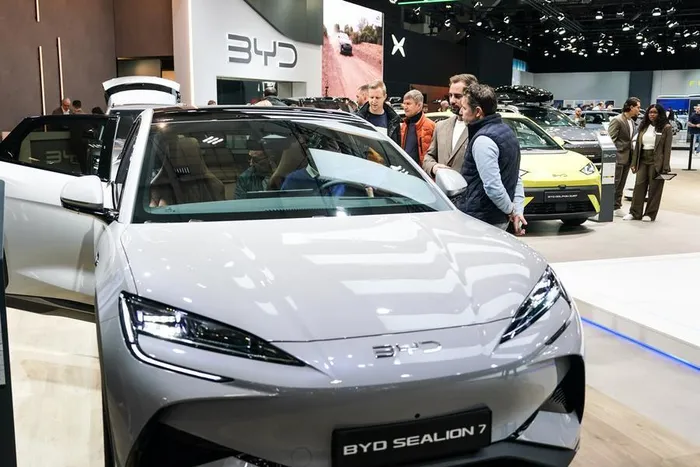
People view a BYD car during the Brussels Motor Show in Brussels, Belgium, Jan. 10, 2026
Image: Xinhua
China and the European Union have taken a significant step towards resolving their dispute over electric vehicle (EV) exports, signalling a pragmatic turn in bilateral trade relations at a time of heightened global economic uncertainty. Both sides have agreed on a framework to address concerns through price undertakings, a mechanism consistent with World Trade Organisation (WTO) rules and grounded in mutual consultation rather than escalation.
According to China’s Ministry of Commerce, the agreement provides general guidance on how Chinese battery electric vehicle (BEV) exporters can commit to minimum export prices when supplying the EU market. Chinese officials have described the development as constructive and stabilising, noting that it has been welcomed by business communities on both sides. The move is expected to support market confidence, reinforce cooperation in the automotive sector, and help safeguard the integrity of global supply chains.
At a regular press briefing, a spokesperson for the ministry emphasised that the resolution demonstrates a shared willingness by China and the EU to uphold a rules-based international trading system. Beyond the immediate EV case, the outcome is being framed as a positive example of resolving trade differences through dialogue and consultation rather than unilateral measures.
EU Guidance on Price Undertakings
On the European side, the European Commission has published detailed guidance outlining how Chinese EV exporters may avoid the imposition of anti-subsidy duties by submitting acceptable price undertaking proposals. These undertakings would establish minimum import prices designed to neutralise the alleged effects of subsidisation.
The guidance follows extensive negotiations between the Commission and China’s Ministry of Commerce and clarifies the legal and technical standards that such offers must meet. All proposals will be assessed under the EU’s basic anti-subsidy regulation, using objective and non-discriminatory criteria that are aligned with WTO obligations.
The Commission’s framework specifies that price undertakings should clearly define key elements, including product scope, minimum prices, annual sales volumes, distribution arrangements, and safeguards against cross-compensation. Where applicable, exporters may also outline future investment plans in the EU, provided these commitments are specific, verifiable and subject to ongoing monitoring.
Minimum import prices may be calculated by adjusting exporters’ historical cost, insurance and freight data to account for the applicable duty margin, or by benchmarking against the prices of comparable, unsubsidised electric vehicles manufactured within the EU. The Commission has indicated that simpler undertakings covering narrower product ranges and straightforward distribution channels will be easier to supervise and enforce.
Background to the Dispute
The guidance builds on the Commission’s decision in October 2024 to impose definitive countervailing duties on Chinese BEVs, ranging from 7.8% to 35.3%, following the conclusion of its anti-subsidy investigation. At the same time, both sides continued exploring alternative, WTO-compatible solutions, with price undertakings emerging as a viable compromise.
Chinese exporters may submit undertaking offers either individually or jointly, with each proposal examined on its own merits. Once a formal offer is lodged, the Commission will initiate a review process that includes consultations with interested stakeholders. Any final decision to accept or reject an undertaking will be adopted through an implementing act, subject to approval by EU member states.
The Commission has also made clear that failure to comply with the terms of an accepted undertaking could lead to its withdrawal and the retroactive collection of duties.
Market Reaction and Broader Significance
The China Chamber of Commerce to the EU has welcomed the outcome of the consultations, describing it as supportive of trade stability and reflective of industry concerns. It has argued that the agreement provides a more predictable operating environment for Chinese EV manufacturers and supply-chain companies active in Europe, while opening space for deeper cooperation in areas such as technology development and market expansion.
More broadly, the resolution of the EV case underscores a shared interest by China and the EU in preventing further fragmentation of global trade. By opting for negotiation within established multilateral frameworks, both sides have signalled a preference for managed competition over confrontation, an approach that could prove increasingly important as industrial policy and green transition strategies continue to reshape international commerce.
Written By
Cole Jackson
Lead Associate at BRICS+ Consulting Group
Chinese & South America Specialist