

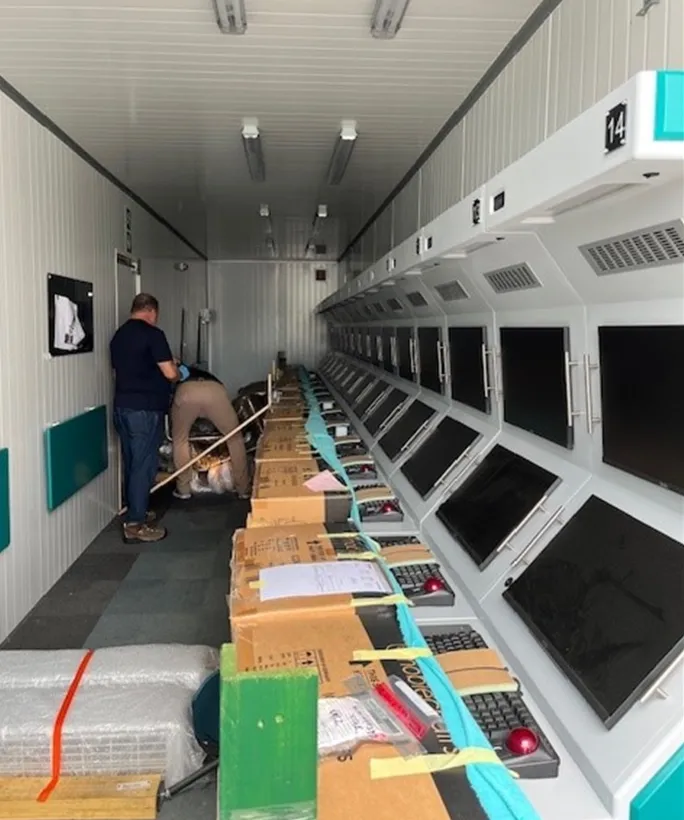
Inside the shipping container.
Image: Supplied
The U.S. Department of Justice has filed a civil forfeiture action to seize two pieces of military training equipment that were intercepted while being shipped from South Africa to China.
U.S. officials alleged that the equipment was meant to help China’s military improve its ability to track submarines and control advanced surveillance aircraft.
According to court filings, the equipment—known as mission crew trainers—was being transported from the Test Flying Academy of South Africa (TFASA) to China’s People’s Liberation Army. U.S. authorities allege the trainers were built using U.S.-origin software and sensitive military technology without the required export authorization.
The MCTs were reportedly designed to resemble the P-8 Poseidon, a U.S.-made aircraft used primarily for anti-submarine warfare. Prosecutors say the goal of the project—internally known as “Project Elgar”—was to train Chinese pilots to locate and track U.S. submarines operating in the Pacific Ocean.
U.S. law enforcement agencies, including the FBI and Homeland Security Investigations (HSI), said the seizure was necessary to protect national security and prevent advanced American military technology from reaching foreign adversaries. Officials warned that such transfers could endanger U.S. service members and undermine America’s military advantage.
The latest seizure comes amid heightened geopolitical tensions, including recent joint naval exercises involving China, Russia, and Iran in waters near South Africa.
The forfeiture case is part of a broader U.S. government effort to disrupt networks that help China obtain sensitive military technology. The investigation is ongoing and involves multiple U.S. agencies working together.
Meanwhile, TFASA rejected allegations that it transferred NATO aviation expertise or exported U.S. military technology in violation of international laws, saying the equipment seized by U.S. authorities consisted only of non-sensitive training materials.
In a statement, the company said the containers contained basic mobile classroom units designed for mission crew training focused on crew resource management in maritime patrol aviation. It said the equipment did not include tactical simulators, advanced systems, or any classified, sensitive, or mission-specific military training capabilities.
The company said the systems relied solely on publicly available information and commercially licensed software and were intended for procedural and instructional use. It denied that the equipment incorporated U.S. military technology, defense technical data, or other export-controlled material.
According to the company, the equipment and associated software were reviewed and vetted by relevant authorities prior to shipment, a process it said confirmed the absence of restricted or sensitive technology. The shipment, it said, was conducted lawfully and transparently, without any attempt to conceal the nature or purpose of the equipment.
The company said it was aware that the program could attract heightened international scrutiny and differing policy interpretations but maintained that it acted in good faith and in compliance with applicable laws.
The Department of International Relations and Cooperation spokesperson, Chrispin Phiri, said the department remains committed to constructive engagement with the United States to address any concerns and to ensure a clear understanding of the facts through diplomatic channels.
sinenhlanhla.masilela@iol.co.za
IOL News
Get your news on the go, click here to join the IOL News WhatsApp channel.