

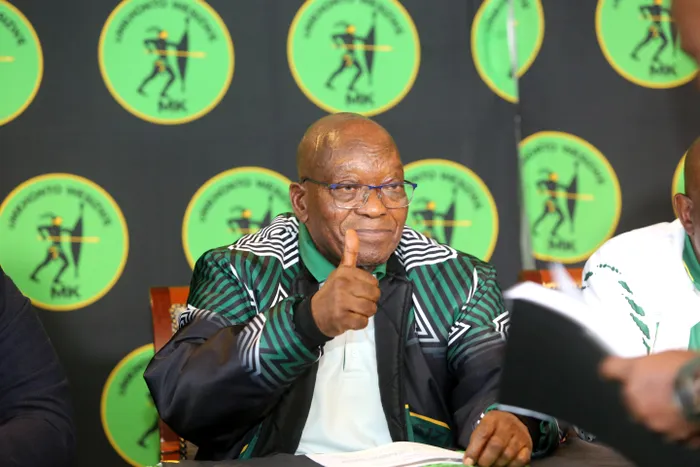
MK Party leaders and the MKMVA accuse former president Thabo Mbeki of delegitimising voters and indirectly inciting violence through claims the party is rooted in apartheid security structures, warning his remarks endanger MK supporters.
Image: Tumi Pakkies / Independent Newspapers
The MK Party has rejected remarks by former president Thabo Mbeki which it says portray the party as a product of “counter-revolutionary forces” rooted in apartheid-era security structures, arguing that the claims are reckless, dangerous and unsupported by evidence.
MK Party spokesperson Nhlamulo Ndhlela said the narrative advanced by Mbeki was an attempt to delegitimise the democratic choices of millions of voters who had withdrawn their support from the ANC.
“The MK Party rejects, as politically reckless, socially dangerous and intellectually dishonest, the narrative advanced by former President Thabo Mbeki,” Ndhlela said.
Mbeki was speaking at the inaugural uMkhonto weSizwe Liberation War Veterans (MKLWV) conference, where he told members that public anger over the imprisonment of former president Jacob Zuma and the July 2021 unrest had been falsely presented as popular solidarity.
He said the idea that people rose in defence of Zuma was “a lie, a complete lie”, and dismissed that explanation as “a lot of rubbish”.
According to Mbeki, the unrest was a deliberate intervention by what he termed the “counter-revolution”, aimed at testing whether it could destabilise and paralyse South Africa.
Mbeki further linked this alleged counter-revolutionary machinery to the rise of the MK Party, questioning why voters in KwaZulu-Natal, Gauteng and Mpumalanga had abandoned the ANC in large numbers in the 2024 elections.
He said this was not due to dissatisfaction with ANC leadership but because “it was the activation of that national security management system which produced that result”.
Referring to hostel communities, Mbeki said hostels that had previously supported the IFP shifted to the MK Party because “they are controlled by the same person”, adding that “the same person who controlled them when they were IFP hostels is the same person who controls them today as MK Party hostels”.
“Comrades, that’s the counterrevolution, and that is how it works,” said Mbeki.
Responding to these remarks, Ndhlela said Mbeki was avoiding “confronting the political reality that millions of South Africans have consciously withdrawn consent from the ANC and placed it elsewhere”.
He said the comments were particularly dangerous because they criminalised and delegitimised entire communities.
“It amounts to an attempt to explain away the democratic will of the people of KwaZulu-Natal by casting suspicion on their identity, culture and political choices,” Ndhlela said.
He accused Mbeki of hypocrisy, noting that long-standing Democratic Alliance victories in the Western Cape had never been labelled counter-revolutionary.
“When communities vote against the ANC, their choices are delegitimised; when others do so, their choices are respected. This is not principle. It is prejudice,” he said.
Ndhlela said Mbeki’s remarks bordered on incitement by portraying MK Party support as illegitimate and externally engineered.
“This reckless language places lives at risk,” he said.
He called on Mbeki to withdraw the statements unconditionally and apologise to the people of KwaZulu-Natal, hostel communities and MK Party supporters.
He also questioned Mbeki’s moral authority, citing his handling of HIV and AIDS while president.
Ndhlela said South Africans had seen before “assertion without proof, delivered with moral authority”, with “catastrophic consequences”, adding that credible research estimated that more than 330,000 people died prematurely due to delayed access to antiretroviral treatment.
Rejecting claims of covert manipulation, Ndhlela said the MK Party’s growth reflected material conditions such as unemployment, inequality, land dispossession and failing services.
“The MK Party is not a counter-revolutionary project. It is a democratic consequence,” he said.
''Not only is the MK Party the fastest growing political organization is South Africa, it is the only revolutionary movement which truly carries, and resonates with the hopes of the poorest of the poor that has been democratically elected by the people.''
Meanwhile, the MK Military Veterans Association (MKMVA) said it was disturbed by what it described as Mbeki’s “unfortunate utterances” to former MK soldiers.
MKMVA president Pumlani Ntsimbi Kubukeli, said the association represented all former MK veterans regardless of political affiliation because politicians had historically “pitied us against each other, and rallied us around their factionalism”.
Kubukeli said Mbeki was insinuating that MK Party members were former apartheid spies and that the ANC’s electoral decline was the result of reactivated apartheid security machinery. He quoted Mbeki as saying “that was the machinery that was used to produce that result in KZN”.
According to Kubukeli, “any analytic mind can read between the lines” of Mbeki’s remarks. “In other words, the above statement is a blatant call for the assassination of the MKP President, His Excellency Comrade Jacob Zuma,” he said.
Kubukeli linked the remarks to recent violence, citing an incident on Sunday 23 November 2025 when MK Party members on a recruitment drive were shot at near Dube Hostel in Gauteng, followed by the killing of Comrade Nzuza later the same day.
He warned that Mbeki’s statements were “not miscalculated but planned” and said the MKMVA believed he was “indirectly instigating former MK soldiers to violence against the hostel dwellers, the people of KZN and the MK Party”.
Calling for restraint, Kubukeli said former commanders understood that “a Commander does not have to give a direct order when he wants something to happen”, and warned against allowing veterans to be pitted against one another again.
hope.ntanzi@iol.co.za
IOL Politics