

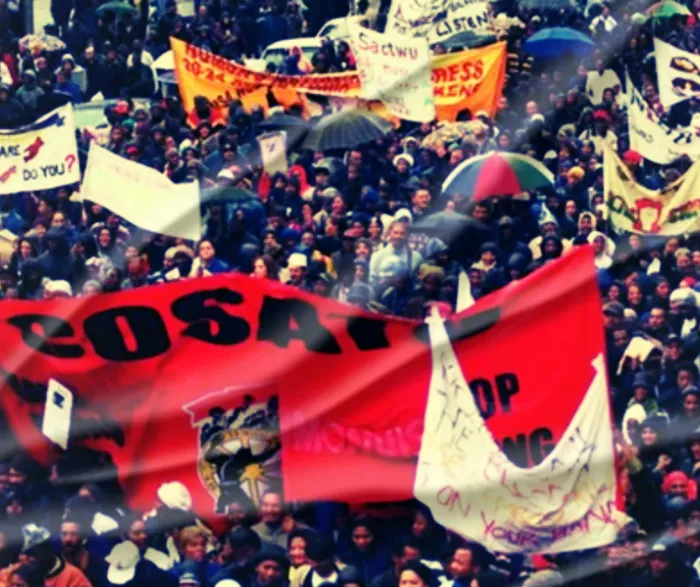
South Africa’s labour movement is facing an intense debate over political alignment, with the South African Federation of Trade Unions (Saftu) insisting that unions must remain independent and accountable to their members.
Image: Independent Newspapers Archive
South Africa’s labour movement is facing an intense debate over political alignment, with the South African Federation of Trade Unions (Saftu) insisting that unions must remain independent and accountable to their members.
Saftu general secretary Zwelinzima Vavi warned that any unity initiative requiring unions to surrender independence to political party discipline would weaken worker power.
“The primary home for labour must be within workers’ own independent formations — strong, democratic unions and federations accountable to members, not political elites,” he said.
He cautioned that political engagement should never amount to political subordination.
“Unions must engage the ANC where necessary, as they would any governing party, but they should not confuse engagement with political subordination,” Vavi said.
He also raised concerns about the role of NGOs and foreign influence: “Many do valuable work in defence of rights and social justice; others can reflect donor priorities that are not aligned with worker-led change. Solidarity support is welcome, but it must never replace democratic worker mandates or shape labour politics from outside.”
This comes amid reports that the National Union of Metalworkers of South Africa (Numsa) is exploring a return to Cosatu and broader political engagement with the ANC, EFF, MK Party, and the Mayibuye Movement.
These proposals have sparked criticism from Saftu and commentators concerned about labour independence.
Cosatu, however, maintains that the federation and its alliance with the ANC remain the most effective vehicle for workers’ interests.
Spokesperson Zanele Sabela said organised labour remained influential, citing its role in shaping policy platforms like Nedlac.
“Labour is strong enough to represent workers’ interests, not only on the shopfloor but also in policymaking,” she said.
She pointed to labour’s role in formulating the Master Plans for textiles and the automotive sector, as well as extensive parliamentary submissions.
She added that Cosatu had collaborated with the ANC since the dawn of democracy to pass progressive labour laws such as the Labour Relations Act, the Basic Conditions of Employment Act and the National Minimum Wage Act.
Sabela dismissed claims that the ANC had abandoned working-class interests.
She cited a January 2026 gazette empowering labour inspectors to enforce employer compliance with pension contributions.
According to the FSCA, over 15,000 employers defaulted last year, with R7.26 billion in outstanding pension contributions.
Responding to suggestions that unions should return to Cosatu, Sabela said: “There is strength in unity. If workers stand together, there is no limit to what they can achieve.”
She also defended Cosatu’s alliance with the ANC, despite criticism of government’s economic direction. “Notwithstanding, the ANC is still the political party most aligned to workers and working-class interests.”
Sabela rejected suggestions that labour had been politically sidelined. “Not at all,” she said, citing organised labour’s ongoing role in the National Dialogue and Nedlac, and policy gains such as UIF benefits for domestic workers.
On political independence, she said: “The alliance has contributed meaningfully to advancing, defending and protecting workers’ rights.”
She cautioned against conflating political parties and trade unions: “Political parties are not unions. There’s a specific skill set required to represent workers effectively — and many parties have failed appallingly when they’ve tried.”
Political analyst Imraan Buccus warned that reunification with Cosatu could destroy the prospects for an independent leftist labour project.
“It would be a betrayal of the working class amid mass unemployment, austerity, and deindustrialisation,” he said.
Buccus also raised transparency concerns over the proposed initiative, noting it had been driven by documents authored by Jonis Ghedi-Alasow of Pan-Africa Today. He said the public deserved clarity on the role of Ghedi-Alasow and all financial matters linked to the project.
Commentator Steven Friedman echoed concerns about union independence, saying it had historically helped hold governments accountable and amplified working-class voices. He warned that eroding that independence would ensure economic policy continues to “pay only lip service to the needs of most people”.
The National Union of Mineworkers (NUM), meanwhile, reaffirmed its commitment to the ANC-led tripartite alliance. NUM spokesperson Livhuwani Mammburu said the union remained strong enough to respond to job losses, retrenchments, and deindustrialisation.
“NUM has colleges where members get skills training,” he said, adding that the union’s artisan college re-skills retrenched workers so they can seek employment or become self-employed.
Mammburu said NUM welcomed the idea of unity: “Unions outside Cosatu must come back. We need one federation to fight for all workers.”
He clarified that NUM membership is not limited by political affiliation. “We do have members who support the EFF or other parties. We don’t look at political affiliation.”
University of KwaZulu-Natal political analyst Siyabonga Ntombela said the political system was failing to meet the economic needs of workers.
“No single party can currently serve as a viable political home for labour,” he said.
He added that independent federations and new political movements were gaining traction by taking up labour issues, but questioned whether unions forming a political party would help.
“What matters most is the effect of their presence,” he said.
hope.ntanzi@iol.co.za
IOL Politics