

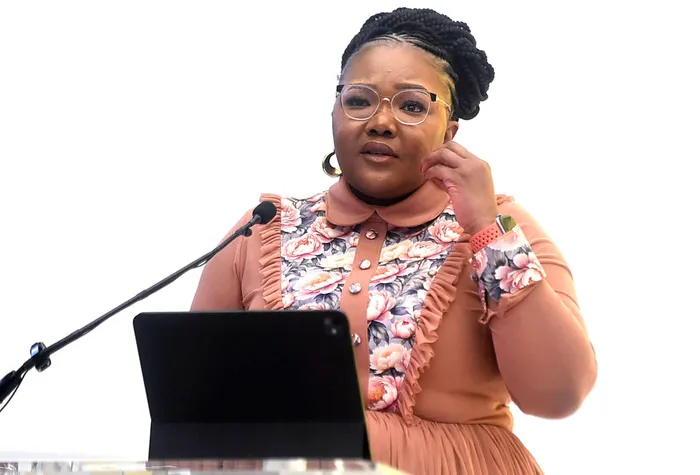
Basic Education Minister Siviwe Gwarube has sung praises for President Cyril Ramaphosa’s State of the Nation Address (SONA).
Image: Itumeleng English / Independent Newspapers
Basic Education Minister Siviwe Gwarube has praised President Cyril Ramaphosa’s recent State of the Nation Address (SONA), while acknowledging ongoing challenges within her department, including severe fiscal constraints.
Speaking on Wednesday during a joint sitting of the National Assembly and the National Council of Provinces, Gwarube said last week’s SONA signalled a new chapter for South Africa, marked by a shared commitment to delivery, stability and progress.
“The Government of National Unity is demonstrating that it is possible to work across political lines to stabilise the country, grow the economy and create jobs,” she said.
“It is possible to place the people at the heart of what we do and to commit ourselves to serving those who have waited too long for change.”
The debate on Ramaphosa’s address began on Tuesday and continues, with the president expected to reply on Thursday at 2pm.
The Democratic Alliance (DA) is the largest party in the Government of National Unity, which is led by the ANC.
The coalition has faced internal divisions, particularly between the DA and the ANC over policy differences.
Gwarube said the DA’s decision to enter the unity government was consistent with its values.
“When we entered government, we were guided by a clear purpose: to help stabilise the country at a moment of profound uncertainty, guard against economic and institutional instability, fight corruption and drive meaningful reform that improves people’s lives,” she said.
She criticised opposition parties such as the MK Party, saying they did not value South Africa’s constitutional democracy.
“We could never allow the country we so love to fall into the hands of those who wish to discard our Constitution for political clout,” she said.
“We took an oath to serve millions of South Africans who look to us for leadership.”
Gwarube said Ramaphosa had correctly placed economic growth and job creation at the centre of the national agenda, but stressed that growth depends on a functioning education system.
“No country can grow without an education system that works,” she said.
“Education is where productivity begins. It is where young people gain the skills and confidence to participate in a growing economy.”
She highlighted the class of 2025’s matric pass rate of 88%, noting that more than 60% of bachelor passes came from no-fee schools.
“Talent and hard work reside even in our most rural and underserved areas,” she said.
Since taking office, Gwarube said her priority has been improving foundational literacy and numeracy to ensure learners progress through school with strong academic foundations and are able to pursue gateway subjects aligned with economic needs.
She said the department had expanded early childhood development (ECD), supported teachers, strengthened accountability and prioritised safe learning environments.
According to her, through the Bana Pele Mass Registration Drive, the department aimed to register 10,000 ECD centres by December 31, 2025.
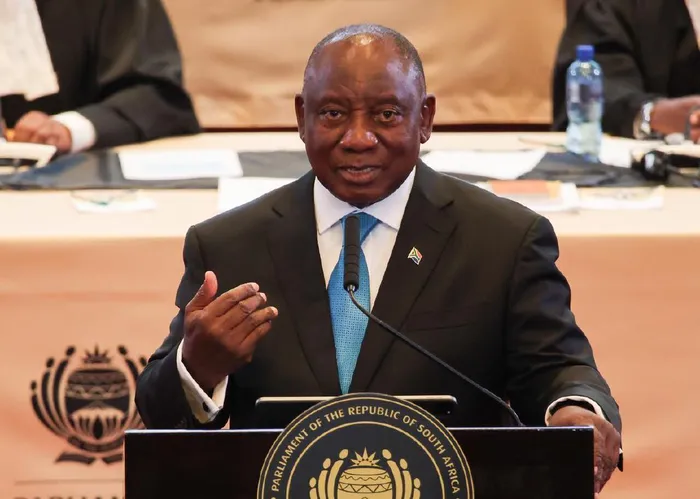
President Cyril Ramaphosa delivering the 2026 State of the Nation Address (SONA) last week on Thursday night in Parliament.
Image: GCIS
She target was reached by September, with more than 13,000 centres registered by year-end.
As a result, more than 1.3 million children now have access to nutrition, foundational learning and safe environments, she said.
The government has allocated R10bn over the next three years to support ECD, increasing the subsidy to R24 per child per day. In 2025 alone, an additional 150,000 children gained access to the subsidy.
“South Africa is not a poor country, and children cannot die of hunger,” Gwarube said.
She added that school nutrition programmes are being extended to ECD centres.
Gwarube also announced the establishment of a nearly R500m Outcomes-Based Fund to create more than 100,000 new ECD spaces in KwaZulu-Natal, the Eastern Cape and Limpopo, describing it as the largest early childhood care and education fund of its kind globally.
“We are determined that a child from Giyani, uMkhanyakude or Lusikisiki must have the same start in life as a child from Sandton or Bishopscourt,” she said.
Despite years of austerity measures that have strained provincial education departments, Gwarube said progress was being made. Provinces have been required to produce financial recovery plans to shield classrooms from budget pressures.
She added that the department had opened partnerships with the private sector, describing education as a national investment in the country’s future.
Corporate and philanthropic partners have supported investments in libraries, additional classrooms, kitchens, digital devices and sports facilities, she said.
“The real measure of success in education is strong foundations that produce young adults who leave school equipped to study further, train, work, build businesses and participate meaningfully in the economy,” Gwarube said.
“If we get the basics right - reading, writing, numeracy, safe schools, supported teachers and accountable governance - we will build the human capital that makes growth possible and restores dignity to millions of our people.
“We will close the gap between the have-nots and the affluent. We will not stop until we get it right.”
simon.majadibodu@iol.co.za
IOL Politics