

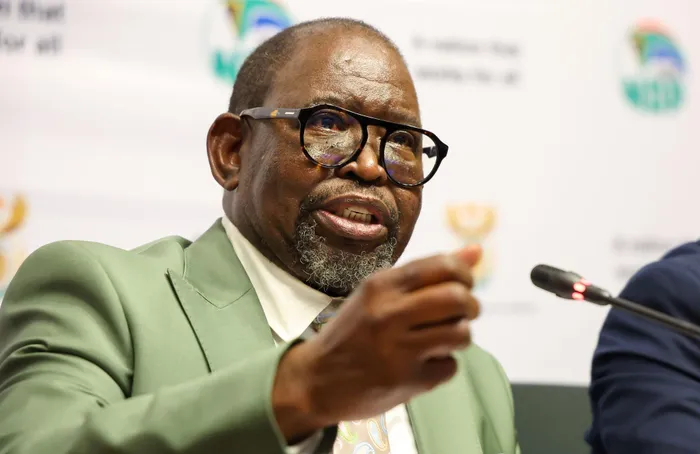
Finance Minister Enoch Godongwana will table his second Budget for the Government of National Unity next week on Tuesday.
Image: GCIS
As South Africa prepares for what many are calling a pivotal moment in its fiscal strategy, opposition parties and civil society groups have expressed strong expectations for Finance Minister Enoch Godongwana's upcoming 2026 Budget Speech.
This will be Godongwana's second budget for the Government of National Unity (GNU) and follows the historic postponement of last year's Budget due to fierce opposition against a proposed VAT increase.
The current economic landscape presents unique challenges, as the National Treasury seeks to strike a delicate balance between fostering economic growth and supporting the most vulnerable citizens amid limited resources.
There is also pressure from commitments made by President Cyril Ramaphosa during his State of the Nation Address, which included the promised employment of 10,000 labour inspectors and initiatives to tackle organised crime and illegal mining, among others.
GOOD Party Secretary-General Brett Herron said they would like to hear Godongwana finally announce his plans for expanding the Social Relief of Distress Grant into a full Basic Income Grant.
“It has been many years of promises to the poorest among us regarding this, and both the president and minister of Finance have consistently kicked the can down the road,” Herron said.
He also said it was of critical importance that Godongwana adequately address the failing municipal finance model.
Similarly, ActionSA MP Alan Beesley echoed concerns over the burden of taxation, insisting that there should be no increases and instead a greater emphasis on cutting corruption and inefficiencies in the public sector.
“Talk and lovely words will not grow the economy. We need measurable, bold, and pragmatic reforms. There needs to be measurable reforms for improving logistics, reducing energy costs, and eliminating red tape,” he said, adding that Godongwana must address the growing illicit trade, which is a cancer killing our people and our economy.
“There must be a freeze on sin taxes and increased funding allocated to SARS, Border Management Association, and the SAPS to specifically target the rapidly growing illegal market,” said Beesley.
ACDP Chief Whip Steve Swart stressed the need for the budget to uplift citizens who grapple with high crime rates, inadequate education and health services, and deteriorating municipal services.
Swart was hopeful that Godongwana will incorporate above-inflation increases in social grants to provide real financial relief to struggling households.
“The good news is that we expect a tax windfall due to the massive increase in gold and Platinum Group Metals prices. This, together with improved tax collection (which is expected to exceed projections by about R19 billion), should mean that there will be no increases in private, corporate, or VAT tax rates, as envisaged in last year’s Budget.
“We believe that there will be some tax relief for hard-pressed taxpayers from bracket creep. We also expect the standard increases in the fuel and RAF levies, as well as on ‘sin’ taxes such as alcohol and tobacco.”
Swart added that more urgent steps were needed to address the illicit trade of alcohol and tobacco products, which are estimated to cost the fiscus an estimated R30 to R50 billion per year in lost tax revenue.”
Build One South Africa spokesperson Roger Solomons said his party expected a Budget for growth, adding that Godongwana should cut VIP protection spending of R4 billion and fund more education initiatives.
“The GNU’s Minister of Finance, Enoch Godongwana, must use the upcoming annual Budget to align the government’s verbal sentiment with tangible support through adequate funding,” he said.
Cosatu parliamentary coordinator Matthew Parks said it was critical that the Budget responds decisively to the pains felt by the working class and provides hope to society.
“The Budget must be anchored upon tackling our dangerously high unemployment rate of 41.1% and weak 1.4% economic growth, entrenched levels of poverty and inequality, and endemic crime and corruption,” Parks said.
He also said a bold stimulus package mobilising resources from the fiscus, Developmental Finance Institutions, private banks, and investment funds was long overdue to make financing available at the pace and scale required for industrialisation and to deliver quality infrastructure.
“Tax incentives and rebates must be deployed to ramp up local procurement. Relief packages for workers, businesses, and sectors affected by global trade turmoil and other challenges, including fixing the Unemployment Insurance Fund’s Temporary Employment Relief Scheme, can no longer wait,” he said.
Organisation Undoing Tax Abuse (OUTA) CEO Wayne Duvenage said the 2026 Budget was a test of credibility and that reform must mean structural change, not cosmetic adjustments.
“South Africa’s fiscal pressure must be addressed through spending reform, not higher taxes.”
Duvenage also said the 2025 Medium-Term Budget Policy Statement had shown that expenditure restraint, curbing low-impact programmes, and improved SARS revenue collection can materially ease fiscal pressure.
“South Africa does not have a revenue problem. We have a spending discipline and accountability problem,” he said.
“The answer cannot be to reach deeper into taxpayers’ pockets while waste, inefficiency, and corruption continue unchecked.”
Duvenage added that the National Treasury must accelerate restructuring and reduce the state’s exposure to non-core and financially distressed state-owned enterprises.
“Exploring equity partnerships for the South African Post Office and the SABC, and developing exit or equity strategies for Denel, SAA, and other non-core state entities, would limit fiscal risk and protect taxpayers from recurring bailouts. Taxpayers cannot continue underwriting structural inefficiency,” he said.
mayibongwe.maqhina@inl.co.za