

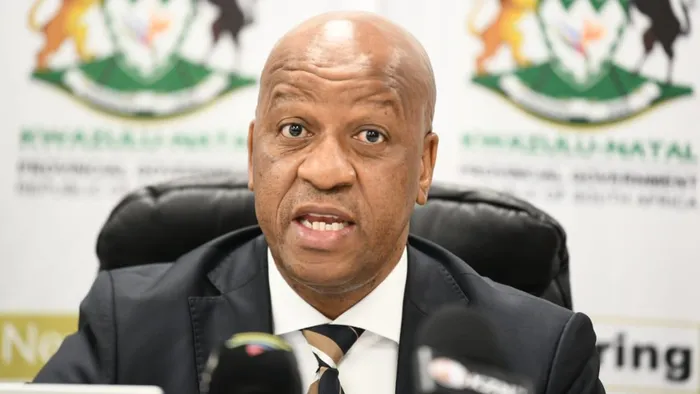
Premier Thami Ntuli announces R216 million investment to tackle KwaZulu-Natal’s pothole backlog, aiming to repair 3.12 million square meters of road, improve safety, and boost economic mobility.
Image: Supplied
KwaZulu Natal Premier Thami Ntuli has announced a R216 million allocation to address KwaZulu-Natal’s severe pothole backlog, with an initial focus on repairing 3.12 million square meters of damaged road surfaces across the province.
He outlined a comprehensive plan to tackle the province’s deteriorating road infrastructure.
He revealed that 55 trucks, alongside over 100 road workers and supervisors, would be deployed to ensure the effective repair of roads, with the goal of improving road safety and reducing the growing number of vehicle damages, delays, and accidents caused by potholes.
“The aim is to restore our road network, reduce delays, and improve the safety of road users,” Ntuli said.
“These efforts are crucial not only for safety but also for improving mobility and facilitating economic activity across the province.”
The Premier also emphasised that the provincial government is addressing bottlenecks in infrastructure development by streamlining approval processes, particularly with regard to land use and water licenses.
He pointed to the need to strengthen agreements with the Ingonyama Trust Board to expedite land-related approvals, which will ultimately help unlock the progress of critical infrastructure projects.
With a public-sector infrastructure investment programme of R4.1 billion allocated for the upcoming financial year, Ntuli highlighted the importance of supporting small and medium-sized enterprises (SMMEs) in the construction sector.
He also mentioned that R3.6 billion in Sanral projects would create 6,842 jobs for residents across the province.
Ntuli spoke of various ongoing projects across KwaZulu-Natal’s districts, aimed at boosting economic growth and improving essential services.
These projects span sectors such as agriculture, infrastructure development, and manufacturing, with significant investments being made in uMgungundlovu, uThukela, Zululand, uMkhanyakude, and King Cetshwayo, among others.
In a move towards increasing gender equality in the construction and infrastructure sectors, the Premier highlighted the province’s efforts to empower women-owned businesses.
He pointed to the R62 million spent across 98 projects, benefiting 84 women contractors, as evidence of tangible progress in advancing women’s participation in the sector.
“We have achieved 35.3% women empowerment in the infrastructure sector, which is a meaningful milestone,” Ntuli said.
The Premier also noted that the government has completed 70 out of the 100 planned capital projects, which have created approximately 5,000 jobs.
Of the 128,906 work opportunities generated through the Expanded Public Works Programme (EPWP), 96,698 went to women and 39,330 to youth.
These figures reflect the government’s commitment to ensuring that public infrastructure investments translate into broad-based social and economic inclusion.
Ntuli further highlighted the importance of skill development, citing various training programs for women contractors.
In districts such as uMzinyathi and Amajuba, women have been trained in bricklaying and other key skills to prepare them for leadership roles in infrastructure projects.
In education and healthcare, several critical infrastructure projects are underway, he said. Among these are the upgrades to Mahlabathini Primary School in Zululand, valued at R78 million, and the development of Cwaka Clinic in uMzinyathi, which is receiving an R87 million investment.
Mosvold Hospital in uMkhanyakude is also undergoing a R200 million upgrade to expand its services, while the Ngwelezane Hospital in King Cetshwayo is being revamped with R63 million in funding.
Additionally, infrastructure projects designed to support agriculture and enhance road safety are in progress, such as the construction of the Nongoma RTI Offices (R98 million) and the Paulpietersburg Agricultural Offices (R42 million), both located in Zululand.
Ntuli also turned his attention to rural road infrastructure, stressing the importance of connectivity between rural communities and economic centers.
Projects like the P304 from KwaMiya to the Drakensberg, and the P31 between Marburg and Port Shepstone, are key to improving access to markets and services in remote areas.
Rural road development has been further supported by the Vukayibambe program, which has already created over 3,100 jobs, with routine road maintenance playing a crucial role in improving mobility across the province.
“Our rural roads are vital not only for economic growth but also for ensuring that every community has access to opportunities,” Ntuli said.
The premier emphasised the long-term impact of these infrastructure projects, which he believes will stimulate economic growth, improve living standards, and create sustainable employment. “Our focus is on building a capable and inclusive economy,” Ntuli said.
“These investments are more than just roads and buildings-they are about connecting communities, creating opportunities, and laying the foundation for a resilient KwaZulu-Natal.”
hope.ntanzi@iol.co.za
IOL Politics