

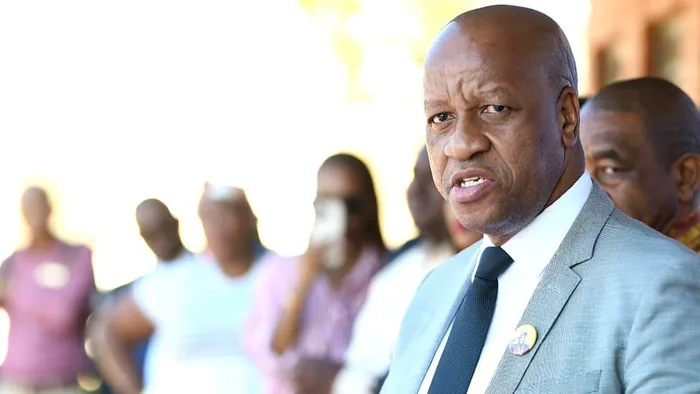
KwaZulu-Natal Premier Thami Ntuli vows to arrest employers hiring undocumented foreign nationals, urging citizens to stop renting to illegal migrants in a bid to restore provincial order.
Image: Supplied
KwaZulu-Natal Premier Thami Ntuli has announced a decisive plan to combat undocumented migration and gender-based violence (GBV) in the province, emphasising the need for law enforcement, community involvement, and political unity in addressing these pressing issues.
Speaking during his State of the Province Address (SOPA) at the Woodburn Rugby Stadium in Pietermaritzburg on Friday,Ntuli outlined a comprehensive strategy for tackling both concerns, stressing that both issues are critical to ensuring the province’s stability and growth.
Ntuli addressed the ongoing problem of undocumented foreign nationals, describing how their presence has been exploited by criminal groups involved in activities such as drug trafficking, cross-border crime, and the illicit circulation of firearms.
He emphasised that while migration itself is not a crime, the exploitation of undocumented individuals creates significant vulnerabilities.
“While migration is not a crime, undocumented migration creates vulnerabilities that are often exploited by criminal elements,” Ntuli said.
“These activities undermine the rule of law, distort local economic activity, and place additional strain on already stretched public services.”
The Premier launched the #EngangeniNgesangoIyafohla campaign, a new intervention that aims to enforce compliance with immigration and labour laws.
He confirmed that multidisciplinary teams have already been deployed to businesses across the province, apprehending hundreds of undocumented individuals and taking action against employers found violating the law.
Ntuli made a direct call to law enforcement, urging them to take action against employers hiring illegal foreign nationals.
“I am calling upon our police to arrest all employers who are employing illegal foreign nationals in our province,” he stated.
The Premier also called on citizens to do their part, suggesting that those who accommodate or rent property to undocumented foreign nationals should be held accountable.
“If citizens can stop accommodating or renting shops to undocumented foreign nationals, they will leave our province,” Ntuli said.
Addressing the issue of border security, Ntuli acknowledged that weaknesses in the province’s border management systems have compounded the problem.
He revealed plans to work closely with the Border Management Authority (BMA) to enhance coordination and intelligence-sharing at key border gates, particularly in the uMhlabuyalingana area.
He also highlighted the deployment of a second drone to monitor illegal activities along vulnerable border corridors, particularly between KwaZulu-Natal and Lesotho.
“This is essential in combating sophisticated cross-border criminal networks,” Ntuli said.
Ntuli’s address also tackled the pressing issue of gender-based violence and femicide, which he described as a national crisis requiring immediate and united action.
He reaffirmed the provincial government’s commitment to the fight against GBV, highlighting his full support for President Cyril Ramaphosa’s characterisation of the issue as an urgent national emergency.
“Gender-Based Violence and Femicide is not, and must never become, an ideological matter,” said Ntuli.
“This is a human crisis - a crisis that transcends geography, class, culture, and politics. It demands extraordinary mobilisation from all spheres of government and society.”
The Premier outlined a year-long campaign under the banner #SilwaneChilo, which will seek to engage communities, empower individuals, and expose perpetrators of violence.
He stressed that the initiative is not just about awareness, but about changing public attitudes and fostering a culture of zero tolerance for abuse.
“We are shifting from silent tolerance to active resistance,” Ntuli said. “From victim-blaming to perpetrator accountability.”
In particular, Ntuli addressed the vulnerability of women and girls with disabilities, noting that they are disproportionately affected by GBV.
He revealed that the province will prioritise the protection and support of disabled women in future campaigns, citing a lack of accessible reporting mechanisms and services as contributing factors to their heightened risk of violence.
“Women and girls with disabilities are at significantly higher risk of violence,” he said. “Our province will place a heightened focus on addressing these vulnerabilities moving forward.”
Alongside this, the Premier announced plans to use arts, sports, and culture as platforms to fight GBV.
Ntuli highlighted the potential of theatre, music, and visual arts to challenge harmful societal norms and provoke necessary conversations.
He also highlighted the role of the taxi industry, religious institutions, and traditional leadership in promoting the campaign’s message.
By collaborating with taxi associations, religious leaders, and community elders, Ntuli said the campaign would ensure GBV awareness reaches every part of society, from daily commutes to places of worship and local communities.
“These groups are central to shaping norms and mobilising communities,” he added.
Ntuli made a call for political unity, emphasising that KwaZulu-Natal’s stability and future progress depend on collective responsibility.
Reflecting on the province’s recent political stability, he warned against the dangers of chaos and division, which he argued could derail economic development and social progress.
“Unity strengthens institutions. Unity protects livelihoods,” Ntuli said.
“Our people must understand that the choice before us is not merely political - it is economic and social. The path of chaos leads to instability, lost jobs, and diminished investor trust. Unity is the foundation for growth and progress.”
hope.ntanzi@iol.co.za
IOL Politics