

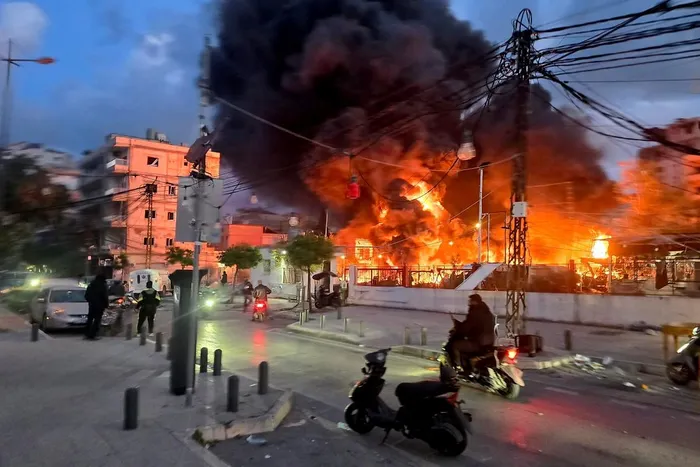
A blaze sweeps following Israeli bombardment on a solar farm and electricity generation facility in Lebanon's southern coastal city of Tyre.
Image: Kawnat Haju/AFP
The Department of International Relations and Cooperation (DIRCO) has issued urgent evacuation procedures for South African citizens in the Middle East, as attacks in the region intensify.
In a statement released on Wednesday, the department confirmed an increase in registrations on its Travel Smart system, with more than 6,400 South Africans currently in the Middle East having registered their presence as of Wednesday.
DIRCO urged citizens in the region for non-essential travel to make arrangements to leave affected cities and countries as soon as possible.
“Several airlines have resumed limited commercial flights out of the region. Citizens are strongly encouraged to take immediate advantage of this opportunity to leave, as heavy attacks are regrettably expected to continue in the coming days. Your safety is our paramount concern,” the department said.
South Africans have also been strongly discouraged from undertaking non-essential travel to the Middle East at this time.
DIRCO advised citizens experiencing difficulties with evacuation or requiring urgent consular support to make contact through official channels.
These are emergency contacts to get in touch with:
South African Emergency Line (DIRCO): +27 12 351 1000 (request Consular Services)
South African Embassy in Amman, Jordan: +962 6-461-5167
Jordan Border Inquiry: +962 5 393 3031
Email coordination: ngwanyaa@dirco.gov.za or segevl@dirco.gov.za
Emergency consular officials available for direct contact:
Mr Litha Ngwanya: +972 50-520-8100 | ngwanyaa@dirco.gov.za
Ms Lizelle Segev: +972 54-588-0698 | segevl@dirco.gov.za
South Africa reiterated its call for all parties to exercise “maximum restraint” and to act in accordance with international law, international humanitarian law, and the principles of the United Nations Charter.
The department stressed that citizens who remain in the region should prioritise their safety and prepare for departure once it is safe to secure passage.
IOL