

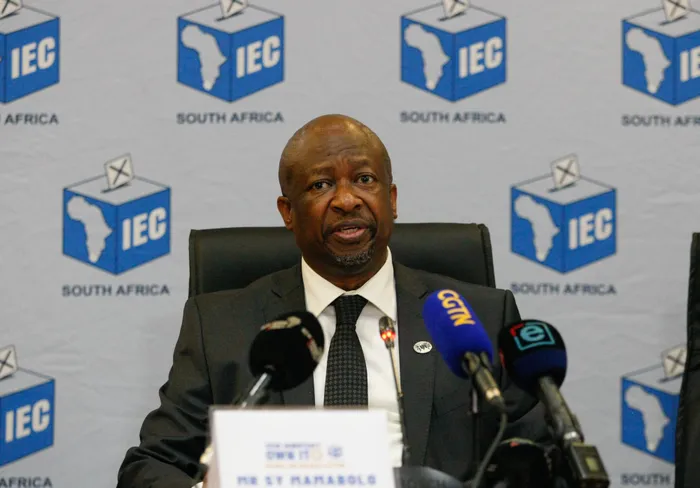
IEC CEO Sy Mamabolo reported that 25 by-elections have been held since November 2025, with 302 councillor replacements made, ensuring continued democratic representation as the Commission prepares for the 2026 local government elections.
Image: Picture: Jacques Naude/Independent Newspapers
The Electoral Commission of South Africa (IEC) says the total number of registered political parties in the country now stands at 508, following the registration of 20 new parties between October 2025 and February 2026.
Of these, 299 are registered at the national level, while the remaining 209 are registered at the provincial, district, or metropolitan levels.
The Commission has urged political parties to ensure their contact details are up to date, as this will help maintain accurate records and facilitate communication when necessary.
In a media briefing on Tuesday, IEC CEO Sy Mamabolo emphasised the importance of having up-to-date information, stating that "accurate and current contact details are essential for the smooth functioning of the electoral process."
He stressed that the Commission’s efforts to keep the registration process streamlined and current were crucial for effective communication, especially as the nation prepares for the 2026 local government elections.
Mamabolo also highlighted the Commission’s efforts in preparing all stakeholders for the upcoming elections.
He said between November 17 and December 10 2025, the Commission conducted a nationwide series of workshops across all nine provinces.
These workshops were aimed at both registered and unregistered political parties, as well as independent candidates, in order to provide key information on the electoral process.
Mamabolo noted that the purpose of these workshops was to "ensure informed and meaningful participation in the upcoming elections," stressing that participants were briefed on a range of important topics.
These included the registration requirements for political parties, the candidate nomination processes, seat calculations, and matters relating to political funding.
Mamabolo noted that additional information sessions are planned for May and June 2026 to further engage with stakeholders ahead of the elections.
"The next series of workshops will be crucial in further educating all stakeholders about the electoral processes and ensuring that the elections are as transparent and fair as possible," Mamabolo added.
In the period between November 2025 and February 2026, the IEC successfully conducted 25 by-elections.
Mamabolo highlighted that this demonstrated the Commission’s ongoing readiness and operational efficiency in managing the country’s electoral processes.
"These by-elections are a vital part of maintaining democratic representation at local government level," Mamabolo said.
He added that the IEC had replaced 302 councillors since the beginning of the financial year, in line with its duty to fill vacancies.
By-elections are generally required to be held within 90 days of a vacancy. However, Mamabolo pointed out that the law allows for exceptions, particularly when the next general election is approaching.
"Section 25.6 of the Municipal Structures Act provides that a provincial MEC for local government may not call a by-election if the next election is scheduled to take place within nine months of the vacancy," he said.
This provision is meant to avoid voter confusion, especially in cases where electoral boundaries or voting districts may have changed.
As a result, the cut-off date for calling by-elections is set for 30 April 2026, based on the latest possible election date of 30 January 2027.
''This cut-off relates to when a vacancy occurs, not when a byelection is held, meaning some of the by-elections may still take place after 30 April 2026. The rule does not apply to PR councillors whose vacancies may still be filled during the mentioned period.''
Mamabolo also discussed the state of the Multi-Party Democracy Fund, which aims to support and enhance a vibrant multi-party democracy in South Africa.
Despite repeated appeals to individuals and corporations across Africa to contribute to the Fund, Mamabolo reported that no contributions had been made for the second consecutive quarter.
"This absence of contributions should not be viewed as a flaw in the Fund itself, but likely reflects a combination of factors, such as donor preferences for direct donations and the current economic climate, fiscal constraints, as well as electoral timing dynamics," Mamabolo said.
He also noted that IEC received international recognition for its efforts in political finance transparency.
According to the 2025 Digital Disclosure of Political Finance in Africa, Asia, the Pacific, Latin America, and the Caribbean report by Transparency International, South Africa was ranked as the most advanced country in Africa for digital political finance disclosure.
The report, which assessed 51 African countries, noted that South Africa, alongside Morocco, is one of the only two countries in the region that publishes political finance information online.
The report recognises that South Africa's system is significantly more advanced, said Mamabolo.
"'The report also places South Africa among a small group of countries globally where political finance data is accessible and downloadable, reflecting a high level of transparency.''
hope.ntanzi@iol.co.za
IOL Politics