

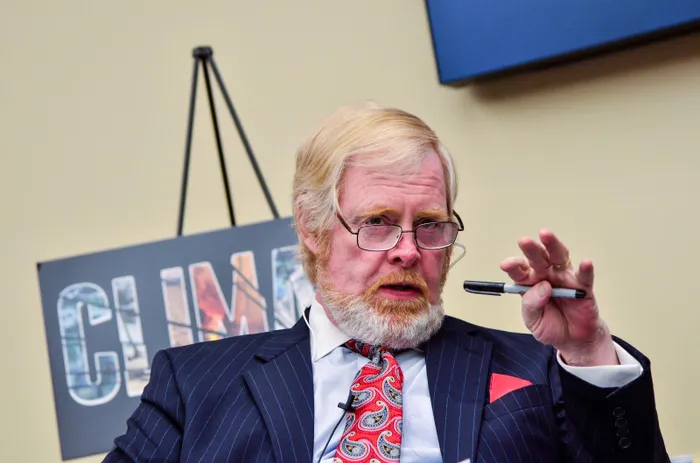
US Ambassador to SA Leo Brent Bozell III has revised his comments on "Kill the Boer," maintaining personal opposition but acknowledging the South African court's ruling.
Image: KRIS CONNOR / GETTY IMAGES NORTH AMERICA / AFP
United States Ambassador to South Africa, Leo Brent Bozell III, backtracked on his previous criticisms of the controversial "Kill the Boer" chant.
The US diplomat took to his official @USAmbRSA account on X to clarify his position, while also acknowledging the stance of the South African government on the matter.
Bozell, who had previously condemned the chant as hate speech, stated that his personal opinion remained aligned with many South Africans who view the song as harmful.
However, he reiterated that the US government respected the independence of South Africa’s judiciary, which had ruled that the chant did not meet the legal definition of hate speech.
He took to his official @USAmbRSA account to make the clarification: "I want to clarify that while my personal view—like that of many South Africans—is that 'Kill the Boer' constitutes hate speech, the US government respects the independence and findings of South Africa’s judiciary," Bozell wrote in his statement.
The ambassador’s remarks came a day after his attendance at a BizNews conference in Hermanus, Western Cape, on Tuesday, where he had engaged with local leaders and business figures.
Bozell highlighted the growing frustration between the two countries, particularly over unresolved demands that the South African government had yet to address.
He had said, "I’m sorry, I don’t care what your courts say. It’s hate speech."
Bozell outlined five critical issues where the United States had sought clearer responses from the South African government.
These concerns, according to Bozell, have been raised for almost a year but have yet to be fully addressed.
“I’ll tell you where our position has been very firm. We put them forward to the South African government, we’ve been waiting for almost a year for a response, and as I’ve made clear in meetings that I’ve had, the United States is running out of patience,” Bozell said.
The five demands Bozell referred to include:
Reevaluation of the Expropriation Act
Addressing Broad-Based Black Economic Empowerment (BBBEE) policies
Condemnation of the "Kill the Boer" chant
Protection of White Farmers and rural safety
A shift to a Non-Aligned Foreign Policy
These points highlighted the growing impatience in Washington, where Bozell is pushing for tangible action on matters that he believes are crucial for fostering a healthier bilateral relationship.
Bozell stressed the importance of greater transparency from South African businesses. He urged business leaders to be more vocal about policies that could be holding back economic growth, specifically referencing BBBEE.
“I don’t want to hear businesses say one thing publicly and another thing privately. I want the businesses who tell me privately that BBBEE is hurting them to say so publicly. I don’t want them to feel fear from the government. There has to be that kind of outspokenness,” he said.
While acknowledging South Africa’s complex history and the ongoing struggle with inequality, Bozell questioned whether current policies were truly achieving their intended outcomes.
“When those policies are structured in ways that introduce challenges to ownership or create complex compliance requirements, or are clouded in charges of corruption, investors begin to reassess risk,” he said.
Despite his frustrations, Bozell said he remained hopeful about the future of US-South Africa relations, particularly in the economic sphere. Highlighting significant investments by US companies such as Google, Microsoft, and Amazon, he reiterated that the US is not asking for special treatment, but rather a level playing field.
“True success would be to level the playing field in business, where the US is allowed to compete on an even footing against any country in the world one on one. Because if there is that level playing field, without question I believe we’ll crush the competition. We have better products, better technology,” Bozell said.
He also emphasised the need for reciprocity in trade and noted that the US values South Africa as a key partner. However, he made it clear that real partnership can only thrive when both sides are willing to make adjustments.
“Partnership must be rooted in reciprocity. President Trump has been clear about our concerns. These concerns are not merely rhetorical. They involve the business environment, rural safety, the Expropriation Act and South Africa’s growing engagement with some of America’s greatest adversaries.
''These issues shape investor confidence, they shape strategic trust, and they shape the trajectory of our bilateral relationship,” Bozell said.
Furthermore, Bozell spoke about South Africa’s foreign policy, particularly the nation’s growing ties with Russia and China.
He reiterated the message he received from President Trump upon his appointment.
“He said, ‘I want South Africa to become non-aligned once again.’ That’s not too much to ask, non-alignment. That’s what he wants. They’ll take non-alignment, not where we’re going right now,” Bozell said, suggesting that a shift in foreign policy could help ease some of the diplomatic tension.
IOL previously reported that the EFF accused the US Ambassador of arrogance, calling his comments "entitled threats" and calling for his immediate expulsion.
“We call for him to be immediately declared persona non grata,” the party said, denouncing what they described as unwarranted interference in South Africa’s domestic and foreign policies. The EFF specifically rejected Bozell’s suggestion that the presence of US-based companies in South Africa—such as Google, Microsoft, Amazon, and VISA—was a sign of "goodwill" or "commercial diplomacy."
EFF spokesperson Sinawo Thambo fired back, saying: “To suggest that the presence of these companies in South Africa is a form of goodwill or political diplomacy is an example of the economic and political illiteracy that plagues the White House today." T
The party further criticised Bozell for implying that South Africa should adjust its policies on issues like expropriation and BBBEE to maintain these foreign investments, labeling such remarks as "disrespectful and out of line."
The EFF also took issue with Bozell’s dismissal of the "Kill the Boer" chant, which they argue is a vital part of South Africa’s anti-apartheid history.
“Perhaps most disrespectfully, as a diplomat, Bozell stated that he does not care what our courts say about the struggle song 'Kill The Boer, Kill The Farmer.'
This song is part of our history in the struggle against racial domination, and to dismiss the court’s decision as irrelevant is an insult to our sovereignty and our legal system,” Thambo said.
hope.ntanzi@iol.co.za
IOL Politics