

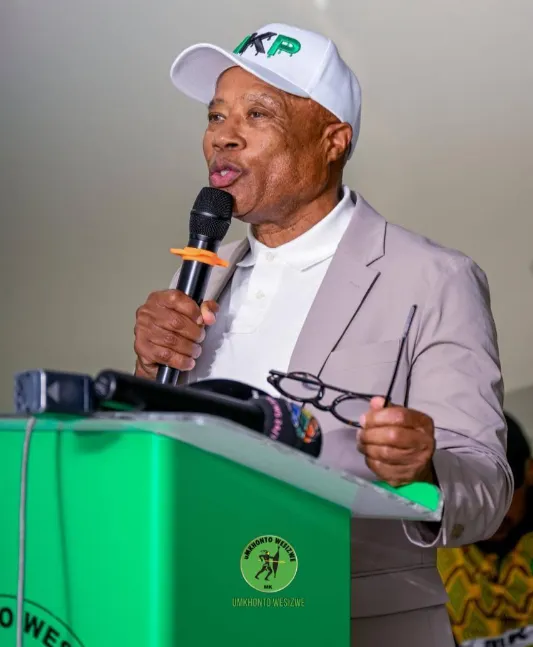
MK Party's deputy president Tony Yengeni says despite silence from the ANC, the party remains hopeful of forming a coalition government with EFF, NFP, and potential talks with DA and IFP.
Image: MK Party/ Facebook
Umkhonto weSizwe Party (MK Party) deputy president Tony Yengeni has expressed confidence that a coalition government can be formed in KwaZulu-Natal if the involved parties demonstrate enough creativity.
In an interview on SABC, Yengeni revealed that the MK Party, along with the Economic Freedom Fighters (EFF) and the National Freedom Party (NFP), had agreed to work together and was now waiting for the African National Congress (ANC) to join the discussions.
Yengeni explained that the MK Party had sent a letter to the ANC to open talks, but had received no response.
"We sent the letter to the ANC, and we expected a response. There was no response whatsoever, either to say we received the letter or were coming or not coming. There was dead silence," he said.
Reflecting on previous attempts, Yengeni explained that the MK Party, along with the EFF and NFP, had met earlier in the year to reassess their approach after last year’s failed vote of no confidence against the KZN Premier Thami Ntuli. The decision was made to invite the ANC to join the conversation.
"We thought that we should, after the experience last year, when we attempted to conduct a vote of no confidence on the premier of KZN, rather, we invite the ANC and see whether we can come up with a way forward together," Yengeni said.
Although the MK Party, the EFF, and the NFP had agreed to form a coalition government, Yengeni emphasised that the discussions could continue with or without the ANC’s involvement.
"Indeed. It stems from last year, our discussions and our working together last year in the House, in the provincial legislature," he said.
The MK Party, Yengeni added, was determined to push ahead with its efforts regardless of the ANC’s involvement.
"The program continues because it’s not about parties per se, it’s more about the voters. The voters of KZN have voted for MK to be the majority party, and this is the responsibility of MK to lead in the process of forming a government that will respond to the aspirations of the people of KZN," he said.
The deputy president acknowledged that a coalition government would require more than just the MK, EFF, and NFP.
He mentioned that potential talks with other parties, such as the Democratic Alliance (DA) and the Inkatha Freedom Party (IFP), could also be considered.
However, he stressed that the goal remained to prioritise the needs of KZN’s residents rather than focusing on party interests.
Asked why the ANC had been slow to respond, Yengeni said the reasons remained unclear.
"The best people to answer that question would be the ANC."I can't answer that question for them," he said.
"But as you may recall, when there was a meeting in the White House, and John Steenhuisen was there, he was very equivocal that they’re in the government of national unity because they want to do away with what they call the doomsday coalition. That would include MK, EFF, and others,'' he said.
He expressed confusion at the ANC’s alignment with the DA. Yengeni also rejected claims that the MK Party missed an opportunity to engage with other political parties after the elections.
"I don’t think so. I think it’s an excuse and it's a narrative that makes them going to bed with the DA palatable," he said.
He added that the MK Party took the initiative by sending the letter, and that the ANC’s refusal to respond clearly pointed to the problem lying with them, not MK.
The MK Party remains open to future discussions with the ANC, but Yengeni also suggested that the ANC’s leadership may be more comfortable working with the DA.
"There are many good men and women in the ANC. But elements in its leadership seem more comfortable with the DA than with MK, which we find hard to understand," he said.
Yengeni also responded to reports that some within the ANC had mentioned that the MK Party had made it clear that President Cyril Ramaphosa would need to resign before any talks could take place.
He denied this, suggesting that the ANC was too eager to work with the DA to be patient and negotiate with the MK Party. "They were too much in a hurry to go and work with the DA,"
Yengeni outlined the type of government he envisions for KZN if the coalition succeeds.
He stressed that such a government would prioritise the people of the province over the interests of big business.
"We see a government that will serve the people of KZN. It must respond to their demands for jobs, clean water, electricity, housing, and better local government services," he said.
Despite the challenges, Yengeni remains hopeful that the coalition discussions will lead to a government focused on the province’s development.
"If we can come together and form a government that addresses the needs of KZN’s people, then that is what matters most,'' Yengeni said.
hope.ntanzi@iol.co.za
IOL Politics