

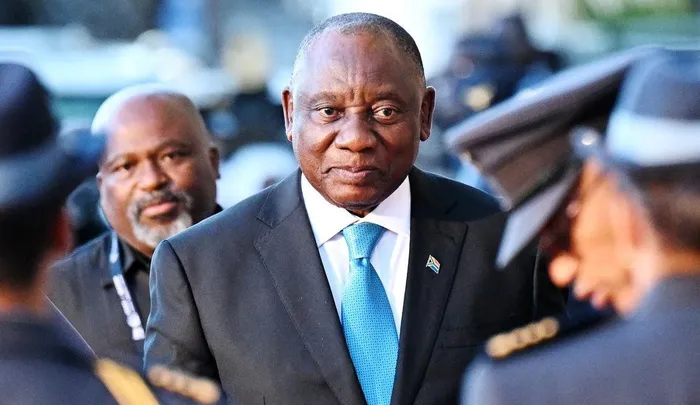
President Cyril Ramaphosa argues that South Africa must adopt a dual training approach while accelerating economic reforms to address persistent unemployment and improve job creation outcomes.
Image: PHANDO JIKELO Parliament of SA
President Cyril Ramaphosa has called for an overhaul of South Africa’s Sector Education and Training Authority (SETA) system, saying it is no longer fit for purpose and must be replaced with a more effective model aligned with the country’s economic needs.
His comments come after the SETA system has been criticised for governance failures, poor performance, inefficiencies and a persistent mismatch between training programmes and labour market demands, with concerns that it has not consistently delivered job-ready skills or effectively absorbed learners into employment.
Speaking at the News24 Record Summit at the Cape Town International Convention Centre, Ramaphosa said the current system should be restructured to better integrate education and practical workplace training.
He said he had examined international models and noted that countries such as Germany and Switzerland operate dual systems combining academic and workplace-based learning, which South Africa should consider adopting.
He emphasised that the existing system had not delivered the desired outcomes, stating that “The SETA system has not served us well at all, it must now be changed.
''We must build from our strength as a country to create jobs for the economy of the future. We have one of the most sophisticated financial systems in the world, we can position SA as a destination for financial services,” he said.
Ramaphosa highlighted the country’s renewable energy potential, noting its “among the best solar and wind resources,” and said continued investment in these sectors was already contributing to economic activity and job creation.
The president stressed that addressing unemployment requires cooperation across society, saying that progress depends on “collaboration between the private sector public sector between labour and community-based organisations.”
He said such cooperation is essential to building a strong foundation for inclusive growth across multiple sectors, including manufacturing, energy and agriculture.
Ramaphosa singled out agriculture as a key sector with significant job creation potential, saying it is an area that “can create a million and more jobs,” and indicated that government would focus on unlocking growth in the sector as part of its broader economic strategy.
He framed South Africa’s unemployment crisis as a structural challenge rooted in historical inequalities and compounded over time by policy and institutional shortcomings.
He said, “South Africa’s high unemployment is not a result of a single failure. It is the outcome of deep historical, and policy linked factors interacting over time. To understand it properly, you have to look at it more holistically and that means we have got to look back at where it originates from.”
Ramaphosa added that job creation remains government’s top priority, stating, “Creating jobs is the most and foremost priority of our government. Our single greatest challenge is to translate positive economic momentum into jobs for millions of South Africans who today remain unemployed.
''A job is more than just an income, it is about dignity, confidence, a sense belonging and an ability to contribute to our society.”
He linked job creation to broader economic growth and ongoing structural reforms, including interventions in the energy and logistics sectors, as well as improvements in visa processes to attract investment. He said these reforms are aimed at addressing constraints that have held back growth over the past decade.
Ramaphosa also pointed to the impact of governance failures, including corruption and “state capture”, which he said weakened key institutions and slowed economic progress. He said rebuilding state capacity has required time, coordination and the repositioning of government systems to function more effectively.
On infrastructure challenges, the president highlighted electricity and water as critical enablers of economic activity and job creation.
He defended the restructuring of Eskom, arguing that diversifying electricity generation would improve reliability and reduce risks associated with a single monopoly system.
Ramaphosa also warned that water insecurity and municipal inefficiencies are limiting investment and development, adding that government may intervene more directly where local authorities are unable to deliver essential services.
He said coordinated reforms are underway to stabilise water supply and strengthen service delivery.
Alongside structural reforms, Ramaphosa stressed the importance of social support for unemployed citizens while economic changes take effect.
He referred to government initiatives such as public employment programmes and youth-focused interventions that have created millions of opportunities since 2020, particularly for young people entering the labour market for the first time.
He called for stronger collaboration between government, business, labour and civil society to expand employment opportunities, urging the private sector to play a greater role in absorbing and training young entrants into the workforce.
“We need more companies to use SAYouth to hire young people, making use of the cutting-edge technology which the network has built to set them up for success,” he said.
“Through a partnership with business, we have established the Youth Employment Service, known as YES ,which has provided work experience opportunities to more than 220 000 young people,” Ramaphosa added.
“I call on all companies to be part of the YES drive, to enable more and more young people to take their first step into the work environment, and to provide them with the skills and experience they need to succeed in the world of work,” he said.
Ramaphosa said that addressing unemployment requires both long-term economic reforms and immediate measures to support livelihoods, as the country continues to pursue inclusive growth.
IOL Politics