

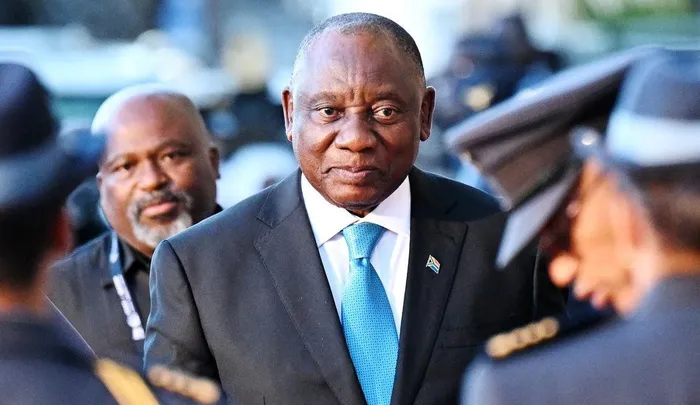
President Cyril Ramaphosa says the activities relating to the National Illicit Economy Disruption Programme will be overseen by the Justice, Crime Prevention and Security cluster.
Image: Phando Jikelo / Parliament of SA
President Cyril Ramaphosa has announced that the launch of Operation Ukubusa, the National Illicit Economy Disruption Programme, is scheduled for April 1.
Operation Ukubusa forms part of the government’s broader strategy to combat organised crime, illicit trade, and economic crimes that threaten the stability and integrity of the country’s economy.
Responding to parliamentary questions from ActionSA MP Alan Beesley, Ramaphosa revealed that the coordination of activities relating to the ambitious programme will be overseen by the Justice, Crime Prevention and Security (JCPS) cluster, under the leadership of the relevant departments responsible for law enforcement and regulatory oversight.
“The visible policing division of the South African Police Service, led by the section head for Emerging Economic Crime, will be responsible for the coordination of activities,” he said.
During his 2026 State of the Nation Address in February, Ramaphosa emphasised the need for a dedicated response to the illicit economy, highlighting that a National Illicit Economy Disruption Programme would provide a framework for aligning the efforts of various stakeholders.
He indicated that the programme would harness advanced technologies such as data analytics and artificial intelligence to effectively target high-risk sectors, including tobacco, fuel, alcohol, and counterfeit products.
Beesley’s probing questions centred on the formal constitution of the programme and the departments under which it would operate.
He also wanted to know about the envisaged mechanisms to engage with Parliament.
In his written response, Ramaphosa said the departments and entities participating in the implementation of measures to combat illicit economic activities include the SAPS, the Directorate for Priority Crime Investigation, the South African Revenue Service, the National Prosecuting Authority, and the Department of Home Affairs.
He also said that the progress of operations designed to disrupt illicit economic activities will be systematically reported through the JCPS cluster structures.
These structures will also relay updates to the Cabinet in accordance with established government oversight mechanisms.
Ramaphosa underscored the importance of establishing measurable indicators to assess the effectiveness of these interventions.
These indicators include the disruption and dismantling of organised criminal networks, the seizure of illicit goods, arrests and prosecutions associated with economic crimes, the recovery of revenue and assets, as well as the enhancement of border security and enforcement operations.
Ramaphosa affirmed that parliamentary oversight of the government’s efforts to combat illicit economic activities is conducted through relevant portfolio committees and parliamentary oversight processes.
“Departments report on their performance, operations and outcomes in line with the applicable legislative and accountability frameworks,” he added.
mayibongwe.maqhina@inl.co.za