

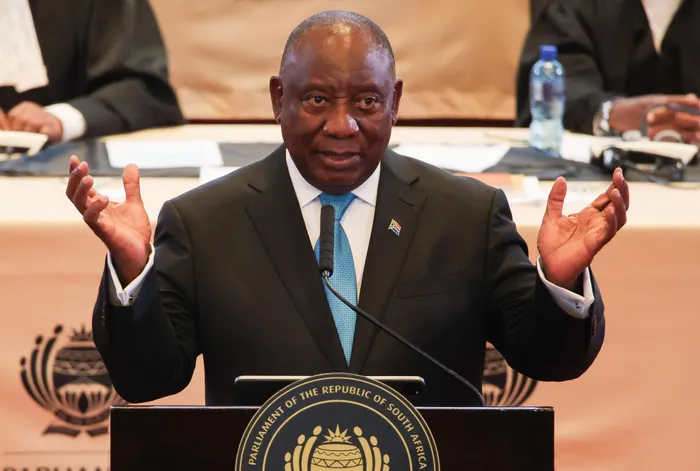
President Cyril Ramaphosa warns South Africans of rising petrol and diesel prices from April 1, urging ministers to find solutions amid global conflicts, inflation, and economic pressures affecting the cost of living.
Image: IOL
President Cyril Ramaphosa has warned that South Africans will face higher petrol and diesel prices from April 1, and said he has directed government ministers to urgently address the challenges posed by rising energy costs.
Speaking at the closing of the Limpopo ANC’s 11th provincial conference on Sunday, Ramaphosa said the global economic and geopolitical environment is placing immense pressure on South Africa’s economy.
“The world economy is shifting beneath us. We are witnessing slower global growth and tighter economic conditions. There's rising geopolitical tensions, protectionism, and a global contest for industrial advantage where nationalism has become the order of the day,” Ramaphosa said.
IOL previously reported that South Africa is facing record petrol and diesel price increases, with petrol set to rise by R5.31–R5.82 per litre and diesel by over R10.
Recent fuel taxes add another 21 cents per litre, pushing prices to around R25.50 for 95 Unleaded at the coast, R26.33 inland, and diesel up to R29.08 in Gauteng. The hikes are driven by surging international oil prices following the Middle East conflict and a weaker rand.
Ramaphosa noted that climate pressures are reshaping systems such as energy and infrastructure, citing recent floods in parts of the country as an example of immediate challenges South Africans face.
He emphasised the effect of international conflicts on domestic prices, pointing to the war in the Middle East and the ongoing conflict in Eastern Europe as key drivers of rising energy and food costs.
“By 1st of April, we're going to see prices of petrol and diesel going up, driven largely by the conflict that is going on,” he said.
He explained that these developments would increase the cost of living, creating hardships for ordinary South Africans and reducing fiscal space for government programs.
Ramaphosa added that “higher inflation is now going to be seen going up and we're also going to see interest rates also falling in tandem,” warning that this would further increase the cost of living for South Africans.
He said he had directed government to take urgent action. Ramaphosa said, “As the ANC, we are saying we direct government to address this matter, to see how best we can address the challenges that South Africans are now going to face as the price of petrol and diesel go up.”
Ramaphosa acknowledged the pressure on his ministers, saying that Finance Minister Enoch Godongwana had told him he was “having sleepless nights over what is happening.” He added, “I am not sleeping at all because of this challenge that our people are now facing.”
“I have instructed Minister Godongwana and his colleagues to address this matter and develop solutions,” Ramaphosa said.
He also highlighted South Africa’s stance on international issues, condemning what he called “the illegal war that is being waged by the United States and Israel” and reaffirming the country’s support for nations struggling for self-determination, including Palestine, Cuba, and Western Sahara.
He praised the recent People’s March at Constitutional Hill as a demonstration of South Africans’ commitment to sovereignty, noting that Limpopo had sent up to 50 buses to participate.
“A clear signal by our people that as South Africa we will not be bullied, we will not be pushed around and we stand firm on our sovereignty because our sovereignty is sacrosanct,” he said.
Ramaphosa stressed the need to tackle long-standing economic and social challenges.
He outlined priorities such as economic growth, job creation, reducing the cost of living, fighting crime and corruption, and strengthening state capacity.
He said government would focus on unlocking infrastructure investment in energy, logistics, water, and roads, while supporting industrialisation and small and medium enterprises in both townships and rural areas.
“This moment requires that we must build domestic industrial strength, we must improve our logistics so that we can export more goods that are made in South Africa and we must improve our energy security as well,” Ramaphosa said.
He highlighted the importance of trade and resilience, noting that these steps are essential to addressing the challenges facing South Africans.
Ramaphosa also emphasised the progress South Africa has made since the advent of democracy, highlighting constitutional mandates to redress past inequalities, expand access to basic services, empower women, protect workers’ rights, and advance black economic empowerment.
“The gains that we have had over the last 30 years are important because we have sought to improve the lives of our people,” he said.
hope.ntanzi@iol.co.za
IOL Politics