

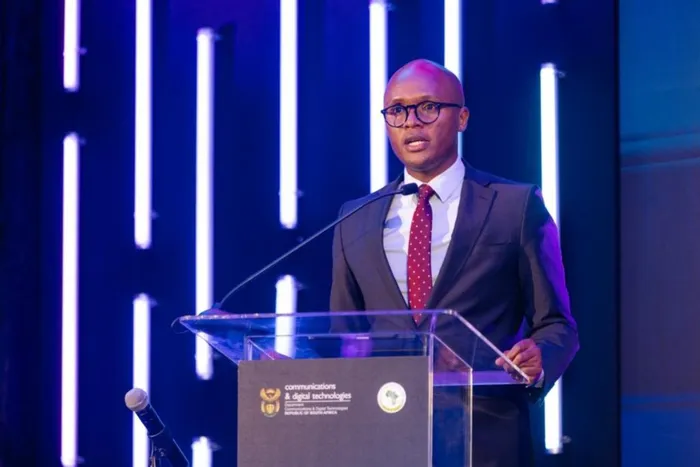
Minister of Communications and Digital Technologies Solly Malatsi.
Image: Supplied
While Minister of Communications and Digital Technologies, Solly Malatsi, has defended recommending the approval of Dell’s Equity Equivalent Investment Programme (EEIP), to the Minister of Trade, Industry and Competition, Parks Tau, he has acknowledged gaps in the EEIP system.
Malatsi came under scrutiny from the Chairperson of the Portfolio Committee on Communications and Digital Technologies, Khusela Sangoni-Diko.
Malatsi stated that the recommendation is based on an assessment by the Department of Communications and Digital Technologies (DCDT) of Dell’s application to renew its EEIP commitment for 2025–2034.
EEIP was created for multinationals whose global practices or policies prevent them from complying with the ownership element of Broad-Based Black Economic Empowerment (B-BBEE) regulations through the traditional sale of equity or shares to Black South Africans.
Malatsi said that Dell's proposed EEIP investment exceeds R230 million directly into the local economy.
Sangoni-Diko believed that the renewal of an EEIP, which substitutes for direct ownership under the ICT Sector Code, must be supported by verifiable evidence of past performance and measurable transformation outcomes.
She sought to understand from Malatsi whether a formal audit or independent performance evaluation of Dell’s previous EEIP was conducted before recommending renewal, clarity on whether all milestones under the previous EEIP were achieved within agreed timeframes, what criteria was used by the department in forming its recommendation, and whether the proposed R230 million commitment is proportionally aligned with Dell’s South African revenue footprint.
Malatsi said: “The monitoring of EEIPS is a function to be undertaken by the ICT Sector Council. However, there has been a clear absence of verified reporting and a functional monitoring framework with respect to the previous Dell EEIP, which has resulted in gaps in available information.
“This has necessitated a more direct role by the department, and work is under way to address these shortcomings going forward.
“The concern that EEIPs must demonstrate real outcomes is valid. As part of the department’s assessment of the application, the department directly obtained the information from Dell and reviewed it to tighten commitments in the current application, including clearer programme design, defined interventions, identified beneficiaries, and improved geographic reach.”
Malatsi explained that DCDT is working on a mechanism of enhanced monitoring and reporting requirements of EEIP going forward to ensure full compliance and delivery on commitments.
He added that the proposed investment of over R230 million does meet the thresholds set out in the ICT Sector Code and is proportionate within the applicable framework.
“The strengthened programme places emphasis on digital skills, enterprise development, and inclusive participation in the digital economy, which contributes to building local capability and supporting South Africa’s broader digital development objectives.”
Malatsi said that the recommendation was not based on the initial proposal, but on a revised application which incorporated the areas DCDT insisted be addressed following direct engagement with Dell.
“Additional conditions have been introduced to ensure accountability, including mandatory bi-annual reporting to the department.”
Tau’s Department of Trade, Industry and Competition (DTIC) is the final arbiter for EEIPs.

ANC's Khusela Sangoni-Diko.
Image: Phando Jikelo / Parliament RSA
Sangoni-Diko added that Malatsi’s comments lay bare what Parliament has long suspected, which is that EEIPs are increasingly being reduced to box-ticking exercises — designed to create the illusion of transformation while failing to deliver meaningful change in the lives of South Africans.
“EEIPs were never meant to be a loophole. They were conceived as a limited concession to multinational corporations whose global models resist local ownership — on the understanding that, in return, there would be real, measurable benefits for the people of South Africa.
“These benefits were to take the form of jobs, skills development, small enterprise development, and genuine empowerment across the value chain. What we are now witnessing is a distortion of that original intent.
“Either this government has failed to enforce its own transformation framework, or multinational corporations are being allowed to game the system with impunity. In both instances, it is the people of South Africa who are being short-changed,” Sangoni-Diko said.
“This is particularly worrying that the minister firstly usurped the ICT Council’s powers in approving that which they specifically rejected on the basis of a lack of information. He then further admits that he, too, concocted his decision based on no information, which is frankly irrational, reckless, and irresponsible.
“The Minister of Trade, Industry and Competition should immediately institute a full, independent audit of all existing EEIPs — interrogating delivery against commitments, identifying real beneficiaries, and exposing any gaps between promise and performance,” Sangoni-Diko said.
“South Africans are tired of the transformation that exists only in reports and press statements. They want to see it in jobs, in opportunities, and in the material improvement of their lives. Anything less is not transformation — it is deception.”
theolin.tembo@ibl.co.za