

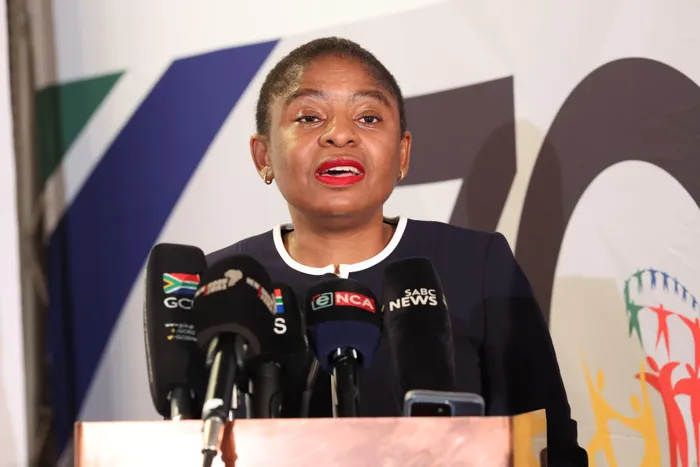
Minister in the Presidency Khumbudzo Ntshavheni has attributed the current fuel shortages as due to logistics and consumer behaviour rather than a lack of supply.
Image: GCIS
Minister in the Presidency Khumbudzo Ntshavheni has said the South African government does not rely on the Middle East for crude oil, sourcing only refined products from the region.
She assured citizens that fuel supplies in the country remain stable and urged them to avoid panic buying and fuel hoarding.
Speaking to the media in Pretoria on Thursday, Ntshavheni said the country’s crude oil comes from Angola and Nigeria.
She briefed the media on the outcomes of a Cabinet meeting held on March 25, 2026.
“Cabinet joined President Cyril Ramaphosa in calling for an immediate ceasefire in the US-Israel-Iran conflict, which is negatively affecting the Middle East region and the world,” she said.
“Cabinet is kept abreast of the security of domestic fuel supply, which is affected by the ongoing war, and it was assured that South Africa's fuel system remains adequately supplied in the immediate period.”
Ntshavheni emphasised that South Africa only relies on the Middle East for refined products.
She said Ramaphosa has established a Ministerial Task Team, chaired by the Minister of Mineral and Petroleum Resources, Gwede Mantashe, to coordinate a holistic government response aimed at mitigating the impact of the crisis on the cost of living, fuel, and food security.
The team includes the ministers of Finance, Transport, Trade, Industry and Competition, International Relations and Cooperation, Agriculture, Electricity and Energy, Forestry, Fisheries and Environment, and the Presidency.
“As an immediate intervention, the Task Team recommended a reduction in the fuel levy to alleviate the impact of fuel price increases that took effect on Wednesday, April 1, 2026,” Ntshavheni said.
She reassured citizens that fuel supplies are stable.
“We would like to assure South Africans that fuel supplies in the country remain stable,” she said.
“Current shortages at some stations are due to logistics constraints caused by panic buying and fuel hoarding. South Africans are discouraged from panic buying and fuel hoarding.”
Ntshavheni said panic buying and the holding are creating logistics problems for supply.
“But we've got an adequate supply for the immediate. So, depending on how South Africans behave, that will determine the extent to which we've got the supply.”
She said the government also clarified that in terms of the country’s reliance on crude oil is not coming from the Middle East, but only refined products.
“Our crude oil is coming from Angola and Nigeria. It's only the refined products. And you must recall that we've got a refining capacity ourselves as a country. It's just that we have not, when they shut down, we have not moved fast to restore that capacity.”
“So part of the consideration is that on the medium to long-term measure is to rebuild our refining capacity because if you check the semblance of refining capacities in South Africa and in Nigeria, that is not safe for a continent to be reliant on other continents.”
“And therefore it is our responsibility as the leading economy in the continent to develop a reliable refining capacity, not only for ourselves but that could also supply the region and the continent. It's part of those things that we are considering,” she added.
Her comments come as South Africans brace for what is being described as the largest fuel price increase in the country’s history.
Panic buying has been reported nationwide, causing long queues and congestion at filling stations.
The sharp increases, which took effect on Wednesday, April 1, follow a surge in international oil prices linked to conflict in the Middle East over the past month.
In response, the National Treasury and the Department of Mineral and Petroleum Resources (DMPR) announced a temporary relief measure: a R3 tax reprieve on petrol and diesel for April.
This reduces the general fuel levy from R4.10 to R1.10 per litre for petrol, and from R3.93 to 93 cents for diesel.
The DMPR confirmed that both grades of petrol increased by R3.06 per litre, while diesel rose by between R7.37 (500ppm) and R7.51 (50ppm).
Illuminating paraffin increased by R11.67 per litre.
Following the adjustments, the price of 95 unleaded petrol now stands at R22.53 per litre at the coast and R23.36 inland, while 93 unleaded petrol inland costs R23.25 per litre.
Meanwhile, 50ppm diesel has risen to R25.35 per litre at the coast and R26.11 in Gauteng.
The Treasury said the relief measure, expected to cost the government about R6 billion per month, will be reviewed monthly over the next two months. It added that the intervention is designed to be fiscally neutral, with plans to recover foregone revenue within the framework of the 2026 budget.
The government also stressed that national fuel supply is sufficient to meet demand.
“The shortages reported in certain areas were largely due to localised distribution and logistical challenges driven by panic buying rather than a lack of national fuel stocks,” it said, adding that the situation should stabilise in the coming days.
IOL Politics